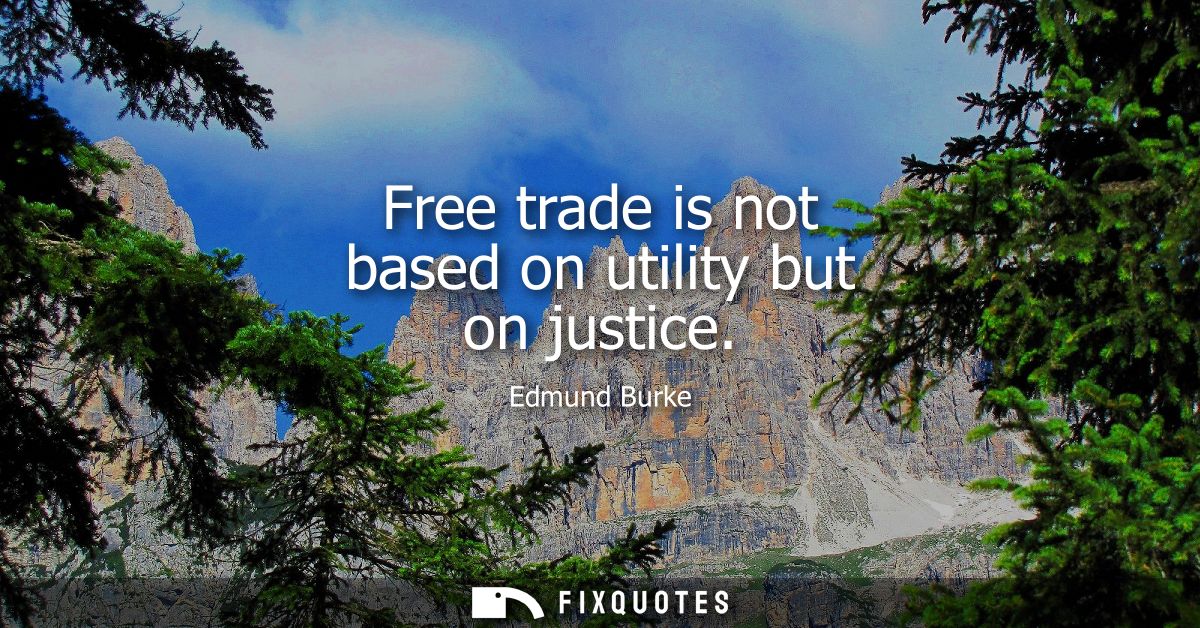
"Free trade is not based on utility but on justice"
About this Quote
Burke’s line is a political sleight of hand with real teeth: he drags “free trade” out of the ledgers and into the moral courtroom. In the late 18th century, trade arguments were already getting trapped in the language of advantage - cheaper goods, richer empires, stronger navies. Burke’s move is to say that even if you could show free exchange isn’t maximally profitable in the short run, it still ought to stand because it answers to a higher standard: what people are owed, what governments are allowed to do, where power must stop.
The intent is less utopian than disciplinary. “Utility” is the alibi of every exception: tariffs for stability, monopolies for strategic industry, restrictions for “the national interest.” Burke treats that logic as endlessly elastic - a justification machine for whichever faction controls the state. Calling trade a matter of justice narrows the state’s room to improvise. It implies rights and reciprocity, not favors; predictable rules, not discretionary permissions.
Subtext: coercive commercial policy is never just economic. It is social engineering by other means, picking winners, manufacturing dependence, and converting citizens into clients. For Burke, the market isn’t sacred; arbitrary power is the enemy. Framing free trade as justice also speaks to empire: Britain’s trade regime was inseparable from colonial extraction. Burke, a critic of imperial abuses, uses “justice” to ask who bears the costs when “utility” is defined by the powerful.
Rhetorically, the sentence works because it reverses the expected hierarchy. It’s not “free trade is useful, therefore just.” It’s “free trade is just, therefore nonnegotiable.” That reversal turns an economic preference into an ethical boundary.
The intent is less utopian than disciplinary. “Utility” is the alibi of every exception: tariffs for stability, monopolies for strategic industry, restrictions for “the national interest.” Burke treats that logic as endlessly elastic - a justification machine for whichever faction controls the state. Calling trade a matter of justice narrows the state’s room to improvise. It implies rights and reciprocity, not favors; predictable rules, not discretionary permissions.
Subtext: coercive commercial policy is never just economic. It is social engineering by other means, picking winners, manufacturing dependence, and converting citizens into clients. For Burke, the market isn’t sacred; arbitrary power is the enemy. Framing free trade as justice also speaks to empire: Britain’s trade regime was inseparable from colonial extraction. Burke, a critic of imperial abuses, uses “justice” to ask who bears the costs when “utility” is defined by the powerful.
Rhetorically, the sentence works because it reverses the expected hierarchy. It’s not “free trade is useful, therefore just.” It’s “free trade is just, therefore nonnegotiable.” That reversal turns an economic preference into an ethical boundary.
Quote Details
| Topic | Justice |
|---|---|
| Source | Later attribution: INTERNATIONAL ECONOMICS (KENNEDY, M. MARIA JOHN, 2014) modern compilationISBN: 9788120349865 · ID: Qqd2BAAAQBAJ
Evidence: ... Free Trade is not based on utility but on Justice. —Edmund BurkE. 8.1. INTRODUCTION. Free trade refers to the trade that is free from all artificial barriers like tariffs, quantitative restrictions, exchange control and others. The free ... Other candidates (1) Letter to Thomas Burgh, Esq. (New Year’s Day, 1780) (Edmund Burke, 1780)50.0% “to fix the principle of a free trade in all the parts of these islands, as founded in justice and beneficial to the ... |
| Cite |
Citation Formats
APA Style (7th ed.)
Burke, Edmund. (2026, February 28). Free trade is not based on utility but on justice. FixQuotes. https://fixquotes.com/quotes/free-trade-is-not-based-on-utility-but-on-justice-19184/
Chicago Style
Burke, Edmund. "Free trade is not based on utility but on justice." FixQuotes. February 28, 2026. https://fixquotes.com/quotes/free-trade-is-not-based-on-utility-but-on-justice-19184/.
MLA Style (9th ed.)
"Free trade is not based on utility but on justice." FixQuotes, 28 Feb. 2026, https://fixquotes.com/quotes/free-trade-is-not-based-on-utility-but-on-justice-19184/. Accessed 23 Mar. 2026.
More Quotes by Edmund
Add to List