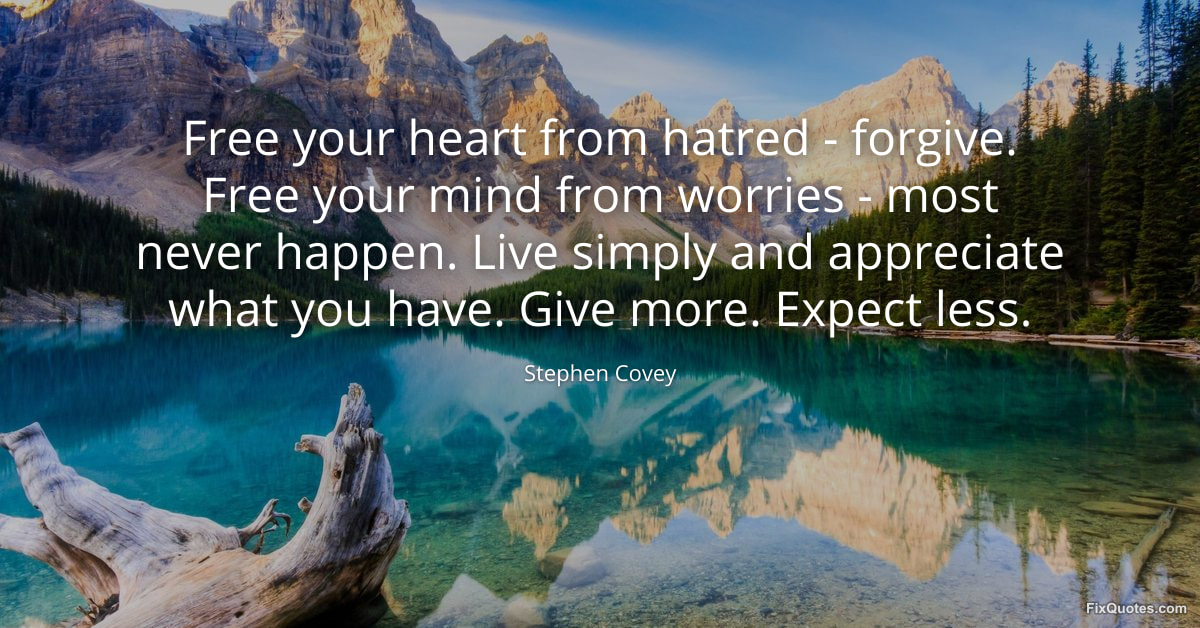
"Free your heart from hatred - forgive. Free your mind from worries - most never happen. Live simply and appreciate what you have. Give more. Expect less"
About this Quote
Covey packages a whole philosophy of self-management into a checklist that reads like a pocket-sized operating system for the modern striver. The imperative verbs - “Free,” “Live,” “Give,” “Expect” - carry the brisk authority of a businessman who’s watched people burn out from invisible costs: grudges, anxiety, lifestyle inflation, and entitlement. It’s not airy spirituality so much as a practical reallocation of attention.
The line “most never happen” is the tell. Covey is speaking to the professional class whose worries are less about survival than about scenario-planning, reputational threat, and the constant background hum of “what if.” He’s smuggling in a cognitive-behavioral move: treat anxious forecasts as bad data. The point isn’t that nothing bad happens; it’s that worry is a lousy strategy for prevention, and a great strategy for exhausting yourself before the meeting even starts.
“Forgive” works here as productivity advice in moral clothing. Hatred is framed as an internal tax, not a righteous stance. That’s the subtext: you may be justified, but you’re still paying. “Give more. Expect less” sounds altruistic, but it also recalibrates agency. You control what you contribute; you don’t control what the world returns. In late-20th-century corporate self-help culture - the era of The 7 Habits - this is Covey’s antidote to status-chasing: simplify inputs, lower the emotional overhead, and you’ll perform better while feeling less owned by outcomes.
The line “most never happen” is the tell. Covey is speaking to the professional class whose worries are less about survival than about scenario-planning, reputational threat, and the constant background hum of “what if.” He’s smuggling in a cognitive-behavioral move: treat anxious forecasts as bad data. The point isn’t that nothing bad happens; it’s that worry is a lousy strategy for prevention, and a great strategy for exhausting yourself before the meeting even starts.
“Forgive” works here as productivity advice in moral clothing. Hatred is framed as an internal tax, not a righteous stance. That’s the subtext: you may be justified, but you’re still paying. “Give more. Expect less” sounds altruistic, but it also recalibrates agency. You control what you contribute; you don’t control what the world returns. In late-20th-century corporate self-help culture - the era of The 7 Habits - this is Covey’s antidote to status-chasing: simplify inputs, lower the emotional overhead, and you’ll perform better while feeling less owned by outcomes.
Quote Details
| Topic | Forgiveness |
|---|---|
| Source | Help us find the source |
More Quotes by Stephen
Add to List