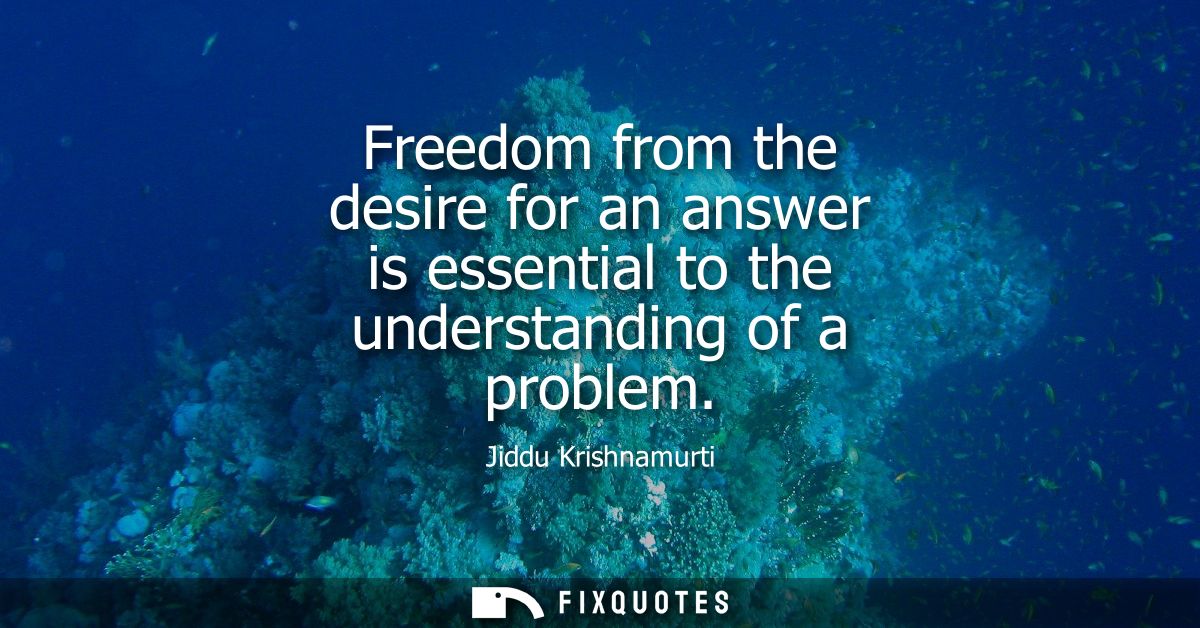
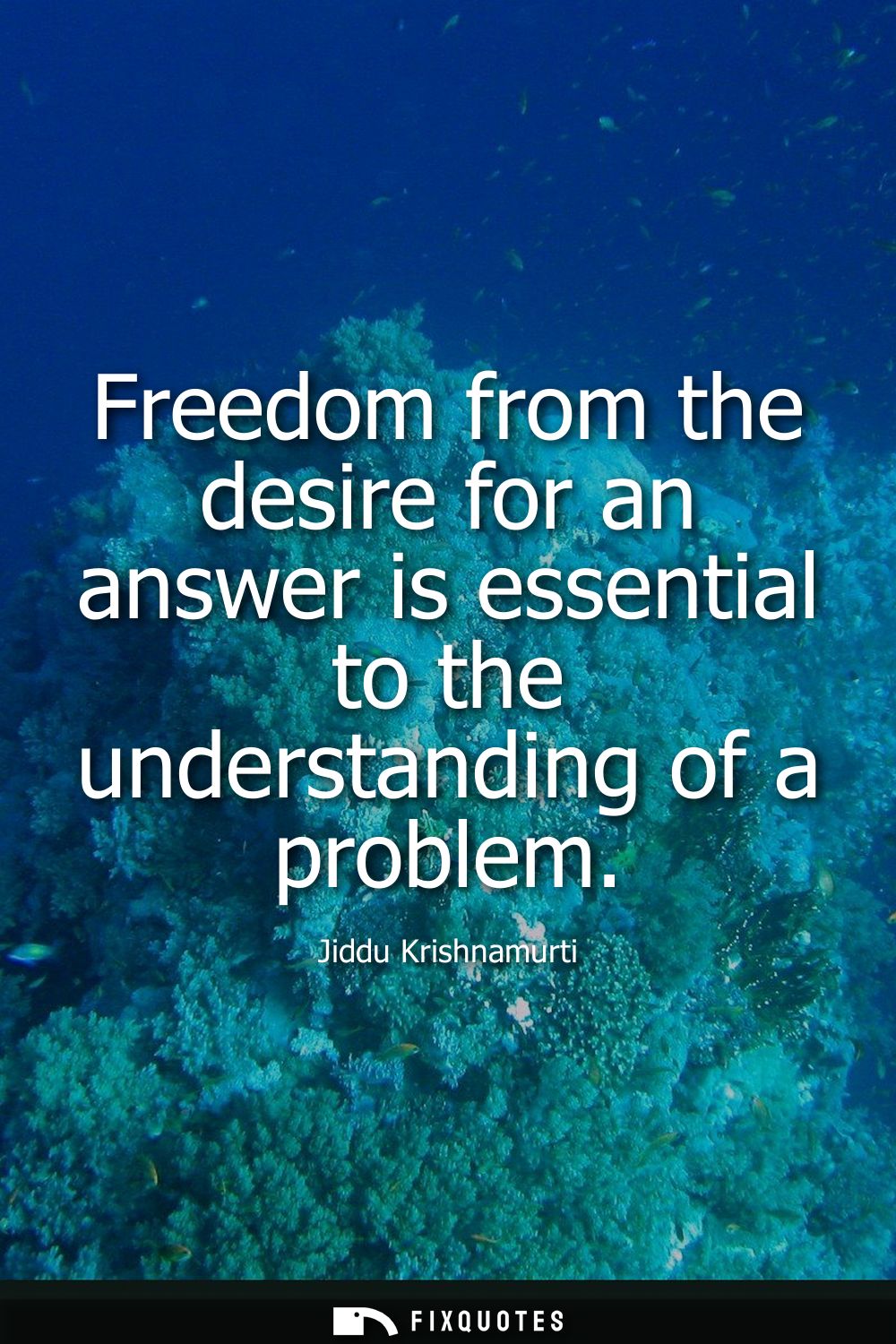
"Freedom from the desire for an answer is essential to the understanding of a problem"
About this Quote
The subtext is a critique of how minds outsource perception. The moment you hunger for an answer, you begin arranging the evidence to pay off that hunger. You stop seeing the problem and start shopping for a conclusion. That’s why the sentence lands with the cool force of a Zen koan: it turns the spotlight from the external puzzle to the internal machinery of the thinker. Understanding becomes less an act of accumulation than an act of subtraction - removing bias, fear, and the ego’s demand to be safe.
Context matters. Krishnamurti, shaped by early 20th-century spiritual movements and then famously rejecting the role of guru, distrusted systems that promise enlightenment on a timetable. After world wars, mass ideologies, and the rise of psychotherapy as a kind of secular salvation, he’s arguing that “answers” can become another dependency. His intent is radical autonomy: if you can stay with uncertainty without flinching, the problem reveals itself on its own terms. The quote works because it weaponizes patience against the modern compulsion to optimize everything into certainty.
Quote Details
| Topic | Wisdom |
|---|---|
| Source | Help us find the source |
| Cite |
Citation Formats
APA Style (7th ed.)
Krishnamurti, Jiddu. (2026, January 17). Freedom from the desire for an answer is essential to the understanding of a problem. FixQuotes. https://fixquotes.com/quotes/freedom-from-the-desire-for-an-answer-is-31922/
Chicago Style
Krishnamurti, Jiddu. "Freedom from the desire for an answer is essential to the understanding of a problem." FixQuotes. January 17, 2026. https://fixquotes.com/quotes/freedom-from-the-desire-for-an-answer-is-31922/.
MLA Style (9th ed.)
"Freedom from the desire for an answer is essential to the understanding of a problem." FixQuotes, 17 Jan. 2026, https://fixquotes.com/quotes/freedom-from-the-desire-for-an-answer-is-31922/. Accessed 3 Apr. 2026.