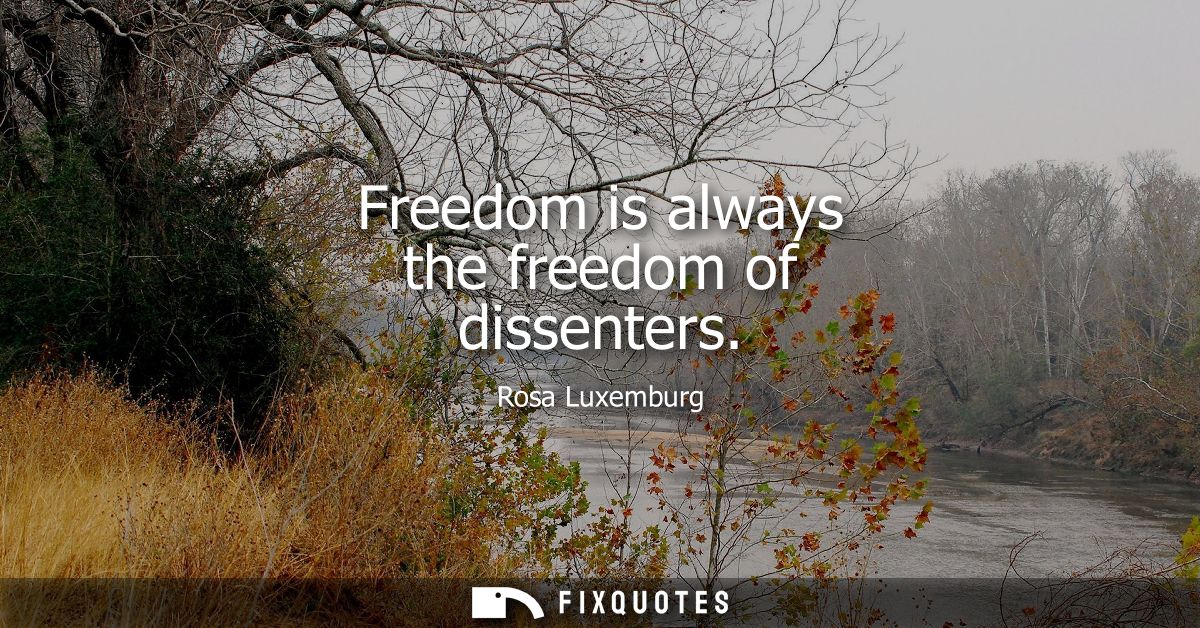
"Freedom is always the freedom of dissenters"
About this Quote
Freedom that only protects the agreeable isn’t freedom; it’s permission. Luxemburg’s line slices through the self-congratulating language of “liberty” and exposes its stress test: dissent. The phrasing is deceptively simple, but it’s built like a trap for power. “Always” makes it non-negotiable, not a luxury you grant when you’re feeling magnanimous. “Dissenters” shifts the focus from abstract rights to a concrete, inconvenient person: the one who interrupts the meeting, publishes the pamphlet, refuses the party line.
The subtext is a warning to revolutionaries as much as to monarchs. Luxemburg wasn’t writing from the safe distance of liberal theory; she was a Marxist arguing with other Marxists. In 1918, amid the Russian Revolution’s aftershocks, she criticized the Bolsheviks for suppressing political opposition and independent press. Her point wasn’t sentimental pluralism; it was a diagnosis of how movements rot. Once a cause starts defining criticism as betrayal, it trades reality-testing for loyalty rituals. “Freedom” becomes a slogan used to police thought, not expand it.
What makes the line work is its moral judo: it forces any regime, party, or institution to prove its commitment on the hardest case. You don’t demonstrate tolerance by indulging your friends; you demonstrate it by protecting the people who make you look bad. Luxemburg paid for this belief in blood and biography, murdered in the volatile aftermath of Germany’s failed revolution. The quote endures because it names the moment every political project hits a fork: keep dissent alive and stay accountable, or crush it and call the silence unity.
The subtext is a warning to revolutionaries as much as to monarchs. Luxemburg wasn’t writing from the safe distance of liberal theory; she was a Marxist arguing with other Marxists. In 1918, amid the Russian Revolution’s aftershocks, she criticized the Bolsheviks for suppressing political opposition and independent press. Her point wasn’t sentimental pluralism; it was a diagnosis of how movements rot. Once a cause starts defining criticism as betrayal, it trades reality-testing for loyalty rituals. “Freedom” becomes a slogan used to police thought, not expand it.
What makes the line work is its moral judo: it forces any regime, party, or institution to prove its commitment on the hardest case. You don’t demonstrate tolerance by indulging your friends; you demonstrate it by protecting the people who make you look bad. Luxemburg paid for this belief in blood and biography, murdered in the volatile aftermath of Germany’s failed revolution. The quote endures because it names the moment every political project hits a fork: keep dissent alive and stay accountable, or crush it and call the silence unity.
Quote Details
| Topic | Freedom |
|---|---|
| Source | Verified source: Zur russischen Revolution (The Russian Revolution) (Rosa Luxemburg, 1918)
Evidence: Freedom only for the supporters of the government, only for members of a party, however numerous they may be, is not freedom. Freedom is always the freedom of dissenters. (Marginal note in the unfinished 1918 manuscript; placement in text not marked (page varies by edition)). Primary origin: Rosa Luxemburg wrote this sentence as a marginal note in her unfinished manuscript “Zur russischen Revolution” while imprisoned in 1918. It was not delivered as a speech/interview line; it appears in her own handwritten manuscript (a marginal annotation). The manuscript was first published posthumously in 1922 (edited/published by Paul Levi). Many English editions render the key clause as “Freedom is always the freedom of the one who thinks differently” or “...of those who think differently,” translating the German “Freiheit ist immer Freiheit der Andersdenkenden.” A commonly cited early English book edition is: Rosa Luxemburg, The Russian Revolution (New York: Workers Age Publishers, 1940 [first publication 1922]), which prints the longer marginal-note passage. Other candidates (1) The Ashgate Research Companion to Paranormal Cultures (Olu Jenzen, Sally R. Munt, 2016) compilation95.0% ... Rosa after Marxist Jewish pacifist and feminist Rosa Luxemburg , who most famously claimed , ' Freedom is always ... |
| Cite |
Citation Formats
APA Style (7th ed.)
Luxemburg, Rosa. (2026, February 24). Freedom is always the freedom of dissenters. FixQuotes. https://fixquotes.com/quotes/freedom-is-always-the-freedom-of-dissenters-65400/
Chicago Style
Luxemburg, Rosa. "Freedom is always the freedom of dissenters." FixQuotes. February 24, 2026. https://fixquotes.com/quotes/freedom-is-always-the-freedom-of-dissenters-65400/.
MLA Style (9th ed.)
"Freedom is always the freedom of dissenters." FixQuotes, 24 Feb. 2026, https://fixquotes.com/quotes/freedom-is-always-the-freedom-of-dissenters-65400/. Accessed 3 Apr. 2026.
More Quotes by Rosa
Add to List