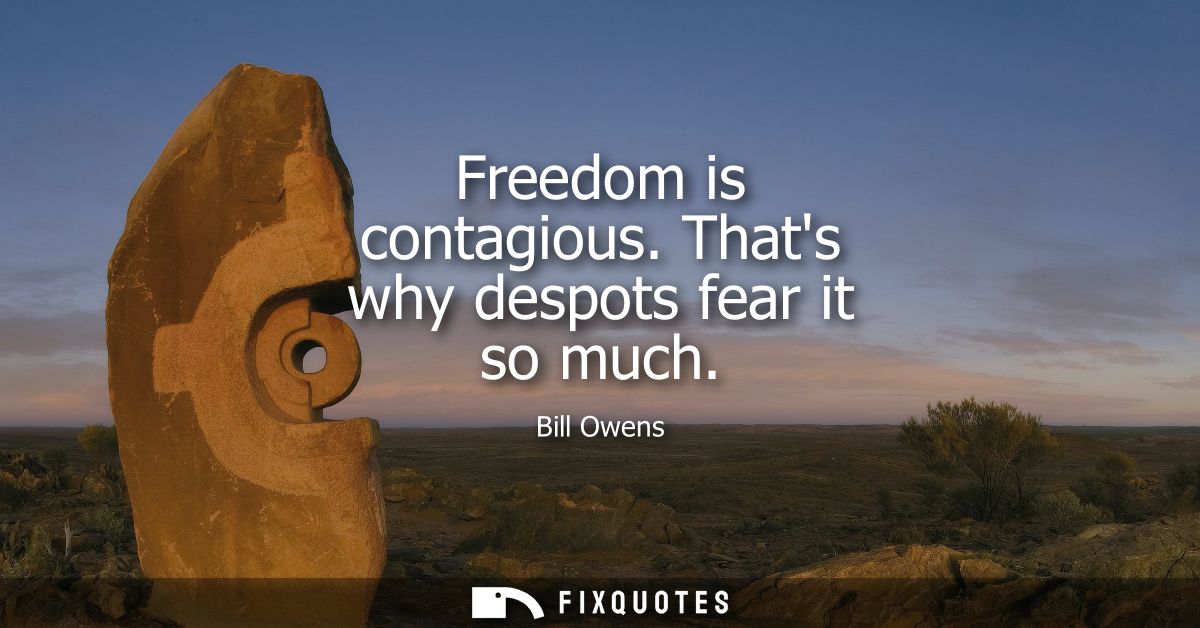
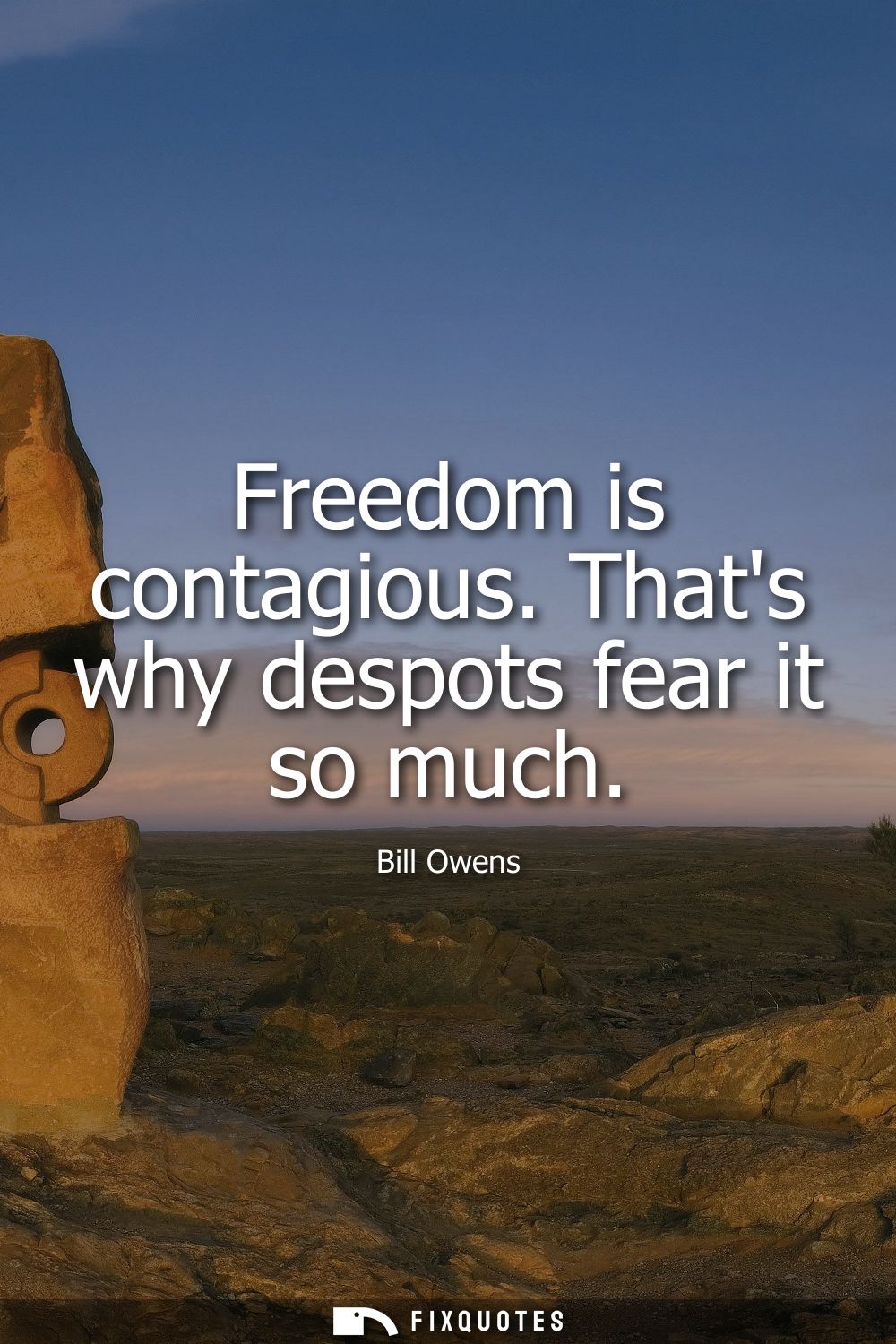
"Freedom is contagious. That's why despots fear it so much"
About this Quote
“Freedom is contagious” is a neat political sleight of hand: it turns an abstract principle into a public-health metaphor, implying spread, exposure, and inevitability. Owens isn’t arguing freedom is merely desirable; he’s suggesting it behaves like a virus in a closed system, jumping borders and bypassing censors. That framing does two things at once. It flatters the listener (you don’t have to be a hero; you just have to be near it), and it terrifies the imagined opponent (control is brittle because ideas travel).
The second sentence sharpens the blade. “That’s why despots fear it so much” casts authoritarianism as fundamentally reactive, defined less by strength than by paranoia. The subtext is strategic: if despots fear freedom, then fear becomes evidence of freedom’s power. It’s a rhetoric of reassurance meant for audiences who feel outmatched by entrenched regimes or institutions. The enemy may have prisons, propaganda, and police, but they can’t fully quarantine aspiration once people witness alternatives.
Contextually, this line sits comfortably in late-20th/early-21st-century democratic messaging, where revolutions and reform movements are narrated as domino effects: one election, one protest, one leak, one image on a screen, and suddenly the “impossible” starts looking copyable. It also smuggles in a moral binary that’s useful in politics: if freedom spreads naturally, then opposition to it isn’t just policy disagreement; it’s pathology. That’s persuasive, galvanizing, and a little dangerous - because it simplifies messy realities into an outbreak story with a clear villain.
The second sentence sharpens the blade. “That’s why despots fear it so much” casts authoritarianism as fundamentally reactive, defined less by strength than by paranoia. The subtext is strategic: if despots fear freedom, then fear becomes evidence of freedom’s power. It’s a rhetoric of reassurance meant for audiences who feel outmatched by entrenched regimes or institutions. The enemy may have prisons, propaganda, and police, but they can’t fully quarantine aspiration once people witness alternatives.
Contextually, this line sits comfortably in late-20th/early-21st-century democratic messaging, where revolutions and reform movements are narrated as domino effects: one election, one protest, one leak, one image on a screen, and suddenly the “impossible” starts looking copyable. It also smuggles in a moral binary that’s useful in politics: if freedom spreads naturally, then opposition to it isn’t just policy disagreement; it’s pathology. That’s persuasive, galvanizing, and a little dangerous - because it simplifies messy realities into an outbreak story with a clear villain.
Quote Details
| Topic | Freedom |
|---|---|
| Source | Help us find the source |
| Cite |
Citation Formats
APA Style (7th ed.)
Owens, Bill. (2026, January 15). Freedom is contagious. That's why despots fear it so much. FixQuotes. https://fixquotes.com/quotes/freedom-is-contagious-thats-why-despots-fear-it-51471/
Chicago Style
Owens, Bill. "Freedom is contagious. That's why despots fear it so much." FixQuotes. January 15, 2026. https://fixquotes.com/quotes/freedom-is-contagious-thats-why-despots-fear-it-51471/.
MLA Style (9th ed.)
"Freedom is contagious. That's why despots fear it so much." FixQuotes, 15 Jan. 2026, https://fixquotes.com/quotes/freedom-is-contagious-thats-why-despots-fear-it-51471/. Accessed 2 Apr. 2026.
More Quotes by Bill
Add to List