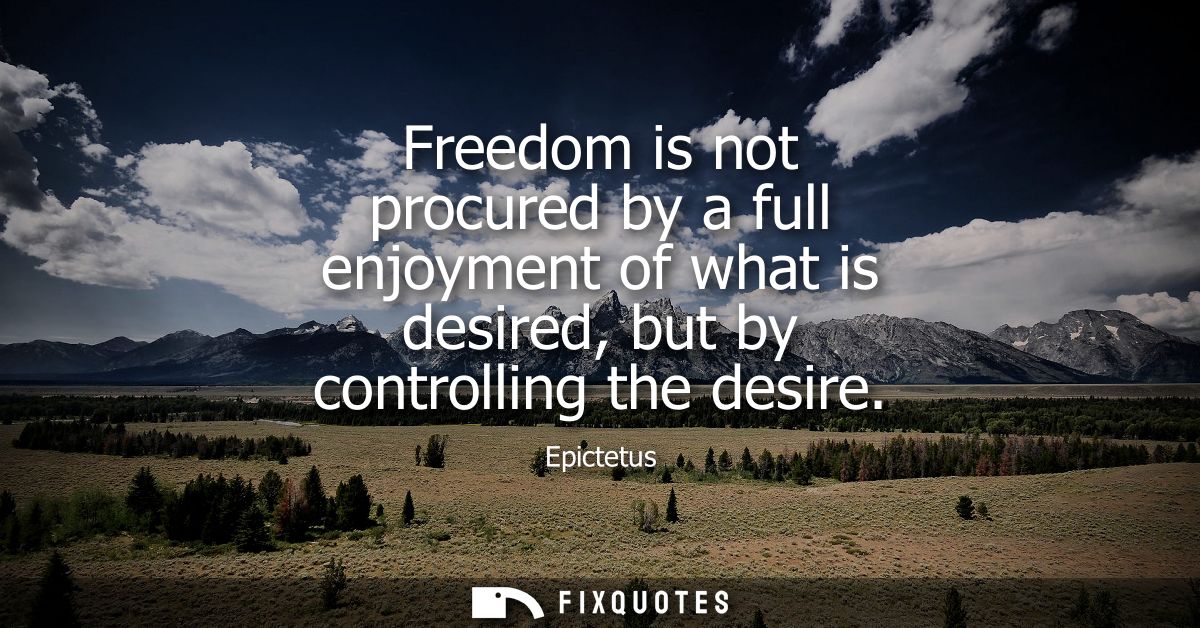
"Freedom is not procured by a full enjoyment of what is desired, but by controlling the desire"
About this Quote
The phrasing matters. “Procured” makes freedom sound like something people try to purchase or secure through accumulation. Epictetus flips the transaction: you don’t acquire freedom from the world; you recover it from within. “Full enjoyment” is a subtle jab at satiation as a myth. Desire doesn’t end when it’s fed; it mutates, escalates, recruits new anxieties. Satisfaction becomes maintenance.
Context sharpens the point. Epictetus was born enslaved and taught in an empire built on domination and spectacle. His philosophy isn’t airy self-help; it’s survival logic for a life where external control is often unavoidable. Stoicism’s distinction between what is “up to us” and what isn’t sits behind this sentence like scaffolding: your body, reputation, and possessions can be taken; your judgments and impulses are the last jurisdiction.
The subtext is almost political: empires, markets, and tyrants thrive by engineering craving. Control the desire, and you become harder to govern, harder to sell to, harder to break. That is Epictetus’s definition of freedom: not indulgence, but independence.
Quote Details
| Topic | Self-Discipline |
|---|---|
| Source | Help us find the source |
| Cite |
Citation Formats
APA Style (7th ed.)
Epictetus. (2026, January 14). Freedom is not procured by a full enjoyment of what is desired, but by controlling the desire. FixQuotes. https://fixquotes.com/quotes/freedom-is-not-procured-by-a-full-enjoyment-of-27183/
Chicago Style
Epictetus. "Freedom is not procured by a full enjoyment of what is desired, but by controlling the desire." FixQuotes. January 14, 2026. https://fixquotes.com/quotes/freedom-is-not-procured-by-a-full-enjoyment-of-27183/.
MLA Style (9th ed.)
"Freedom is not procured by a full enjoyment of what is desired, but by controlling the desire." FixQuotes, 14 Jan. 2026, https://fixquotes.com/quotes/freedom-is-not-procured-by-a-full-enjoyment-of-27183/. Accessed 27 Mar. 2026.