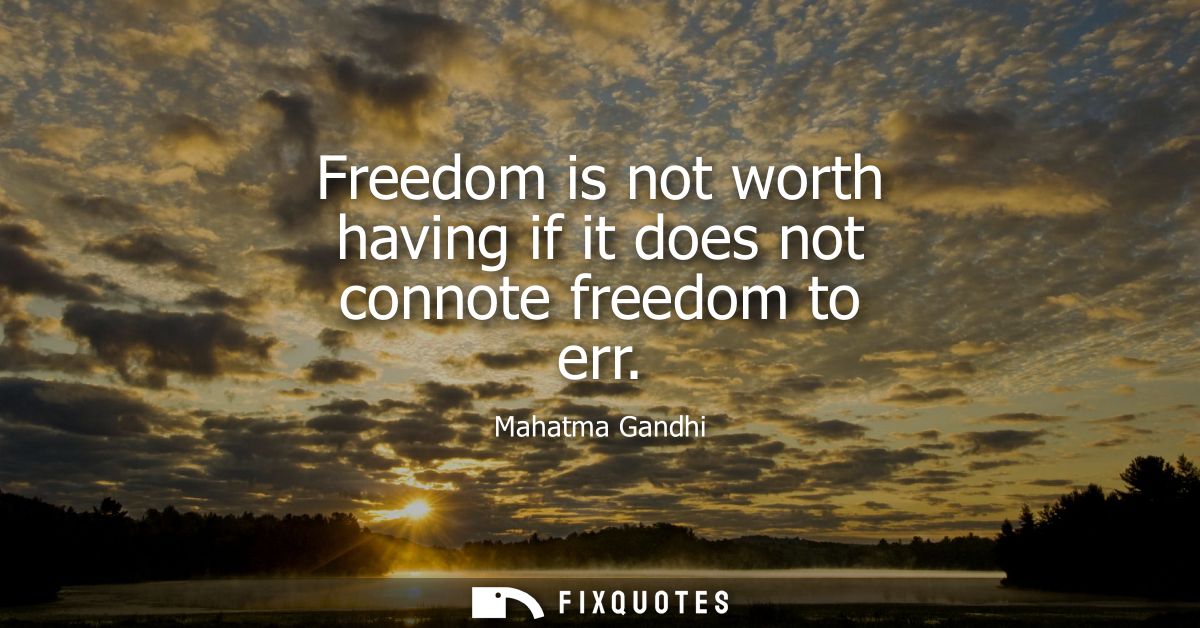
"Freedom is not worth having if it does not connote freedom to err"
About this Quote
Freedom, for Gandhi, is only real when it includes the right to get things wrong. The line refuses the tidy, sanitized version of liberty that empires and anxious majorities like to sell: freedom as permission, rationed out to the “responsible,” the “civilized,” the “safe.” By insisting that freedom must “connote” freedom to err, Gandhi turns a political concept into a moral stress test. If dissent, experimentation, and even failure are punishable, then what you have is order, not liberty.
The subtext is strategic as much as philosophical. Gandhi was leading a mass movement under colonial rule, where British authorities routinely justified repression as maintaining stability and “good governance.” The quote exposes that paternalism: a regime that cannot tolerate mistakes in speech, protest, or self-rule is admitting it doesn’t believe people are fit to govern themselves. His phrasing also nudges his own side. National movements, once they gain momentum, can become impatient with internal disagreement, treating unity as sacred and error as betrayal. Gandhi is warning that a free India cannot be built with the habits of coercion inherited from the Raj.
Rhetorically, it’s deceptively modest. “Err” sounds small, even human-scale, which is the point: the ordinary right to misjudge, to argue poorly, to try and fail is where freedom actually lives day to day. Strip that away and “freedom” becomes a slogan used to discipline the very public it claims to empower.
The subtext is strategic as much as philosophical. Gandhi was leading a mass movement under colonial rule, where British authorities routinely justified repression as maintaining stability and “good governance.” The quote exposes that paternalism: a regime that cannot tolerate mistakes in speech, protest, or self-rule is admitting it doesn’t believe people are fit to govern themselves. His phrasing also nudges his own side. National movements, once they gain momentum, can become impatient with internal disagreement, treating unity as sacred and error as betrayal. Gandhi is warning that a free India cannot be built with the habits of coercion inherited from the Raj.
Rhetorically, it’s deceptively modest. “Err” sounds small, even human-scale, which is the point: the ordinary right to misjudge, to argue poorly, to try and fail is where freedom actually lives day to day. Strip that away and “freedom” becomes a slogan used to discipline the very public it claims to empower.
Quote Details
| Topic | Freedom |
|---|---|
| Source | Help us find the source |
| Cite |
Citation Formats
APA Style (7th ed.)
Gandhi, Mahatma. (2026, January 15). Freedom is not worth having if it does not connote freedom to err. FixQuotes. https://fixquotes.com/quotes/freedom-is-not-worth-having-if-it-does-not-26056/
Chicago Style
Gandhi, Mahatma. "Freedom is not worth having if it does not connote freedom to err." FixQuotes. January 15, 2026. https://fixquotes.com/quotes/freedom-is-not-worth-having-if-it-does-not-26056/.
MLA Style (9th ed.)
"Freedom is not worth having if it does not connote freedom to err." FixQuotes, 15 Jan. 2026, https://fixquotes.com/quotes/freedom-is-not-worth-having-if-it-does-not-26056/. Accessed 13 Feb. 2026.
More Quotes by Mahatma
Add to List