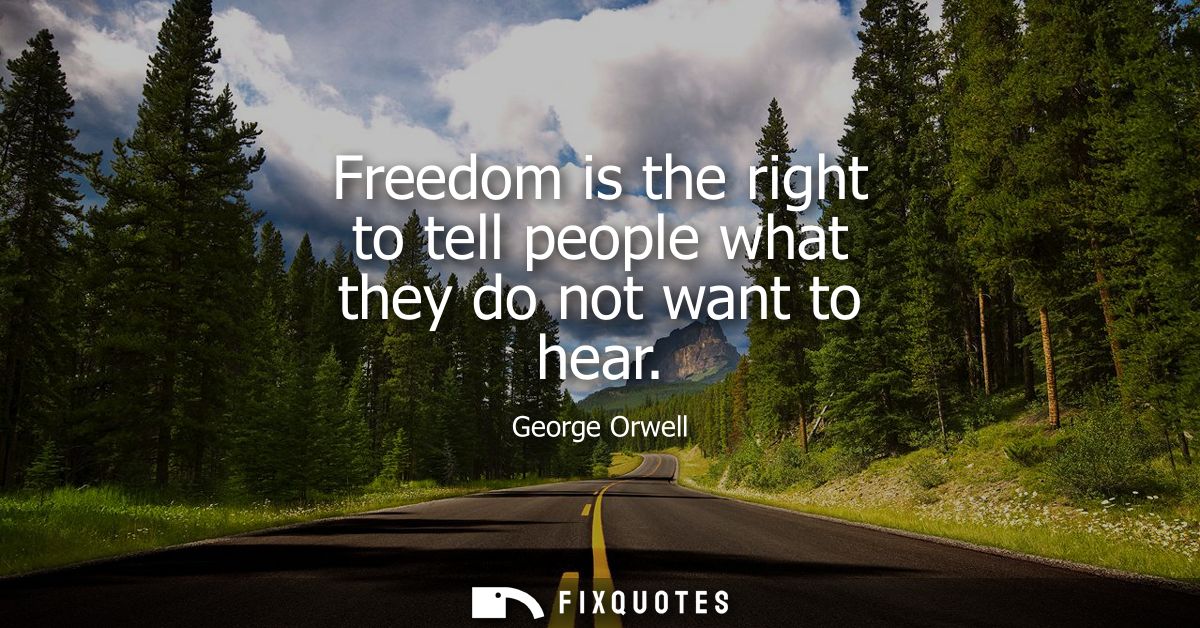
"Freedom is the right to tell people what they do not want to hear"
About this Quote
Orwell’s version of “freedom” doesn’t show up as a soaring abstraction; it arrives as a social stress test. The line is engineered to puncture the comfortable, poster-ready idea that liberty means everyone gets to feel affirmed. Instead, he defines it by its most inconvenient use-case: speech that irritates the majority, embarrasses the powerful, or simply ruins the mood. Freedom, in this framing, is not proven when you agree with someone. It’s proven when you’re tempted to shut them up.
The subtext is a warning about how censorship actually sells itself. It rarely arrives announcing tyranny; it comes dressed as public decency, unity, safety, patriotism, “responsibility,” or protection from harm. Orwell understood that the first thing a nervous society reaches for is permission to silence “unhelpful” truths - and that many people will volunteer to build the muzzle if they’re convinced it’s for the greater good. His sentence is intentionally blunt, almost legalistic, because it’s meant to strip away those soothing justifications.
Context matters: Orwell wrote in the shadow of propaganda, wartime information control, and his own experience watching ideological movements demand loyalty over honesty. The quote is often linked to debates around publishing and dissent in mid-century Britain, but it reads eerily contemporary because it targets a constant: the urge to confuse discomfort with danger. Orwell’s point isn’t that every unpopular statement is brave or valuable. It’s that a society that can’t tolerate hearing what it hates is already negotiating the terms of its own unfreedom.
The subtext is a warning about how censorship actually sells itself. It rarely arrives announcing tyranny; it comes dressed as public decency, unity, safety, patriotism, “responsibility,” or protection from harm. Orwell understood that the first thing a nervous society reaches for is permission to silence “unhelpful” truths - and that many people will volunteer to build the muzzle if they’re convinced it’s for the greater good. His sentence is intentionally blunt, almost legalistic, because it’s meant to strip away those soothing justifications.
Context matters: Orwell wrote in the shadow of propaganda, wartime information control, and his own experience watching ideological movements demand loyalty over honesty. The quote is often linked to debates around publishing and dissent in mid-century Britain, but it reads eerily contemporary because it targets a constant: the urge to confuse discomfort with danger. Orwell’s point isn’t that every unpopular statement is brave or valuable. It’s that a society that can’t tolerate hearing what it hates is already negotiating the terms of its own unfreedom.
Quote Details
| Topic | Freedom |
|---|---|
| Source | Verified source: The Freedom of the Press (proposed preface to Animal Farm) (George Orwell, 1972)
Evidence: But at least let us have no more nonsense about defending liberty against Fascism. If liberty means anything at all it means the right to tell people what they do not want to hear.. The wording most often circulated (“Freedom is the right to tell people what they do not want to hear”) is a shortened/paraphrased form. Orwell’s own text uses “If liberty means anything at all…”. This sentence appears in Orwell’s essay "The Freedom of the Press", written in 1945 as a proposed preface to the first edition of Animal Farm, but it was not included in the 1945 book. The typescript was reportedly discovered in 1971 and the essay was first published in print in The Times Literary Supplement on 15 September 1972 (with an introduction by Bernard Crick titled "How the essay came to be written"). As a result, the earliest *publication* appears to be 15 September 1972 in TLS, even though the *composition* date is 1945. The provided URL is a transcription that explicitly states the TLS publication details and contains the quote in context. Other candidates (1) Society in the Self (H. J. M. Hermans, 2018) compilation95.0% ... George Orwell says: “Freedom is the right to tell people what they do not want to hear.” If that is right, what a... |
| Cite |
Citation Formats
APA Style (7th ed.)
Orwell, George. (2026, February 27). Freedom is the right to tell people what they do not want to hear. FixQuotes. https://fixquotes.com/quotes/freedom-is-the-right-to-tell-people-what-they-do-28278/
Chicago Style
Orwell, George. "Freedom is the right to tell people what they do not want to hear." FixQuotes. February 27, 2026. https://fixquotes.com/quotes/freedom-is-the-right-to-tell-people-what-they-do-28278/.
MLA Style (9th ed.)
"Freedom is the right to tell people what they do not want to hear." FixQuotes, 27 Feb. 2026, https://fixquotes.com/quotes/freedom-is-the-right-to-tell-people-what-they-do-28278/. Accessed 2 Apr. 2026.
More Quotes by George
Add to List