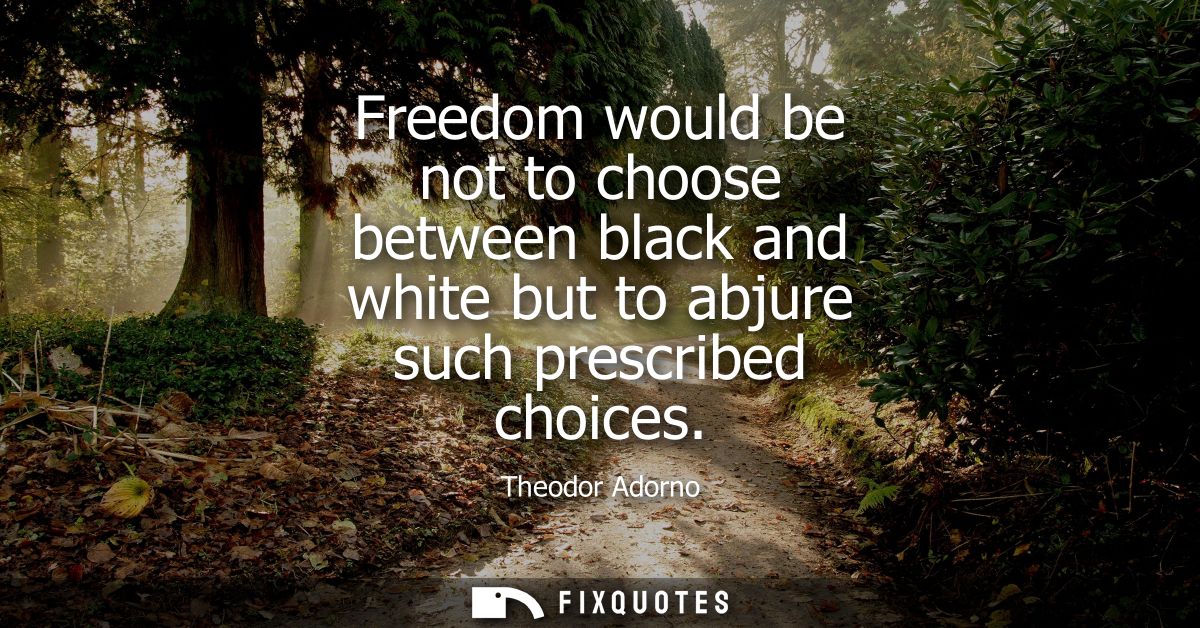
"Freedom would be not to choose between black and white but to abjure such prescribed choices"
About this Quote
The key verb is “abjure”: not merely “decline,” but renounce, as if the options themselves are contaminated. That’s classic Frankfurt School suspicion: modern capitalism doesn’t just sell products; it manufactures the categories through which we recognize ourselves. Under that pressure, agency gets outsourced to the available positions. Your dissent becomes another selectable identity, already priced in.
Context matters: Adorno is writing in the long shadow of fascism and the postwar culture industry, where mass media standardizes desire and politics curdles into slogans. The quote implies a grim lesson from that era: when public life is organized around rigid oppositions, it becomes easier to mobilize, police, and punish. “Prescribed choices” are governance by repertoire.
So the line works as both diagnosis and dare. Freedom, for Adorno, is negative at first: breaking the spell of compulsory simplification. It’s the hard work of insisting that reality is messier than the options offered, and that thinking begins where the ballot-box binary ends.
Quote Details
| Topic | Freedom |
|---|---|
| Source | Verified source: Minima Moralia: Reflections from Damaged Life (Theodor Adorno, 1951)
Evidence: Die apriorische Reduktion auf das Freund-Feind-Verhältnis ist eines der Urphänomene der neuen Anthropologie. Freiheit wäre, nicht zwischen schwarz und weiß zu wählen, sondern aus solcher vorgeschriebenen Wahl herauszutreten. (Aphorism 85 (German text); English translation commonly cited as p. 132 in Jephcott/VERSO (2005 ed.)). This is the original German wording in Adorno’s own work (Minima Moralia, aphorism numbered 85 in many editions). The widely-circulated English quote (“Freedom would be not to choose between black and white but to abjure such prescribed choices”) is a translation/paraphrase of this sentence. Secondary sources frequently point to the E.F.N. Jephcott English translation and cite it as appearing in Minima Moralia (often given as p. 132 in the Verso 2005 edition), but I am only directly verifying the primary-language original sentence from the online German text shown at the URL provided. Other candidates (1) Critique of Identity Thinking (Michael Jackson, 2019) compilation95.0% ... Adorno observes that under such circumstances “ freedom would be not to choose between black and white but to abj... |
| Cite |
Citation Formats
APA Style (7th ed.)
Adorno, Theodor. (2026, March 3). Freedom would be not to choose between black and white but to abjure such prescribed choices. FixQuotes. https://fixquotes.com/quotes/freedom-would-be-not-to-choose-between-black-and-462/
Chicago Style
Adorno, Theodor. "Freedom would be not to choose between black and white but to abjure such prescribed choices." FixQuotes. March 3, 2026. https://fixquotes.com/quotes/freedom-would-be-not-to-choose-between-black-and-462/.
MLA Style (9th ed.)
"Freedom would be not to choose between black and white but to abjure such prescribed choices." FixQuotes, 3 Mar. 2026, https://fixquotes.com/quotes/freedom-would-be-not-to-choose-between-black-and-462/. Accessed 9 Mar. 2026.