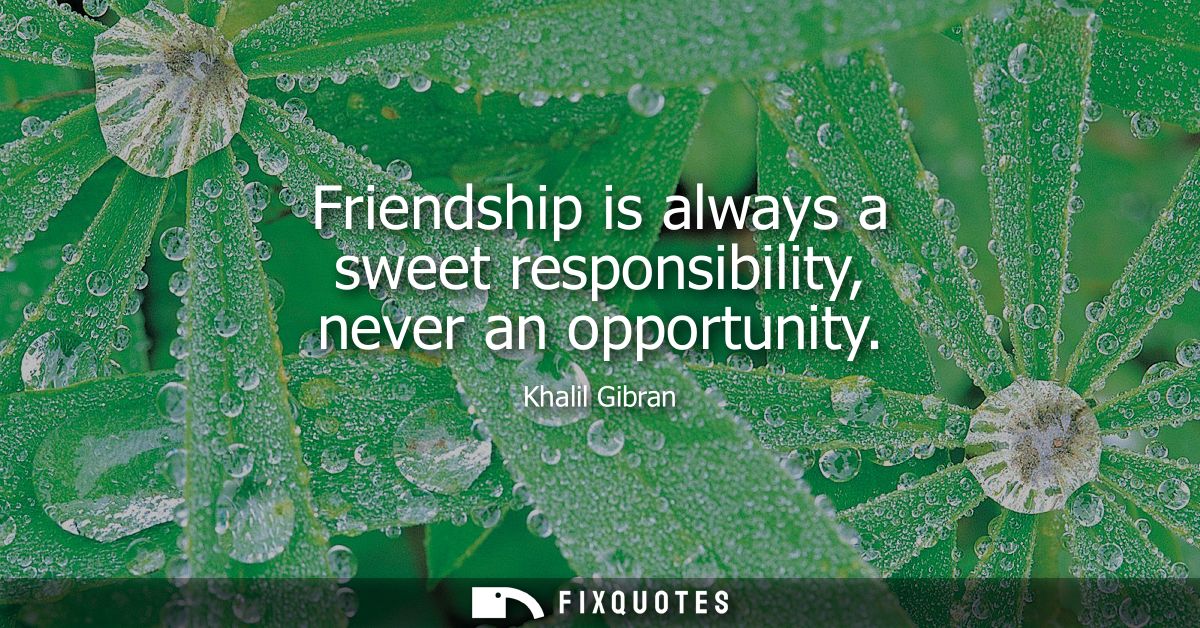
"Friendship is always a sweet responsibility, never an opportunity"
About this Quote
Gibran frames friendship as a moral burden you choose, not a social slot you exploit. The line turns on a quiet reversal: in modern life, we’re trained to scan relationships for upside - access, status, networking, romance-by-proxy. By calling friendship “never an opportunity,” he refuses that marketplace logic. The friend is not a ladder; they’re a life entrusted to you.
“Sweet responsibility” is doing a lot of work. Responsibility alone would sound dutiful, even grim. Sweetness smuggles in pleasure and desire, suggesting the obligation isn’t a chore but a kind of consented devotion: you show up, you listen, you keep confidences, you tell the hard truth when it’s needed. The sweetness is the reward, but it’s also the test. If it’s genuinely sweet, you won’t need to turn it into an “opportunity” to justify it.
The subtext is faintly admonishing, the voice of a poet who distrusts transactional intimacy. Gibran wrote in the early 20th century, moving between Lebanon and the U.S., shaped by immigrant life, spiritual eclecticism, and an era when industrial modernity was reorganizing community into institutions, clubs, and careers. Against that churn, he argues for friendship as a sacred practice with ethics attached.
It works because it’s simple but not soft. “Always” and “never” are absolutes, almost liturgical, staking out a clear boundary: the minute friendship becomes instrumental, it stops being friendship. What remains is care with consequences.
“Sweet responsibility” is doing a lot of work. Responsibility alone would sound dutiful, even grim. Sweetness smuggles in pleasure and desire, suggesting the obligation isn’t a chore but a kind of consented devotion: you show up, you listen, you keep confidences, you tell the hard truth when it’s needed. The sweetness is the reward, but it’s also the test. If it’s genuinely sweet, you won’t need to turn it into an “opportunity” to justify it.
The subtext is faintly admonishing, the voice of a poet who distrusts transactional intimacy. Gibran wrote in the early 20th century, moving between Lebanon and the U.S., shaped by immigrant life, spiritual eclecticism, and an era when industrial modernity was reorganizing community into institutions, clubs, and careers. Against that churn, he argues for friendship as a sacred practice with ethics attached.
It works because it’s simple but not soft. “Always” and “never” are absolutes, almost liturgical, staking out a clear boundary: the minute friendship becomes instrumental, it stops being friendship. What remains is care with consequences.
Quote Details
| Topic | Friendship |
|---|---|
| Source | Kahlil Gibran, The Prophet (1923), "On Friendship" section. |
More Quotes by Kahlil
Add to List