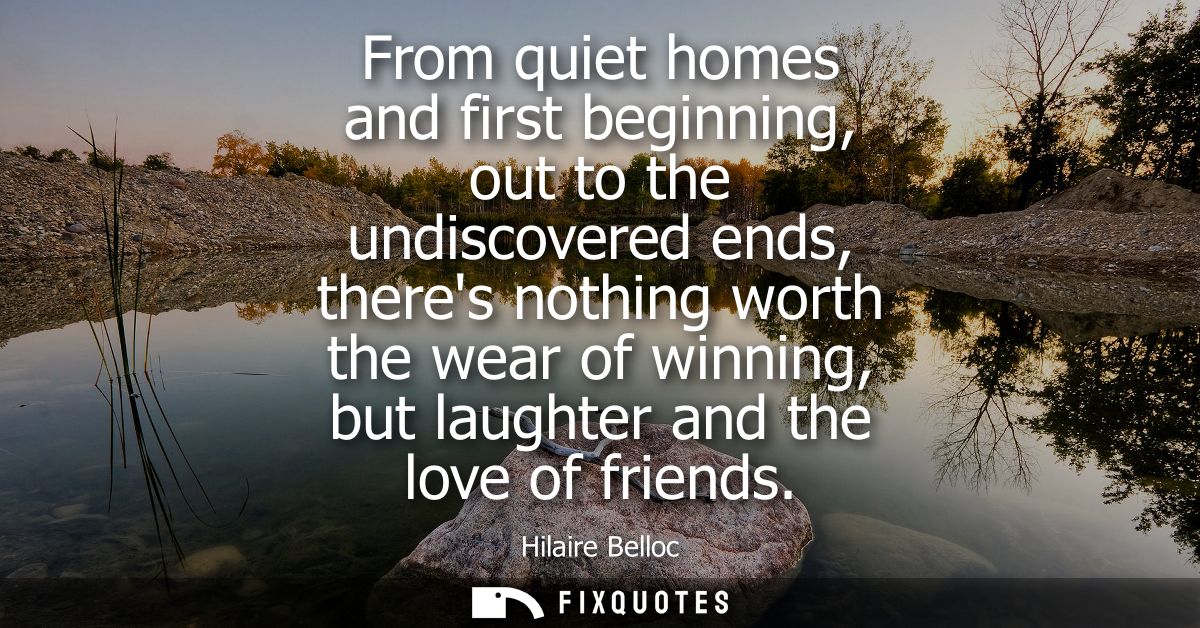
"From quiet homes and first beginning, out to the undiscovered ends, there's nothing worth the wear of winning, but laughter and the love of friends"
About this Quote
Belloc’s line dresses itself up like a travelogue of ambition, then quietly robs ambition of its prize. The movement is epic in miniature: “quiet homes” and “first beginning” suggest domestic innocence, the place you start before you learn to perform for the world. Then the poem widens its lens to “the undiscovered ends,” the old imperial phrase for distant frontiers and grand self-making. Belloc knew that fantasy well: an Anglo-French Catholic writing in an age when Britain still imagined itself destined to map and manage everything.
The trick is in the phrase “the wear of winning.” Winning isn’t framed as triumph; it’s abrasion. “Wear” implies friction, cost, the slow sanding down of the self that comes with status-chasing and conquest. Belloc’s subtext isn’t anti-adventure so much as anti-myth: he’s puncturing the Victorian/Edwardian promise that striving automatically produces meaning. By the time he lands on “laughter and the love of friends,” it’s not sentimental consolation; it’s a value judgment after the tally is taken. Laughter is bodily, unprestigious, impossible to hoard. Friendship is similarly non-transactional, a kind of wealth that can’t be proven on paper.
Formally, the line works because it’s built like a hymn and ends like a toast. The cadence flatters the heroic narrative just long enough to make the reversal sting. Belloc’s intent is to smuggle a radically modest ethic into an era obsessed with bigness: go as far as you like, he implies, but don’t confuse distance traveled with a life won.
The trick is in the phrase “the wear of winning.” Winning isn’t framed as triumph; it’s abrasion. “Wear” implies friction, cost, the slow sanding down of the self that comes with status-chasing and conquest. Belloc’s subtext isn’t anti-adventure so much as anti-myth: he’s puncturing the Victorian/Edwardian promise that striving automatically produces meaning. By the time he lands on “laughter and the love of friends,” it’s not sentimental consolation; it’s a value judgment after the tally is taken. Laughter is bodily, unprestigious, impossible to hoard. Friendship is similarly non-transactional, a kind of wealth that can’t be proven on paper.
Formally, the line works because it’s built like a hymn and ends like a toast. The cadence flatters the heroic narrative just long enough to make the reversal sting. Belloc’s intent is to smuggle a radically modest ethic into an era obsessed with bigness: go as far as you like, he implies, but don’t confuse distance traveled with a life won.
Quote Details
| Topic | Friendship |
|---|
More Quotes by Hilaire
Add to List