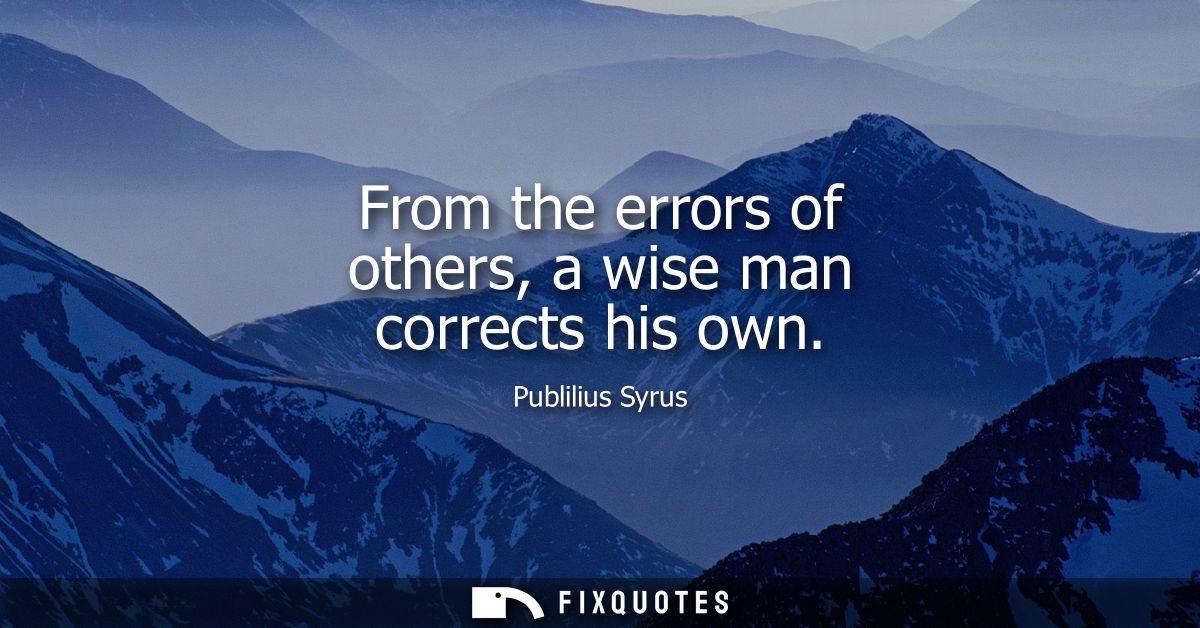
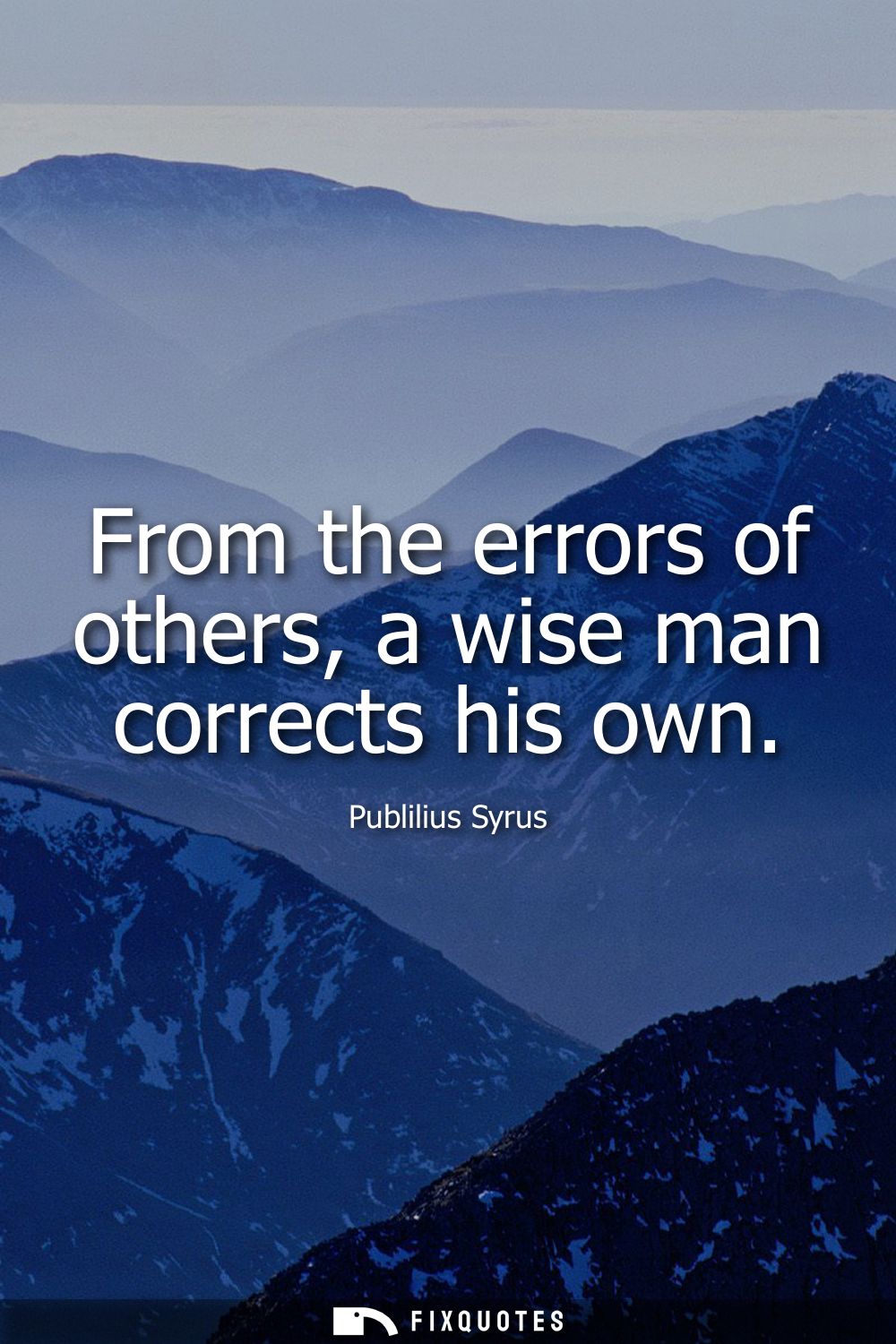
"From the errors of others, a wise man corrects his own"
About this Quote
Wisdom, for Publilius Syrus, isn’t a private lightbulb moment; it’s a public act of attention. “From the errors of others, a wise man corrects his own” recasts the crowd as a classroom and turns morality into a kind of surveillance-with-benefits. The line works because it flatters the reader while quietly demanding discipline: if you’re truly wise, you don’t need your own crash to learn where the wall is. You watch someone else hit it and adjust your steering.
Syrus wrote in late Republican Rome, a society addicted to exempla - moral case studies, often served up through theater, rhetoric, and gossip. As a mime writer known for aphorisms, he specialized in portable ethics: sentences that could be remembered, repeated, and used to police behavior. The subtext is pragmatic, almost transactional. Mistakes are expensive; observation is cheaper. In a world where status could evaporate over a scandal, a bad patron, or a misread political wind, “learning the hard way” wasn’t romantic, it was reckless.
There’s also a sharper edge: the quote implies that most people are not wise because they can’t resist the ego boost of thinking they’re the exception. Syrus nudges us toward humility by indirect means. You don’t correct yourself because you’re virtuous; you correct yourself because you’ve seen how ugly it gets when someone else doesn’t. It’s empathy, yes, but it’s also self-preservation dressed as philosophy.
Syrus wrote in late Republican Rome, a society addicted to exempla - moral case studies, often served up through theater, rhetoric, and gossip. As a mime writer known for aphorisms, he specialized in portable ethics: sentences that could be remembered, repeated, and used to police behavior. The subtext is pragmatic, almost transactional. Mistakes are expensive; observation is cheaper. In a world where status could evaporate over a scandal, a bad patron, or a misread political wind, “learning the hard way” wasn’t romantic, it was reckless.
There’s also a sharper edge: the quote implies that most people are not wise because they can’t resist the ego boost of thinking they’re the exception. Syrus nudges us toward humility by indirect means. You don’t correct yourself because you’re virtuous; you correct yourself because you’ve seen how ugly it gets when someone else doesn’t. It’s empathy, yes, but it’s also self-preservation dressed as philosophy.
Quote Details
| Topic | Learning from Mistakes |
|---|---|
| Source | Later attribution: The Moral Sayings of Publius Syrus (Publilius Syrus, 1856) modern compilation
Evidence: The wise man corrects his own errors by observing those of others. (Saying 242). The commonly circulated wording "From the errors of others, a wise man corrects his own" appears to be an English paraphrase. A verifiable primary-source tradition attributes the saying to Publilius Syrus's Sententiae, preserved in Latin as "Ex vitio alterius sapiens emendat suum" (also translated as "From the faults of another a wise man will correct his own"). Because Publilius Syrus wrote in the 1st century BC and his original mime texts do not survive as authorial first editions, the earliest directly verifiable source I could confirm online is the 1856 book The Moral Sayings of Publius Syrus, A Roman Slave, translated by Darius Lyman, where it appears as Saying 242. That edition gives the wording: "The wise man corrects his own errors by observing those of others." Other candidates (1) The Book of Positive Quotations (Steve Deger, Leslie Ann Gibson, 2024) compilation95.0% ... From the errors of others , a wise man corrects his own . -Publilius Syrus Learn from the mistakes of others— you... |
| Cite |
Citation Formats
APA Style (7th ed.)
Syrus, Publilius. (2026, March 6). From the errors of others, a wise man corrects his own. FixQuotes. https://fixquotes.com/quotes/from-the-errors-of-others-a-wise-man-corrects-his-137405/
Chicago Style
Syrus, Publilius. "From the errors of others, a wise man corrects his own." FixQuotes. March 6, 2026. https://fixquotes.com/quotes/from-the-errors-of-others-a-wise-man-corrects-his-137405/.
MLA Style (9th ed.)
"From the errors of others, a wise man corrects his own." FixQuotes, 6 Mar. 2026, https://fixquotes.com/quotes/from-the-errors-of-others-a-wise-man-corrects-his-137405/. Accessed 7 Mar. 2026.
More Quotes by Publilius
Add to List