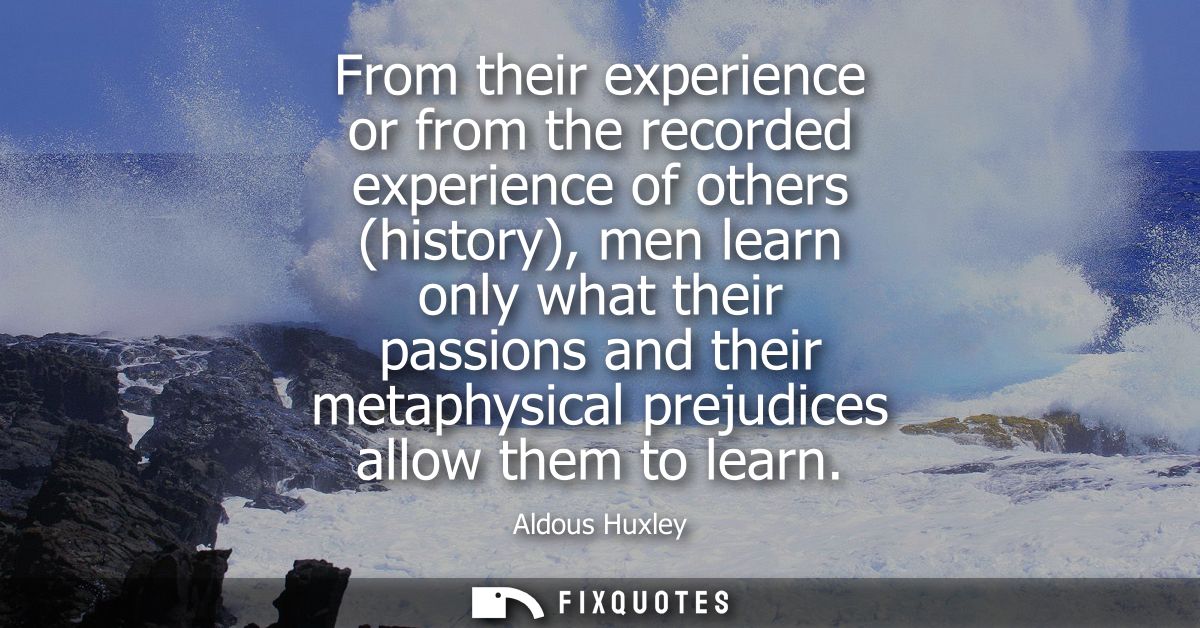
"From their experience or from the recorded experience of others (history), men learn only what their passions and their metaphysical prejudices allow them to learn"
About this Quote
The intent is less to scold ignorance than to diagnose its mechanics. "Passions" aren’t just emotions; they’re investments - status, identity, fear, libido, ambition. They create incentives to misread reality. Pair that with "metaphysical prejudices", a deliberately highbrow jab at the ideas people treat as sacred furniture: assumptions about human nature, providence, progress, the inevitability of markets or empires. Those aren’t opinions so much as operating systems. Once installed, they determine which facts feel "real" and which feel like noise or heresy.
Context matters: Huxley writes in the long shadow of World War I and amid the ideological churn leading to World War II, when "never again" quickly became "again, with better slogans". As a novelist who dissected modernity’s seductions, he understood that narratives don’t merely reflect belief; they manufacture it. History, in this view, isn’t a neutral archive waiting to educate us. It’s raw material we selectively process to protect the self and sanctify the tribe. The cynicism is surgical: humans don’t fail to learn because the lessons are unclear. They fail because the lessons threaten what they already worship.
Quote Details
| Topic | Truth |
|---|---|
| Source | Help us find the source |
| Cite |
Citation Formats
APA Style (7th ed.)
Huxley, Aldous. (2026, January 18). From their experience or from the recorded experience of others (history), men learn only what their passions and their metaphysical prejudices allow them to learn. FixQuotes. https://fixquotes.com/quotes/from-their-experience-or-from-the-recorded-3106/
Chicago Style
Huxley, Aldous. "From their experience or from the recorded experience of others (history), men learn only what their passions and their metaphysical prejudices allow them to learn." FixQuotes. January 18, 2026. https://fixquotes.com/quotes/from-their-experience-or-from-the-recorded-3106/.
MLA Style (9th ed.)
"From their experience or from the recorded experience of others (history), men learn only what their passions and their metaphysical prejudices allow them to learn." FixQuotes, 18 Jan. 2026, https://fixquotes.com/quotes/from-their-experience-or-from-the-recorded-3106/. Accessed 27 Mar. 2026.