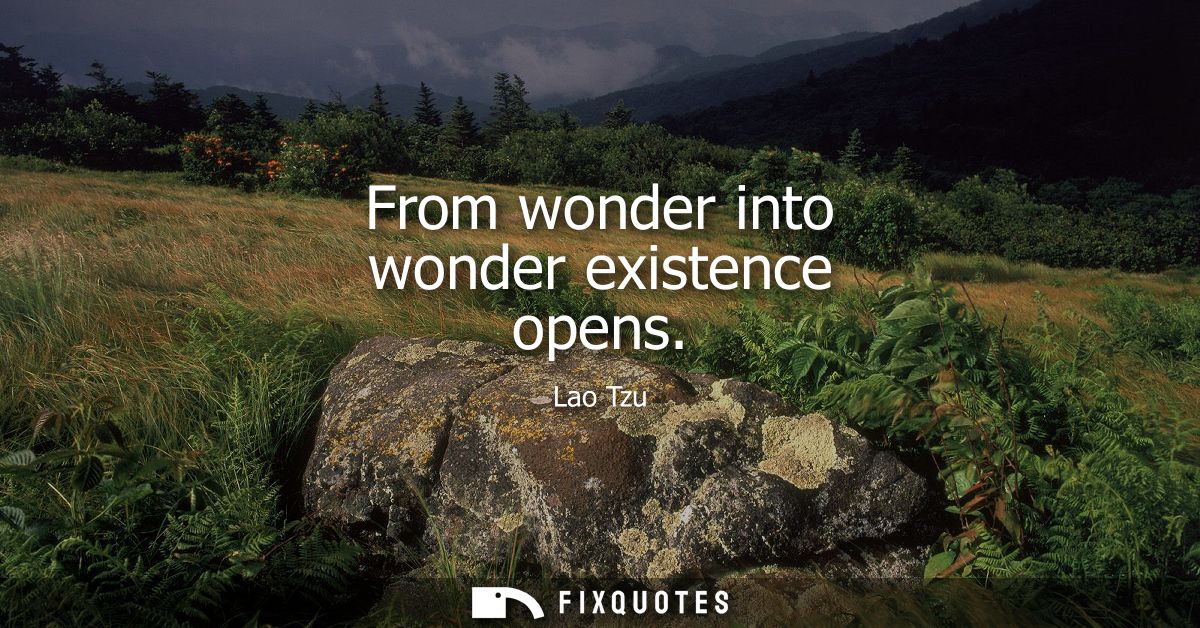
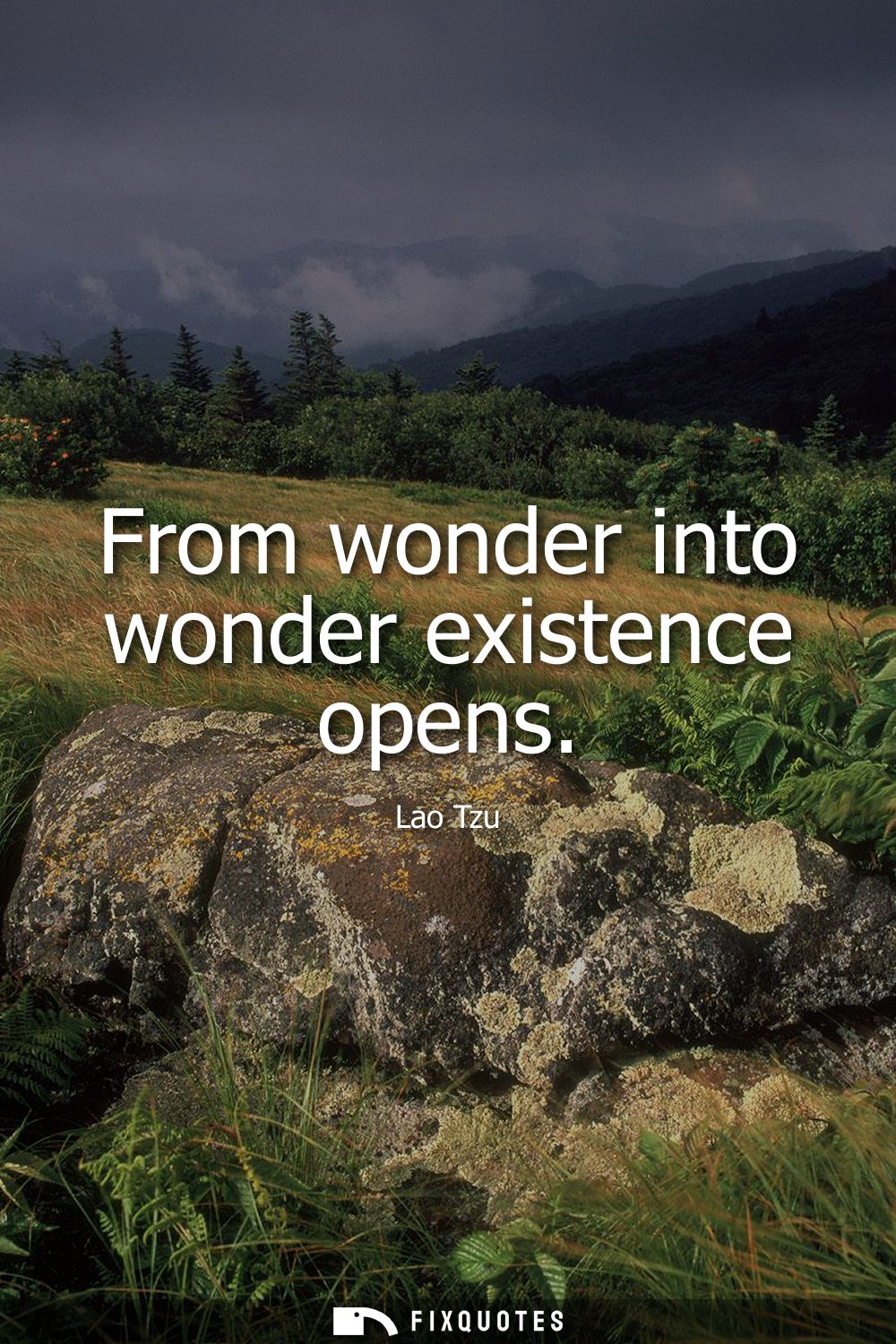
"From wonder into wonder existence opens"
About this Quote
A single line that refuses to behave like advice, Lao Tzu's "From wonder into wonder existence opens" works by slipping past the managerial voice we usually bring to life. It doesn't promise progress, achievement, or even understanding. It promises aperture. Existence "opens" not when we dominate it with explanations, but when we meet it with a particular posture: wonder, then more wonder.
The intent is quietly corrective. Early Taoist thought, written against the grain of status-obsessed courts and rule-bound moralists, treats certainty as a kind of spiritual clenched fist. Wonder is the unclenching. It's not the wide-eyed consumer version of awe; it's a disciplined receptivity, a willingness to be surprised without immediately converting surprise into doctrine. The line suggests that reality isn't a closed system waiting to be solved. It's relational: it yields as you approach it with humility, attentiveness, and a light grip on your own conclusions.
The subtext is also a critique of linear ambition. "From ... into ..". implies motion, but not a ladder. It's a drift, a current. That fits the Tao Te Ching's broader argument that the deepest way of moving through the world is wu wei: action that doesn't bully the moment. Wonder becomes both method and ethic. You don't force the door; you notice it's already ajar.
In context, Lao Tzu is writing for people trained to treat life as a problem of governance - of the self, the household, the state. This line proposes an alternative politics of attention: the world doesn't need more control; it needs a different kind of seeing.
The intent is quietly corrective. Early Taoist thought, written against the grain of status-obsessed courts and rule-bound moralists, treats certainty as a kind of spiritual clenched fist. Wonder is the unclenching. It's not the wide-eyed consumer version of awe; it's a disciplined receptivity, a willingness to be surprised without immediately converting surprise into doctrine. The line suggests that reality isn't a closed system waiting to be solved. It's relational: it yields as you approach it with humility, attentiveness, and a light grip on your own conclusions.
The subtext is also a critique of linear ambition. "From ... into ..". implies motion, but not a ladder. It's a drift, a current. That fits the Tao Te Ching's broader argument that the deepest way of moving through the world is wu wei: action that doesn't bully the moment. Wonder becomes both method and ethic. You don't force the door; you notice it's already ajar.
In context, Lao Tzu is writing for people trained to treat life as a problem of governance - of the self, the household, the state. This line proposes an alternative politics of attention: the world doesn't need more control; it needs a different kind of seeing.
Quote Details
| Topic | Wisdom |
|---|---|
| Source | Help us find the source |
| Cite |
Citation Formats
APA Style (7th ed.)
Tzu, Lao. (2026, January 15). From wonder into wonder existence opens. FixQuotes. https://fixquotes.com/quotes/from-wonder-into-wonder-existence-opens-13822/
Chicago Style
Tzu, Lao. "From wonder into wonder existence opens." FixQuotes. January 15, 2026. https://fixquotes.com/quotes/from-wonder-into-wonder-existence-opens-13822/.
MLA Style (9th ed.)
"From wonder into wonder existence opens." FixQuotes, 15 Jan. 2026, https://fixquotes.com/quotes/from-wonder-into-wonder-existence-opens-13822/. Accessed 12 Feb. 2026.
More Quotes by Lao
Add to List