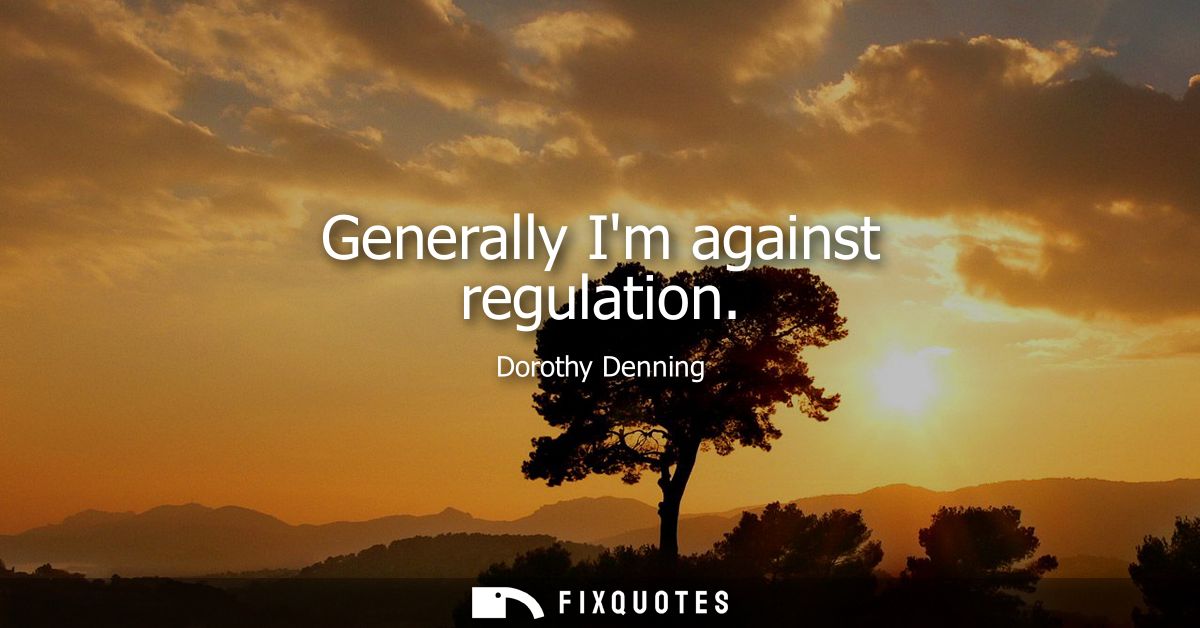
"Generally I'm against regulation"
About this Quote
“Generally I’m against regulation” is a loaded little sentence because it performs two moves at once: it signals ideological preference while leaving a trapdoor open for exceptions. That first word, “Generally,” isn’t a softener so much as a legal brief in miniature. It inoculates the speaker against being caricatured as anti-government or pro-corporate at any cost. In policy rooms, that qualifier matters: it frames regulation as a last resort, but not an unthinkable one.
Dorothy Denning’s career sits at the intersection of computing, security, and the state, where “regulation” is never abstract. It can mean export controls on cryptography, surveillance authorities, data retention mandates, or compliance regimes that reshape what engineers build. Against that backdrop, the line reads less like libertarian swagger and more like a pragmatic warning about unintended consequences. Tech regulation often calcifies quickly, while the underlying systems mutate fast; what looks like “consumer protection” on paper can become a permanent chokepoint for innovation or civil liberties.
The subtext is also about governance style. A public servant saying this is telegraphing trust in norms, expertise, and voluntary standards before coercive rules. It’s a bid to keep policy flexible, to prefer incentives, transparency, and accountability over bureaucratic machinery that, once built, tends to expand.
The quiet sting is that “regulation” is treated as suspect by default, not because it’s always wrong, but because in security and tech, bad rules don’t merely fail; they scale.
Dorothy Denning’s career sits at the intersection of computing, security, and the state, where “regulation” is never abstract. It can mean export controls on cryptography, surveillance authorities, data retention mandates, or compliance regimes that reshape what engineers build. Against that backdrop, the line reads less like libertarian swagger and more like a pragmatic warning about unintended consequences. Tech regulation often calcifies quickly, while the underlying systems mutate fast; what looks like “consumer protection” on paper can become a permanent chokepoint for innovation or civil liberties.
The subtext is also about governance style. A public servant saying this is telegraphing trust in norms, expertise, and voluntary standards before coercive rules. It’s a bid to keep policy flexible, to prefer incentives, transparency, and accountability over bureaucratic machinery that, once built, tends to expand.
The quiet sting is that “regulation” is treated as suspect by default, not because it’s always wrong, but because in security and tech, bad rules don’t merely fail; they scale.
Quote Details
| Topic | Freedom |
|---|---|
| Source | Help us find the source |
| Cite |
Citation Formats
APA Style (7th ed.)
Denning, Dorothy. (2026, January 17). Generally I'm against regulation. FixQuotes. https://fixquotes.com/quotes/generally-im-against-regulation-72925/
Chicago Style
Denning, Dorothy. "Generally I'm against regulation." FixQuotes. January 17, 2026. https://fixquotes.com/quotes/generally-im-against-regulation-72925/.
MLA Style (9th ed.)
"Generally I'm against regulation." FixQuotes, 17 Jan. 2026, https://fixquotes.com/quotes/generally-im-against-regulation-72925/. Accessed 25 Mar. 2026.
More Quotes by Dorothy
Add to List