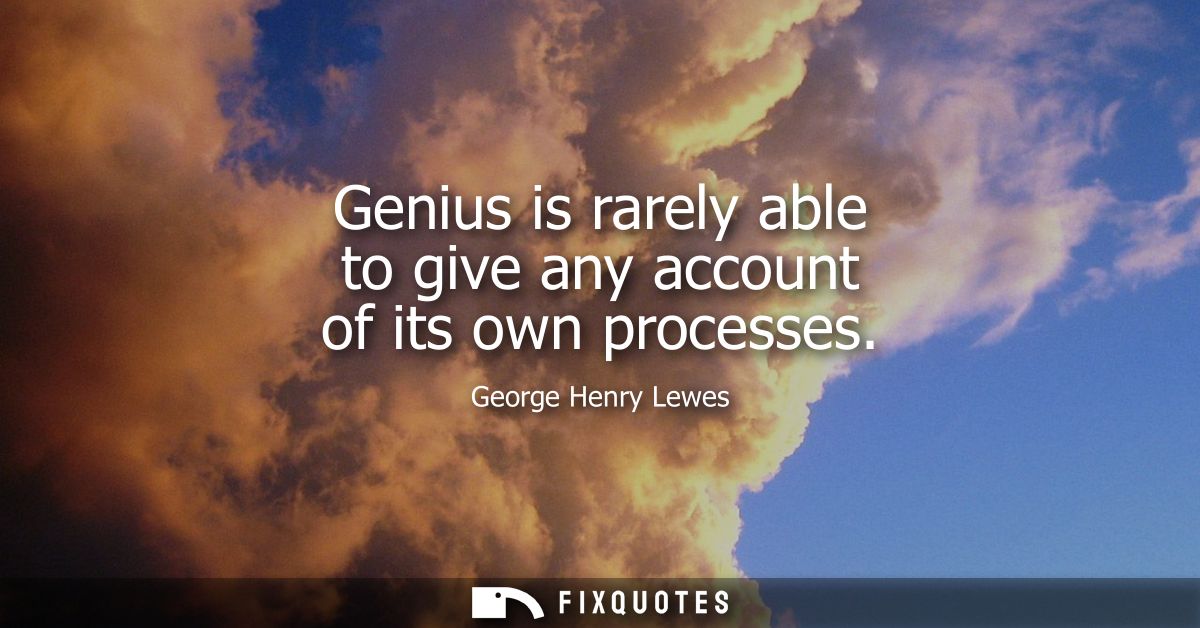
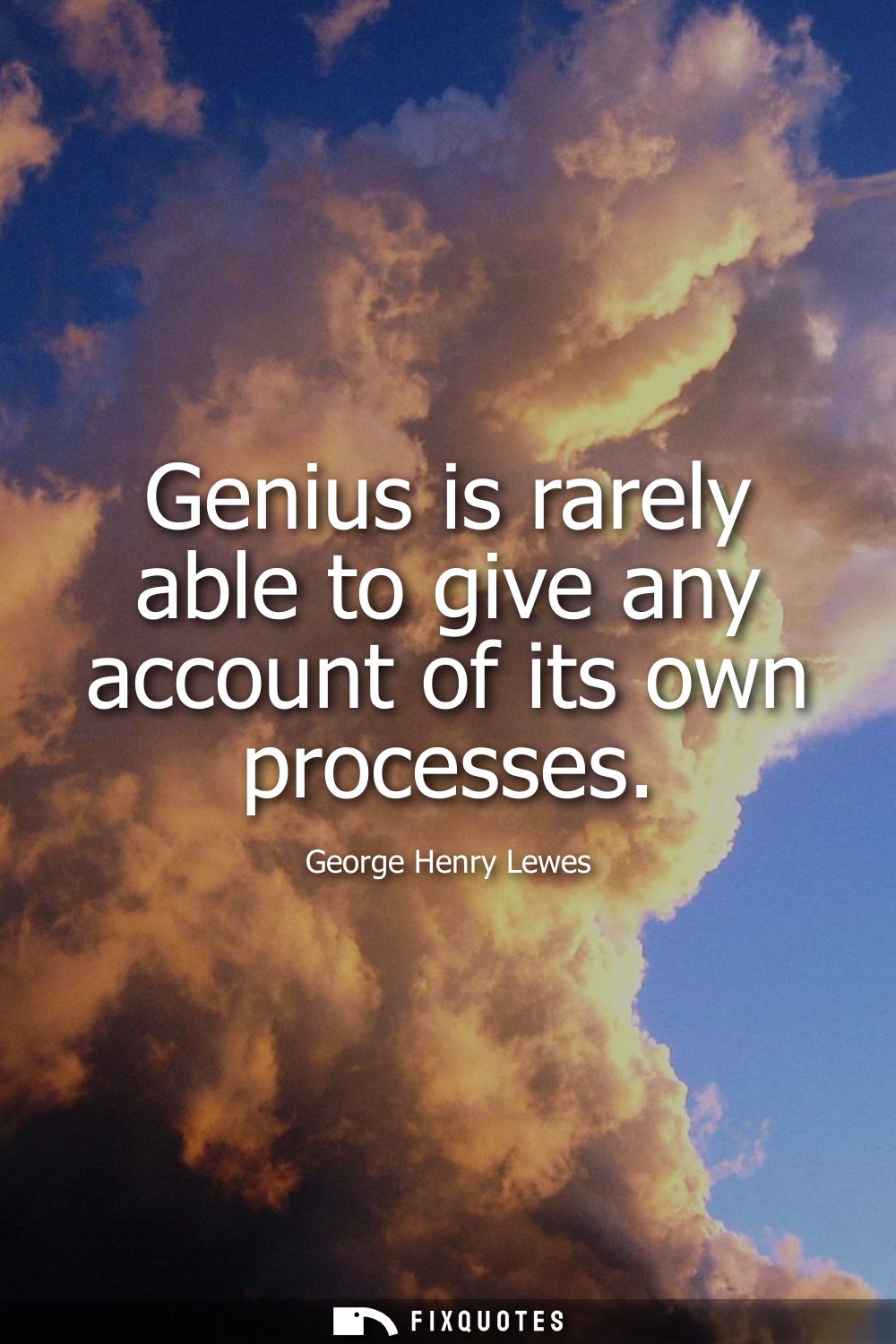
"Genius is rarely able to give any account of its own processes"
About this Quote
Genius, Lewes suggests, isn’t a spotlight trained on itself; it’s a furnace that can’t narrate how it burns. The line pushes back against a comforting Victorian fantasy: that brilliance is simply skill plus self-knowledge, neatly explainable, teachable, and therefore controllable. By insisting that genius is “rarely able” to account for its own processes, Lewes quietly demotes introspection from master key to unreliable afterthought. What feels like a clean chain of reasons after the fact may be a retrospective story we tell to make the miracle seem managerial.
The wording matters. “Account” is a bureaucratic term, the language of audits and rational balance sheets. Dropping it onto “genius” creates productive friction: society wants the exceptional mind to itemize its methods, to prove legitimacy, to be replicable. Lewes implies that the demand itself misunderstands creative cognition. The most valuable leaps often occur below the level of conscious articulation, where pattern recognition, association, and long incubation do their work without asking permission.
Contextually, Lewes sits in the 19th-century shift toward psychology and empiricism, trying to describe mind not as a transparent inner theater but as a layered system with limits. Subtext: don’t confuse a genius’s confidence with their explanatory power; don’t treat the inability to “show the work” as evidence the work is fraudulent. It’s also a warning to would-be engineers of talent: you can study outputs, conditions, and habits, but the spark resists conversion into a step-by-step manual.
The wording matters. “Account” is a bureaucratic term, the language of audits and rational balance sheets. Dropping it onto “genius” creates productive friction: society wants the exceptional mind to itemize its methods, to prove legitimacy, to be replicable. Lewes implies that the demand itself misunderstands creative cognition. The most valuable leaps often occur below the level of conscious articulation, where pattern recognition, association, and long incubation do their work without asking permission.
Contextually, Lewes sits in the 19th-century shift toward psychology and empiricism, trying to describe mind not as a transparent inner theater but as a layered system with limits. Subtext: don’t confuse a genius’s confidence with their explanatory power; don’t treat the inability to “show the work” as evidence the work is fraudulent. It’s also a warning to would-be engineers of talent: you can study outputs, conditions, and habits, but the spark resists conversion into a step-by-step manual.
Quote Details
| Topic | Wisdom |
|---|---|
| Source | Help us find the source |
| Cite |
Citation Formats
APA Style (7th ed.)
Lewes, George Henry. (2026, January 18). Genius is rarely able to give any account of its own processes. FixQuotes. https://fixquotes.com/quotes/genius-is-rarely-able-to-give-any-account-of-its-22872/
Chicago Style
Lewes, George Henry. "Genius is rarely able to give any account of its own processes." FixQuotes. January 18, 2026. https://fixquotes.com/quotes/genius-is-rarely-able-to-give-any-account-of-its-22872/.
MLA Style (9th ed.)
"Genius is rarely able to give any account of its own processes." FixQuotes, 18 Jan. 2026, https://fixquotes.com/quotes/genius-is-rarely-able-to-give-any-account-of-its-22872/. Accessed 24 Mar. 2026.
More Quotes by George
Add to List