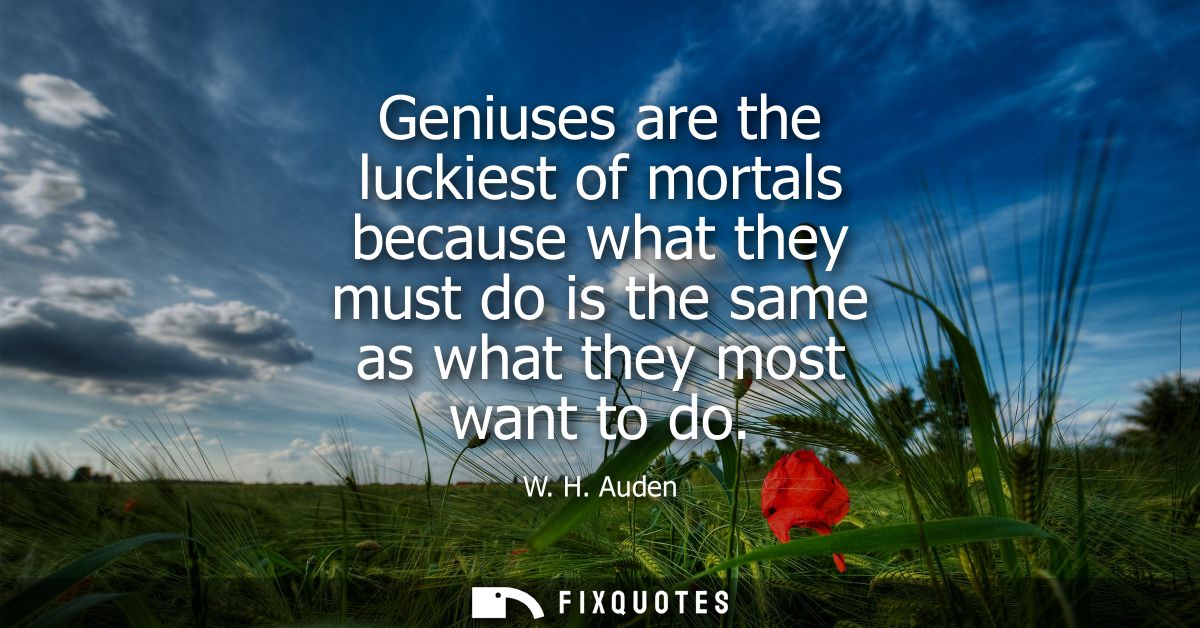
"Geniuses are the luckiest of mortals because what they must do is the same as what they most want to do"
About this Quote
The subtext is pointedly anti-romantic. Auden had little patience for the holy-artiste myth that great work is purchased only through torment. Here, the engine of achievement is not tragedy but compulsion that happens to be useful. “Must” carries the pressure of necessity: the genius is driven, even cornered, by an inner demand. Yet Auden twists that pressure into a privilege because it matches what they “most want” - not what they should want, not what earns applause, but what their desire already insists on.
Contextually, it reads like a poet taking stock in a century that professionalized creativity and turned “vocation” into a job title. Auden knew both the glamour and the grind of being a public writer. The line suggests a bleak arithmetic: most people ration themselves between work that pays and work that matters. Genius, for once, gets to spend the same hour twice.
Quote Details
| Topic | Motivational |
|---|---|
| Source | Help us find the source |
| Cite |
Citation Formats
APA Style (7th ed.)
Auden, W. H. (2026, January 17). Geniuses are the luckiest of mortals because what they must do is the same as what they most want to do. FixQuotes. https://fixquotes.com/quotes/geniuses-are-the-luckiest-of-mortals-because-what-73366/
Chicago Style
Auden, W. H. "Geniuses are the luckiest of mortals because what they must do is the same as what they most want to do." FixQuotes. January 17, 2026. https://fixquotes.com/quotes/geniuses-are-the-luckiest-of-mortals-because-what-73366/.
MLA Style (9th ed.)
"Geniuses are the luckiest of mortals because what they must do is the same as what they most want to do." FixQuotes, 17 Jan. 2026, https://fixquotes.com/quotes/geniuses-are-the-luckiest-of-mortals-because-what-73366/. Accessed 30 Mar. 2026.