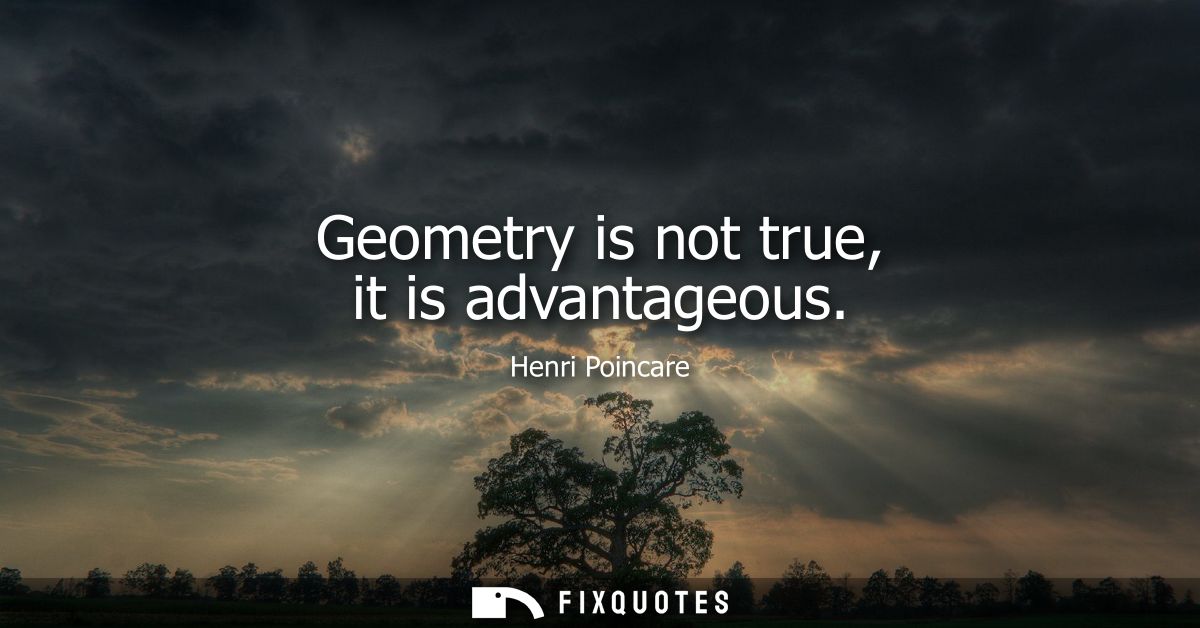
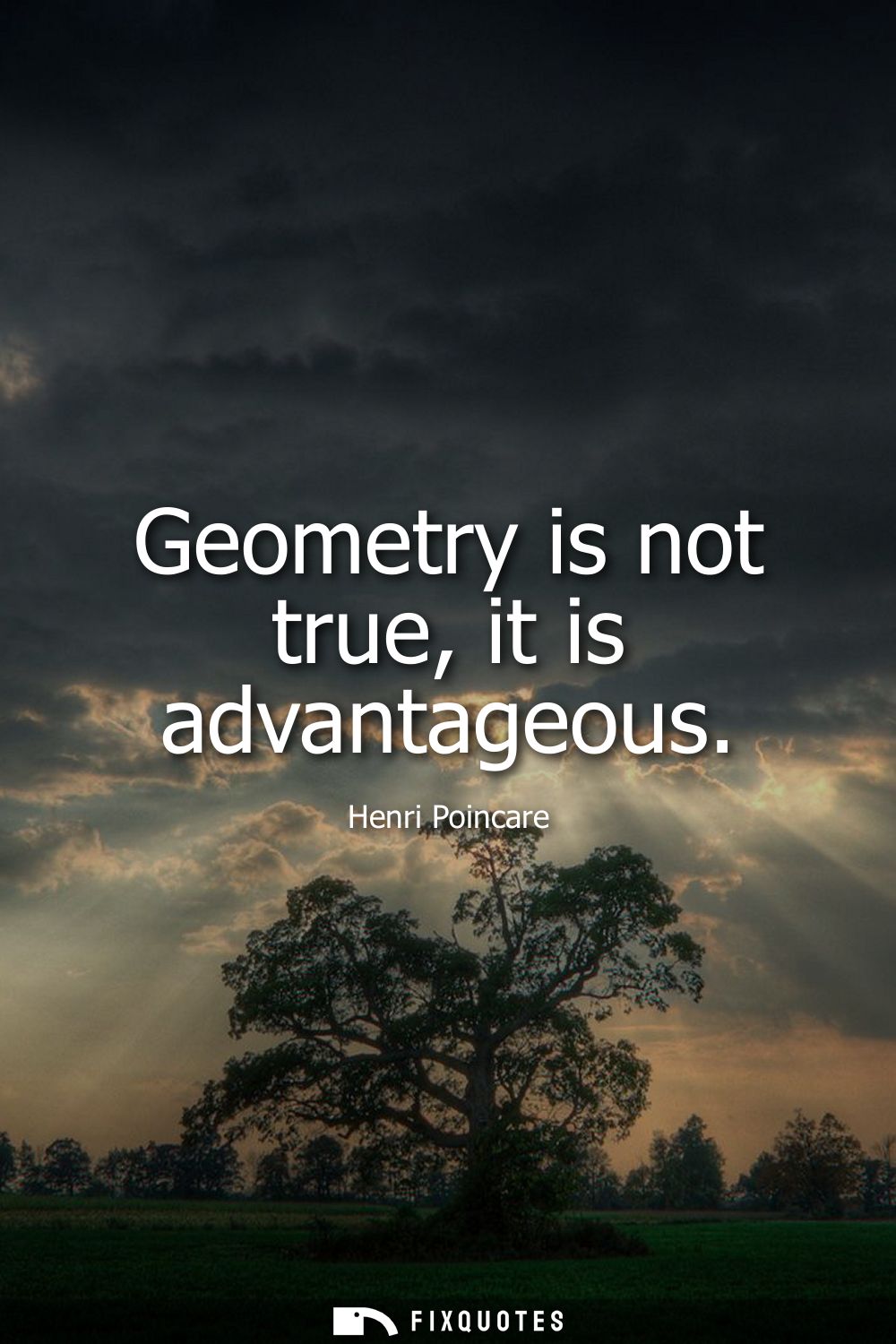
"Geometry is not true, it is advantageous"
About this Quote
Poincare’s line is a polite grenade tossed into the temple of mathematical certainty. “Geometry is not true, it is advantageous” doesn’t deny that triangles have angles or that circles have radii; it denies the metaphysical swagger we attach to those facts. In his era, Euclidean geometry was still treated like the universe’s native tongue. Then non-Euclidean geometries arrived and, with them, an awkward realization: multiple, internally consistent geometries can describe space. If several systems “work,” calling any one of them “true” starts to look like a category error.
The intent is surgical: relocate geometry from the realm of revelation to the realm of selection. Poincare is making a conventionalist move: axioms aren’t discovered like fossils; they’re adopted like standards. We choose a geometry the way engineers choose coordinate systems or programmers choose a data structure - not because it is ordained, but because it makes certain problems easier, calculations cleaner, predictions tighter.
The subtext is a critique of intellectual vanity. Humans love to mistake a successful model for reality itself, especially when the model feels crisp and inevitable. Poincare reminds us that elegance can be a cognitive trap: we confuse convenience with ontology. “Advantageous” is doing heavy lifting here; it’s a word that smells of workshops, not heavens. Geometry becomes a toolset, judged by friction, fit, and payoff.
Historically, the quote sits right on the fault line that would soon become modern physics. When Einstein later treats geometry as responsive to matter and energy, Poincare’s point lands with extra bite: the “shape” of space isn’t an eternal truth so much as a framework whose usefulness depends on what the world is doing.
The intent is surgical: relocate geometry from the realm of revelation to the realm of selection. Poincare is making a conventionalist move: axioms aren’t discovered like fossils; they’re adopted like standards. We choose a geometry the way engineers choose coordinate systems or programmers choose a data structure - not because it is ordained, but because it makes certain problems easier, calculations cleaner, predictions tighter.
The subtext is a critique of intellectual vanity. Humans love to mistake a successful model for reality itself, especially when the model feels crisp and inevitable. Poincare reminds us that elegance can be a cognitive trap: we confuse convenience with ontology. “Advantageous” is doing heavy lifting here; it’s a word that smells of workshops, not heavens. Geometry becomes a toolset, judged by friction, fit, and payoff.
Historically, the quote sits right on the fault line that would soon become modern physics. When Einstein later treats geometry as responsive to matter and energy, Poincare’s point lands with extra bite: the “shape” of space isn’t an eternal truth so much as a framework whose usefulness depends on what the world is doing.
Quote Details
| Topic | Truth |
|---|---|
| Source | Help us find the source |
| Cite |
Citation Formats
APA Style (7th ed.)
Poincare, Henri. (2026, January 18). Geometry is not true, it is advantageous. FixQuotes. https://fixquotes.com/quotes/geometry-is-not-true-it-is-advantageous-9883/
Chicago Style
Poincare, Henri. "Geometry is not true, it is advantageous." FixQuotes. January 18, 2026. https://fixquotes.com/quotes/geometry-is-not-true-it-is-advantageous-9883/.
MLA Style (9th ed.)
"Geometry is not true, it is advantageous." FixQuotes, 18 Jan. 2026, https://fixquotes.com/quotes/geometry-is-not-true-it-is-advantageous-9883/. Accessed 12 Feb. 2026.
More Quotes by Henri
Add to List