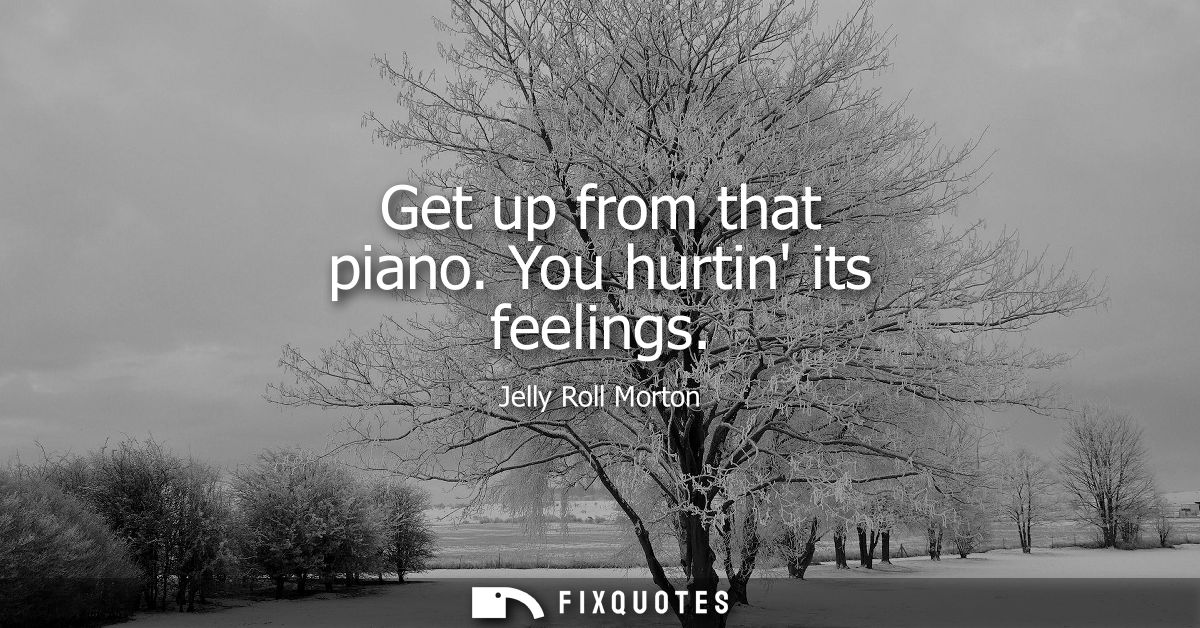
"Get up from that piano. You hurtin' its feelings"
About this Quote
It lands like a punchline, but it’s really a doctrine of craft. When Jelly Roll Morton snaps, "Get up from that piano. You hurtin' its feelings", he’s doing three things at once: asserting authority, policing standards, and turning technique into something visceral enough to shame you into improvement. The joke is the bait. The bite is that, in his world, bad playing isn’t just sloppy; it’s disrespectful.
Personifying the piano makes the criticism feel both playful and absolute. He doesn’t say you’re hurting the audience, or the song, or yourself - all debatable. He says you’re hurting the instrument, an object that can’t argue back. That rhetorical move corners the musician: if you keep playing, you’re not merely unskilled, you’re cruel. It’s comedic, but it’s also a way to enforce a code without sounding like a lecturer.
Context matters. Morton comes out of early New Orleans jazz, where music is competitive, communal, and relentlessly performative. You learned on bandstands, in cutting contests, in rooms where your reputation could be made or wrecked in a chorus. Humor was part of the pedagogy; insult was a teaching tool that traveled fast and stuck. The line also hints at a deeper musical ethic: the piano isn’t a neutral machine, it’s a partner with a personality, a voice you’re obligated to treat right. In that sense, Morton’s quip is a compact manifesto about swing-era seriousness hiding inside a laugh.
Personifying the piano makes the criticism feel both playful and absolute. He doesn’t say you’re hurting the audience, or the song, or yourself - all debatable. He says you’re hurting the instrument, an object that can’t argue back. That rhetorical move corners the musician: if you keep playing, you’re not merely unskilled, you’re cruel. It’s comedic, but it’s also a way to enforce a code without sounding like a lecturer.
Context matters. Morton comes out of early New Orleans jazz, where music is competitive, communal, and relentlessly performative. You learned on bandstands, in cutting contests, in rooms where your reputation could be made or wrecked in a chorus. Humor was part of the pedagogy; insult was a teaching tool that traveled fast and stuck. The line also hints at a deeper musical ethic: the piano isn’t a neutral machine, it’s a partner with a personality, a voice you’re obligated to treat right. In that sense, Morton’s quip is a compact manifesto about swing-era seriousness hiding inside a laugh.
Quote Details
| Topic | Witty One-Liners |
|---|---|
| Source | Help us find the source |
| Cite | Cite this Quote |
Citation Formats
APA Style (7th ed.)
Morton, Jelly Roll. (n.d.). Get up from that piano. You hurtin' its feelings. FixQuotes. https://fixquotes.com/quotes/get-up-from-that-piano-you-hurtin-its-feelings-119510/
Chicago Style
Morton, Jelly Roll. "Get up from that piano. You hurtin' its feelings." FixQuotes. Accessed February 2, 2026. https://fixquotes.com/quotes/get-up-from-that-piano-you-hurtin-its-feelings-119510/.
MLA Style (9th ed.)
"Get up from that piano. You hurtin' its feelings." FixQuotes, https://fixquotes.com/quotes/get-up-from-that-piano-you-hurtin-its-feelings-119510/. Accessed 2 Feb. 2026.
More Quotes by Jelly
Add to List