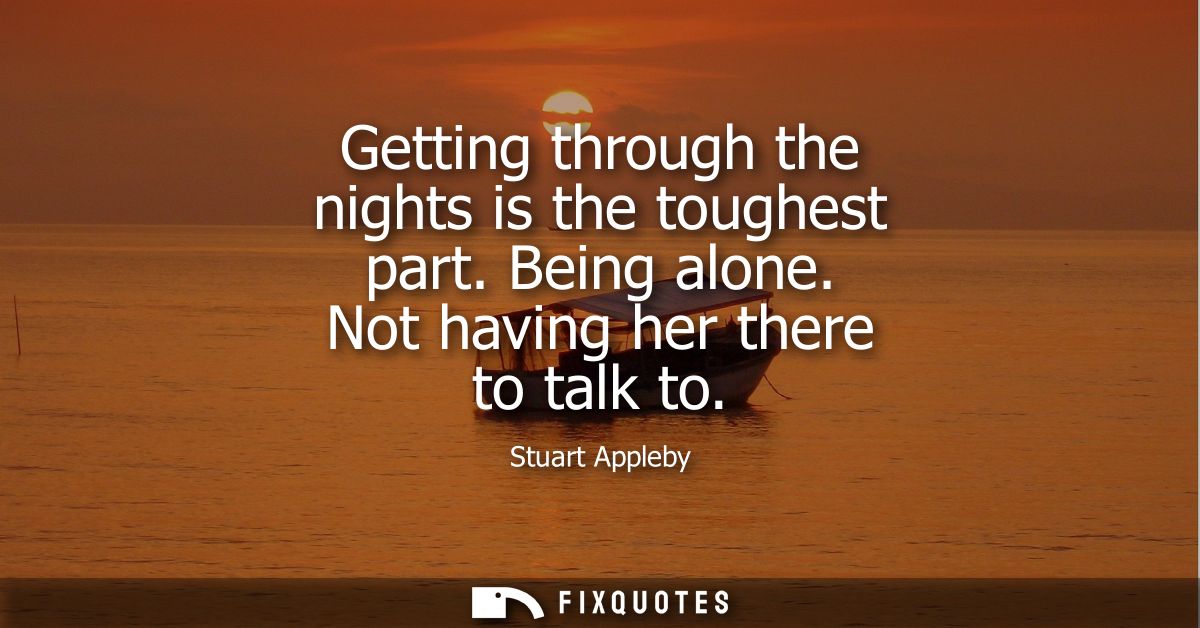
"Getting through the nights is the toughest part. Being alone. Not having her there to talk to"
About this Quote
The blunt fragments - “Being alone. Not having her there to talk to” - read like someone trying to keep composure and failing in real time. There’s a practical intimacy in “to talk to,” not “to love” or “to hold.” That choice is the tell. It points to companionship as infrastructure: the person who absorbs the mundane recap of the day, the small fears, the unpolished thoughts. Without that, even a life structured around travel, routines, and competition collapses into dead air.
The subtext is also about masculinity in a sports culture that rewards stoicism. Appleby frames vulnerability as a matter of endurance, a challenge to “get through,” borrowing the language of athletic suffering to describe emotional loss. It’s a quiet translation device: he can admit pain without making it sound like confession. In that sense, the quote works as a cultural counter-image to the invincible pro. The hardest part isn’t losing a tournament; it’s losing the witness to your life when the lights go out.
Quote Details
| Topic | Loneliness |
|---|---|
| Source | Help us find the source |
| Cite |
Citation Formats
APA Style (7th ed.)
Appleby, Stuart. (2026, January 17). Getting through the nights is the toughest part. Being alone. Not having her there to talk to. FixQuotes. https://fixquotes.com/quotes/getting-through-the-nights-is-the-toughest-part-58667/
Chicago Style
Appleby, Stuart. "Getting through the nights is the toughest part. Being alone. Not having her there to talk to." FixQuotes. January 17, 2026. https://fixquotes.com/quotes/getting-through-the-nights-is-the-toughest-part-58667/.
MLA Style (9th ed.)
"Getting through the nights is the toughest part. Being alone. Not having her there to talk to." FixQuotes, 17 Jan. 2026, https://fixquotes.com/quotes/getting-through-the-nights-is-the-toughest-part-58667/. Accessed 13 Mar. 2026.