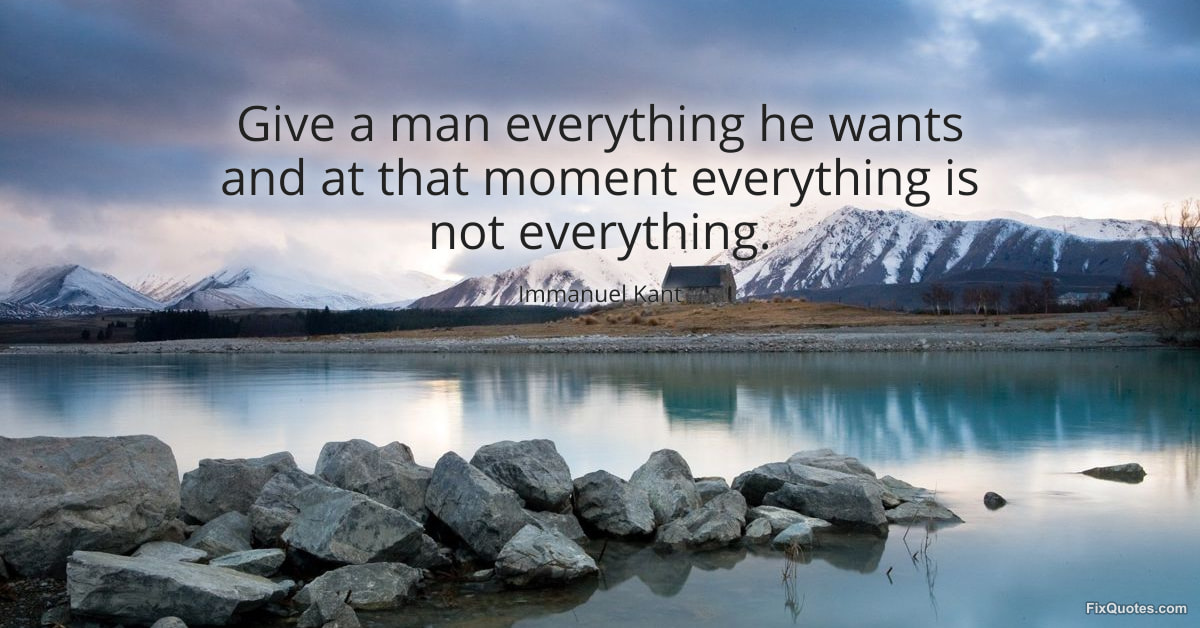
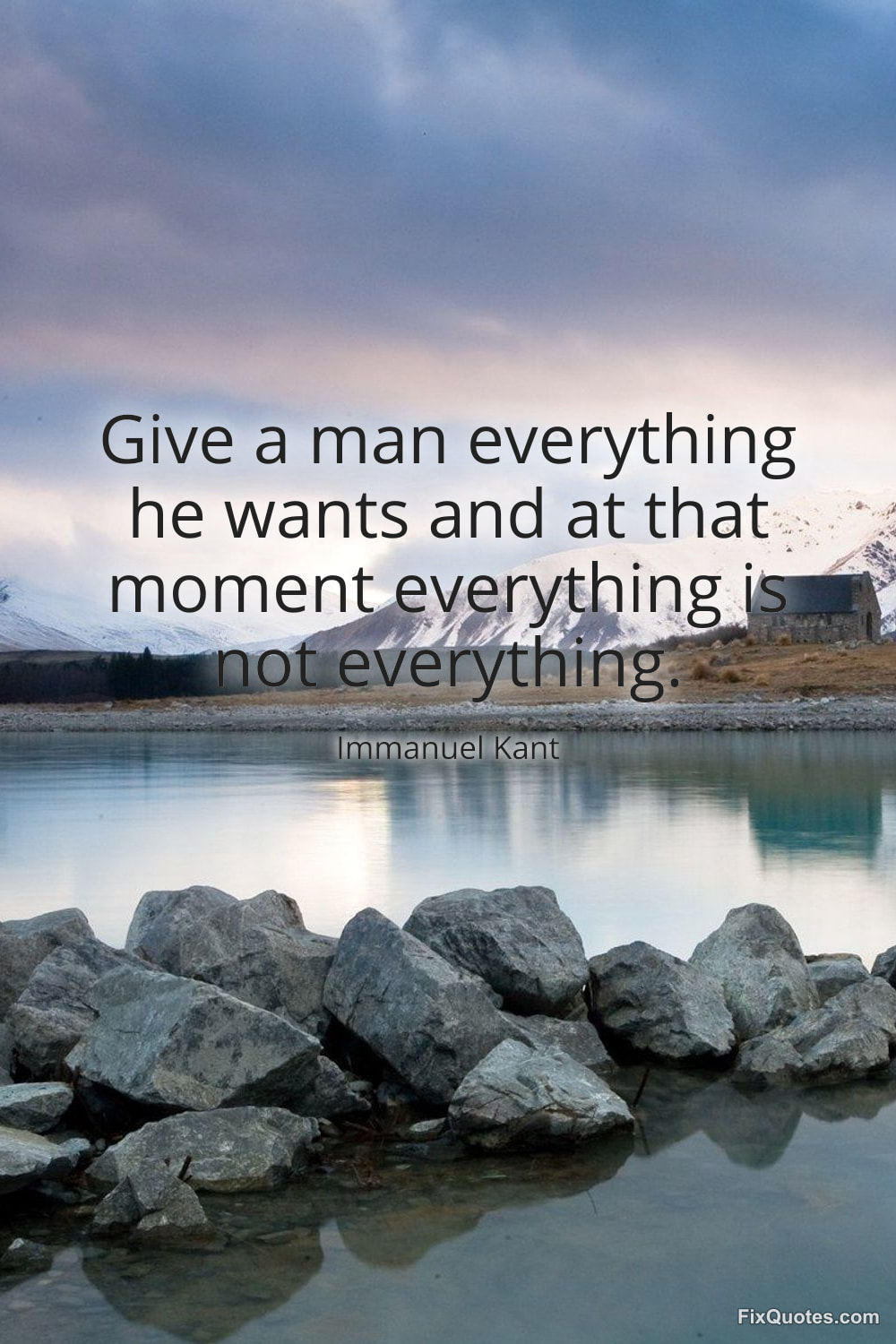
"Give a man everything he wants and at that moment everything is not everything"
About this Quote
The subtext is distinctly Enlightenment-era. Kant is writing against the idea that happiness is a stable pile of pleasures you can accumulate and call complete. For him, human beings aren’t just appetite machines; we’re rational agents who can step back and ask what should count as fulfillment. If you treat “everything I want” as the measure of a life, you submit to impulses that mutate faster than any inventory can keep up. The instant “everything” is delivered, desire quietly revises the order.
Context matters: Kant’s ethics doesn’t hinge on maximizing happiness, but on autonomy and duty - acting from principles you can will as universal. Read that way, the quote has a sharper edge. It suggests that the pursuit of total satisfaction is not merely futile but self-defeating: it hands your freedom to a moving target inside you. “Everything is not everything” is Kant’s reminder that completeness isn’t a quantity. It’s a stance - one achieved less by acquisition than by governing what counts as worth wanting.
Quote Details
| Topic | Deep |
|---|---|
| Source | Help us find the source |
| Cite |
Citation Formats
APA Style (7th ed.)
Kant, Immanuel. (2026, February 10). Give a man everything he wants and at that moment everything is not everything. FixQuotes. https://fixquotes.com/quotes/give-a-man-everything-he-wants-and-at-that-moment-185060/
Chicago Style
Kant, Immanuel. "Give a man everything he wants and at that moment everything is not everything." FixQuotes. February 10, 2026. https://fixquotes.com/quotes/give-a-man-everything-he-wants-and-at-that-moment-185060/.
MLA Style (9th ed.)
"Give a man everything he wants and at that moment everything is not everything." FixQuotes, 10 Feb. 2026, https://fixquotes.com/quotes/give-a-man-everything-he-wants-and-at-that-moment-185060/. Accessed 12 Feb. 2026.