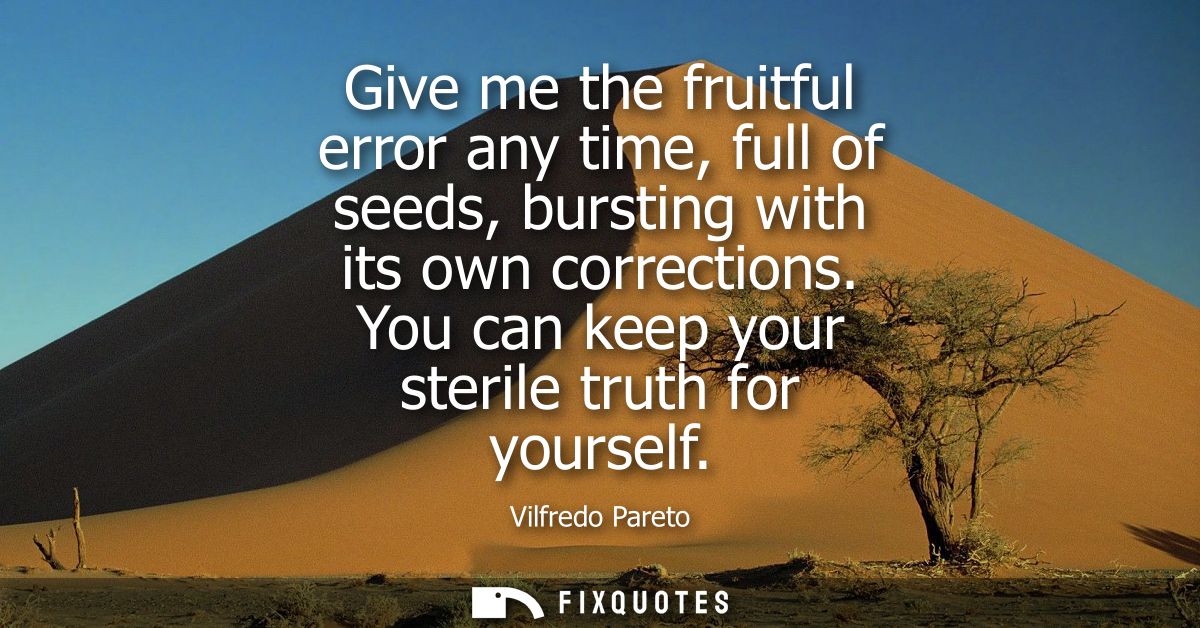
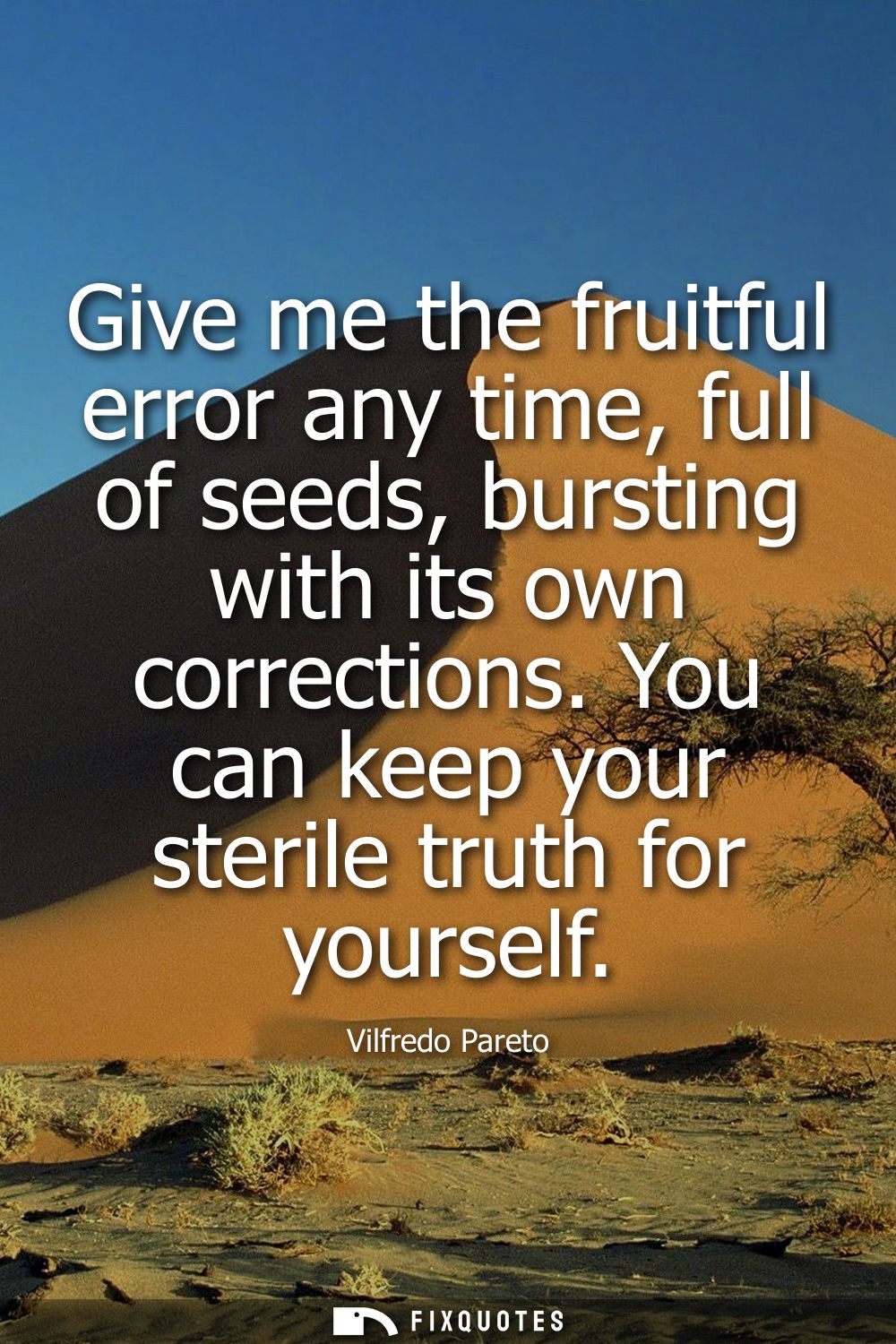
"Give me the fruitful error any time, full of seeds, bursting with its own corrections. You can keep your sterile truth for yourself"
About this Quote
Pareto’s line is a slap at the kind of “truth” economists love to parade when it’s been scrubbed of uncertainty, politics, and human messiness. A “sterile truth” is tidy, internally consistent, and socially useless: a model so clean it can’t get traction in the real world. By contrast, the “fruitful error” is a provocation. It’s wrong in a way that generates new questions, exposes hidden assumptions, and forces revision. Pareto isn’t celebrating ignorance; he’s praising a certain kind of intellectual risk-taking where the mistake is productive because it contains feedback loops, “bursting with its own corrections.”
The subtext is methodological and, quietly, psychological. Pareto spent his career watching elites justify themselves with rational-sounding principles while actual behavior followed incentives, status anxiety, and power. If people are going to dress interest up as truth anyway, better to have a framework that admits it’s provisional and can evolve under pressure. The “seeds” metaphor matters: knowledge grows in iterations, not proclamations. He’s aiming at dogmatists who treat a result as a trophy rather than a tool.
Contextually, this sits neatly in the early-20th-century fight over what counts as scientific in social science: elegant deductive systems versus messy empiricism, equilibrium fantasies versus stubborn facts. Pareto’s rhetorical move is to invert the prestige hierarchy. He makes error the engine of discovery and “truth” the luxury good of thinkers who prefer being right to being useful.
The subtext is methodological and, quietly, psychological. Pareto spent his career watching elites justify themselves with rational-sounding principles while actual behavior followed incentives, status anxiety, and power. If people are going to dress interest up as truth anyway, better to have a framework that admits it’s provisional and can evolve under pressure. The “seeds” metaphor matters: knowledge grows in iterations, not proclamations. He’s aiming at dogmatists who treat a result as a trophy rather than a tool.
Contextually, this sits neatly in the early-20th-century fight over what counts as scientific in social science: elegant deductive systems versus messy empiricism, equilibrium fantasies versus stubborn facts. Pareto’s rhetorical move is to invert the prestige hierarchy. He makes error the engine of discovery and “truth” the luxury good of thinkers who prefer being right to being useful.
Quote Details
| Topic | Learning from Mistakes |
|---|---|
| Source | Help us find the source |
More Quotes by Vilfredo
Add to List