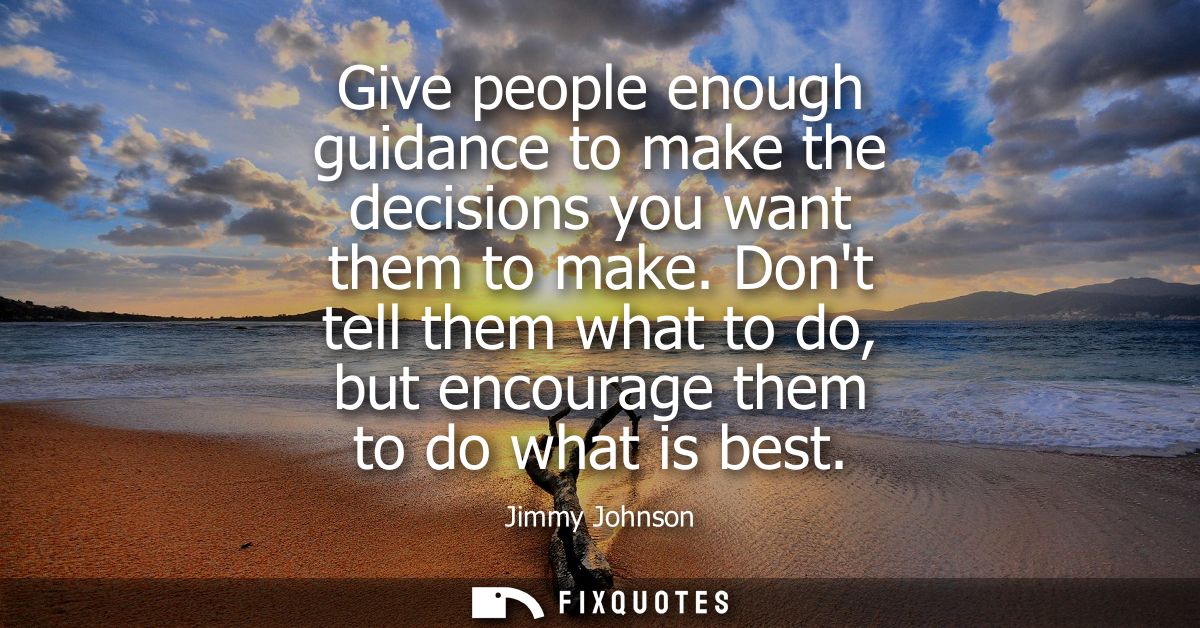
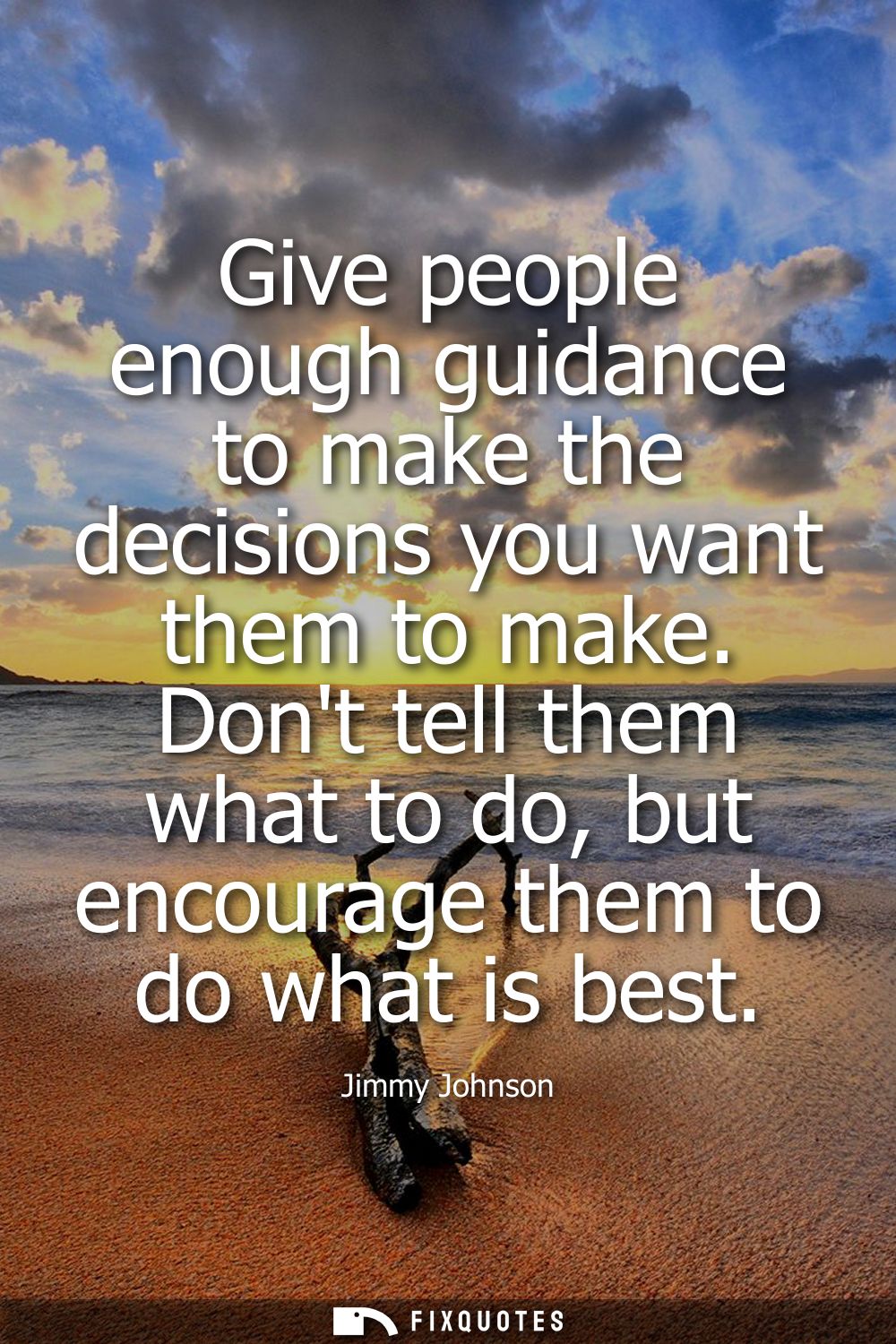
"Give people enough guidance to make the decisions you want them to make. Don't tell them what to do, but encourage them to do what is best"
About this Quote
Jimmy Johnson’s line is coaching stripped down to its most politically savvy core: you don’t command outcomes, you design the conditions that make the “right” outcome feel like the athlete’s own idea. It’s persuasion in a whistle and visor, and it explains a lot about why Johnson’s reputation isn’t just about schemes but about managing grown men with egos, bodies, and careers on the line.
The first sentence is the tell. “Enough guidance” implies a calibrated dose, not a lecture. The coach becomes an architect of choices: simplify the read, define the role, set the incentives, repeat the standard. In football terms, that’s the playbook, the practice script, and the film-room narrative all pointing in one direction so the player reaches the desired decision at full speed. The intent is control without the backlash of control. When a coach “tells,” he owns the failure; when a player “chooses,” he owns the responsibility.
The second sentence softens the power move with moral language: “encourage them to do what is best.” Best for whom? Team, player, coach, organization - Johnson leaves it conveniently elastic. That ambiguity is the subtextual genius. It frames compliance as maturity, not submission, and turns coaching into a kind of guided autonomy.
Context matters: Johnson’s era of pro and big-time college football required leadership that could travel across locker rooms, not just whiteboards. Authority still matters, but buy-in wins. This is buy-in, engineered.
The first sentence is the tell. “Enough guidance” implies a calibrated dose, not a lecture. The coach becomes an architect of choices: simplify the read, define the role, set the incentives, repeat the standard. In football terms, that’s the playbook, the practice script, and the film-room narrative all pointing in one direction so the player reaches the desired decision at full speed. The intent is control without the backlash of control. When a coach “tells,” he owns the failure; when a player “chooses,” he owns the responsibility.
The second sentence softens the power move with moral language: “encourage them to do what is best.” Best for whom? Team, player, coach, organization - Johnson leaves it conveniently elastic. That ambiguity is the subtextual genius. It frames compliance as maturity, not submission, and turns coaching into a kind of guided autonomy.
Context matters: Johnson’s era of pro and big-time college football required leadership that could travel across locker rooms, not just whiteboards. Authority still matters, but buy-in wins. This is buy-in, engineered.
Quote Details
| Topic | Servant Leadership |
|---|
More Quotes by Jimmy
Add to List