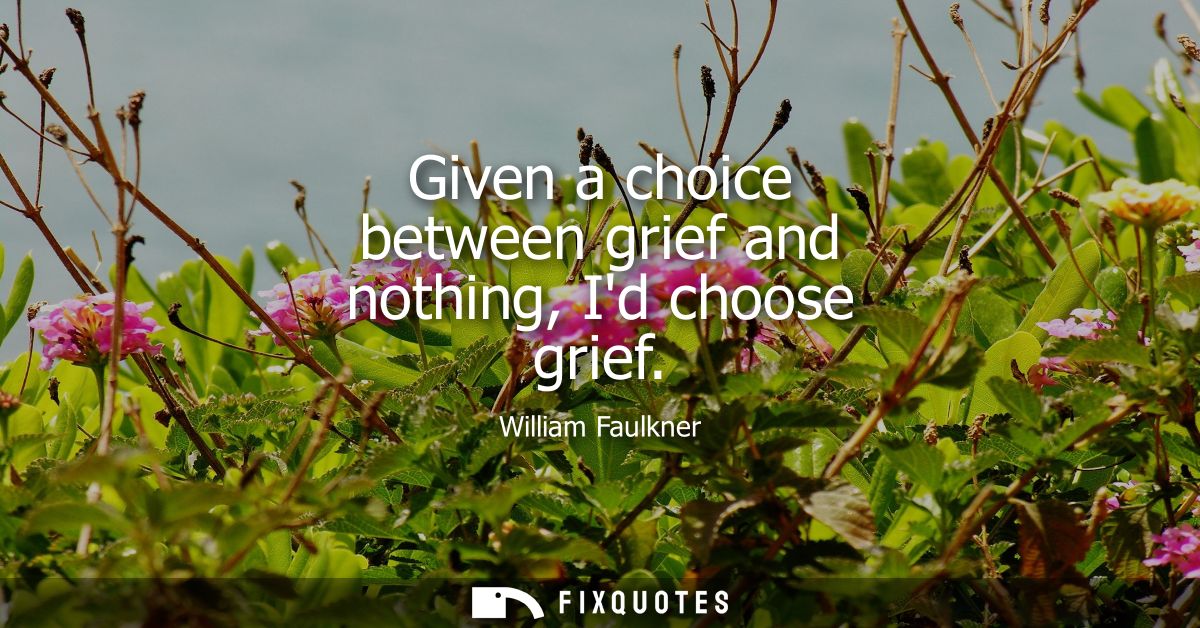
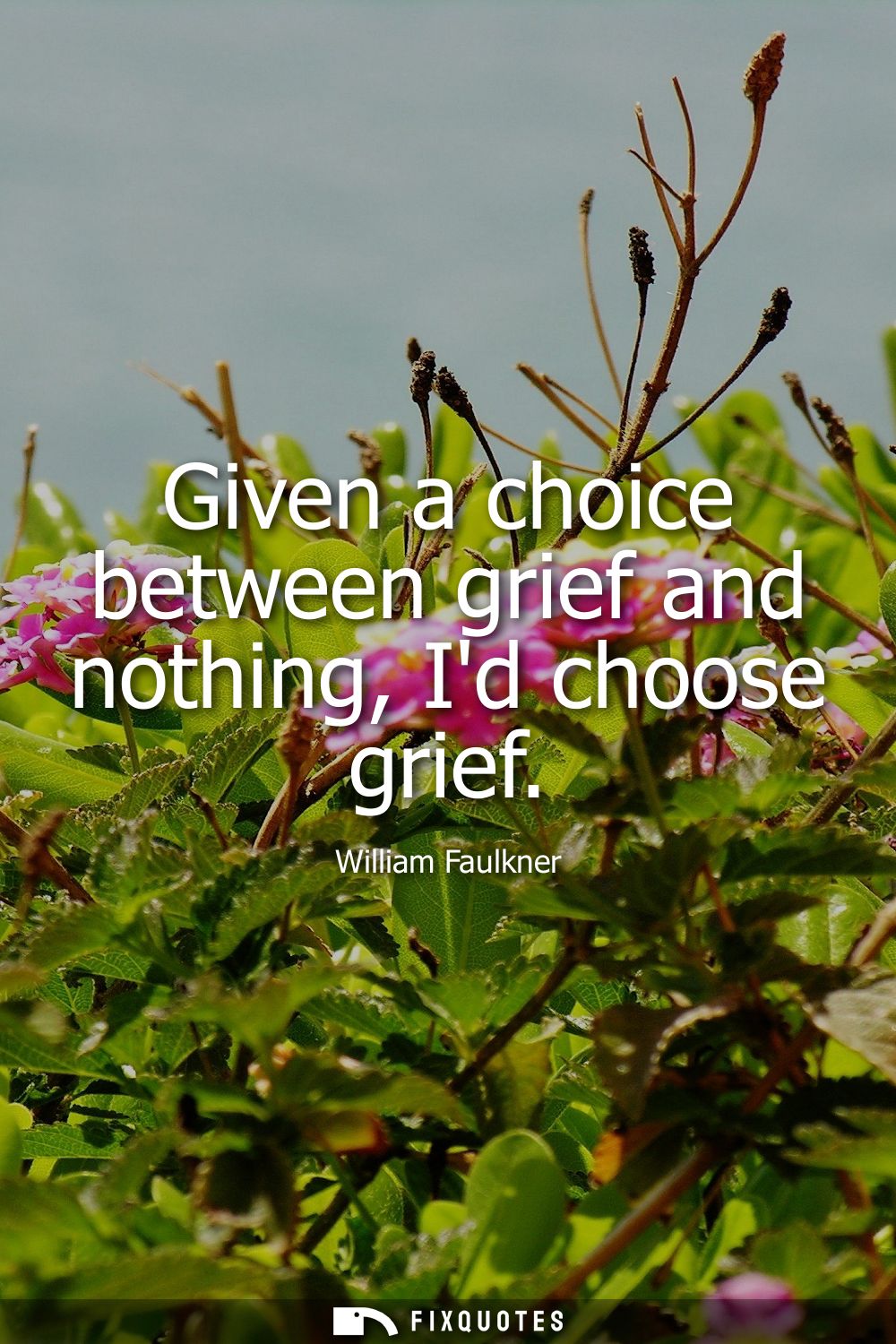
"Given a choice between grief and nothing, I'd choose grief"
About this Quote
Faulkner’s line is a refusal of emotional anesthesia, and it lands with the blunt authority of someone who knows how easily “nothing” can masquerade as peace. Grief, in this framing, isn’t just pain; it’s proof. Proof that something mattered enough to leave a wound, proof that you were present for a life and not merely adjacent to it. The sentence turns on its stark binary: grief versus nothing. Faulkner doesn’t offer the softer alternatives we like to imagine (acceptance, closure, moving on). He forces the reader to admit what we often dodge: the real opposite of grief isn’t happiness, it’s numbness.
The intent is almost combative. Faulkner is pushing back against a cultural instinct to treat grief as a malfunction to be repaired, a phase to “get through.” By choosing grief, he chooses attachment and memory, even when they hurt. The subtext is moral as much as emotional: to opt for nothing is to opt out of love’s consequences, to live without stakes. Grief becomes a kind of fidelity.
Context matters because Faulkner’s fiction is crowded with the dead and haunted by what refuses to stay buried: family legacies, historical violence, the South’s unresolved aftermath. His characters don’t simply mourn; they are inhabited by loss. So the quote reads less like inspirational comfort than like a grim credo from a writer who understood that erasure is the greater tragedy. Pain, at least, keeps the record. Nothing deletes it.
The intent is almost combative. Faulkner is pushing back against a cultural instinct to treat grief as a malfunction to be repaired, a phase to “get through.” By choosing grief, he chooses attachment and memory, even when they hurt. The subtext is moral as much as emotional: to opt for nothing is to opt out of love’s consequences, to live without stakes. Grief becomes a kind of fidelity.
Context matters because Faulkner’s fiction is crowded with the dead and haunted by what refuses to stay buried: family legacies, historical violence, the South’s unresolved aftermath. His characters don’t simply mourn; they are inhabited by loss. So the quote reads less like inspirational comfort than like a grim credo from a writer who understood that erasure is the greater tragedy. Pain, at least, keeps the record. Nothing deletes it.
Quote Details
| Topic | Sadness |
|---|---|
| Source | Verified source: The Wild Palms [If I Forget Thee, Jerusalem] (William Faulkner, 1939)
Evidence: Between grief and nothing I will take grief. (Chapter 9 ("Wild Palms") , exact page varies by edition (e.g., p. 324 in Vintage Books 1966 ed.)). The wording most commonly circulating online (“Given a choice between grief and nothing, I'd choose grief”) is a paraphrase/variant. The primary-source line appears as the closing thought of Harry Wilbourne in Faulkner’s 1939 novel published as The Wild Palms (later commonly re-titled/printed as If I Forget Thee, Jerusalem). Page number depends on the edition; one widely-cited pagination is p. 324 in the Vintage Books (1966) edition (as reflected in secondary references that quote the line in-context). Other candidates (1) GRIEVING ONE DAY AT A TIME (Dr. George Akinkuoye, 2023) compilation95.0% ... Given a choice between grief and nothing , I'd choose grief . " – William Faulkner - William Faulkner Losing a lo... |
| Cite |
Citation Formats
APA Style (7th ed.)
Faulkner, William. (2026, March 2). Given a choice between grief and nothing, I'd choose grief. FixQuotes. https://fixquotes.com/quotes/given-a-choice-between-grief-and-nothing-id-2421/
Chicago Style
Faulkner, William. "Given a choice between grief and nothing, I'd choose grief." FixQuotes. March 2, 2026. https://fixquotes.com/quotes/given-a-choice-between-grief-and-nothing-id-2421/.
MLA Style (9th ed.)
"Given a choice between grief and nothing, I'd choose grief." FixQuotes, 2 Mar. 2026, https://fixquotes.com/quotes/given-a-choice-between-grief-and-nothing-id-2421/. Accessed 30 Mar. 2026.
More Quotes by William
Add to List