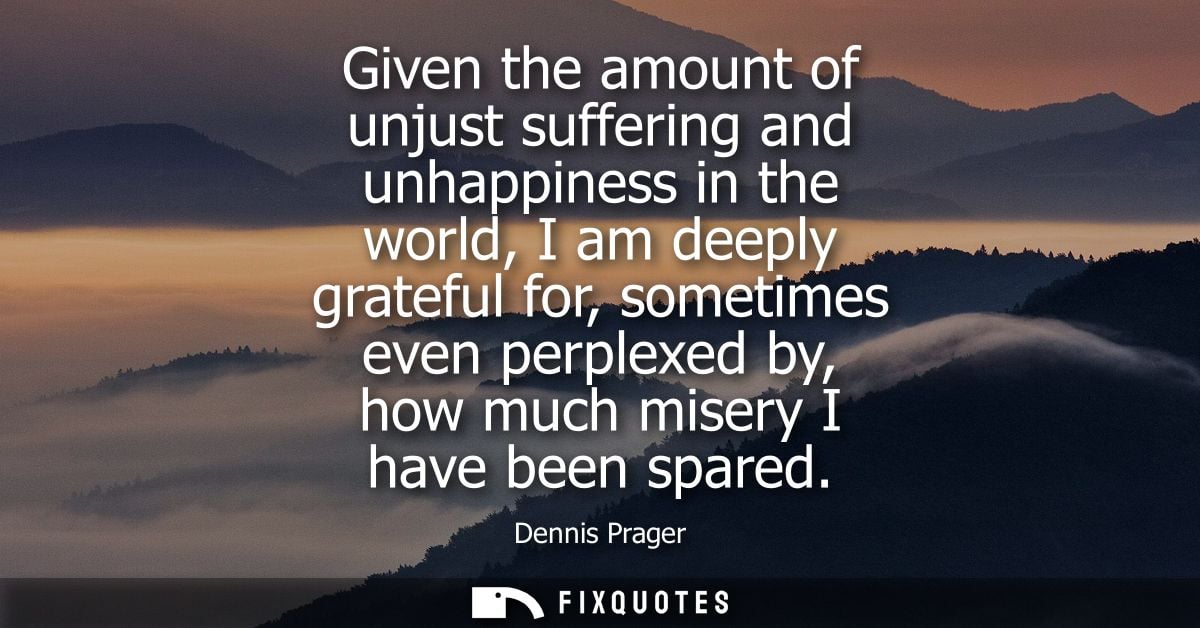
"Given the amount of unjust suffering and unhappiness in the world, I am deeply grateful for, sometimes even perplexed by, how much misery I have been spared"
About this Quote
The subtext carries two competing impulses. One is genuinely disarming: an acknowledgment that a decent life can feel undeserved when held against global pain. The other is an implicit rebuttal to grievance politics. By emphasizing “misery I have been spared,” he suggests the baseline is suffering and that sanity comes from recognizing the exceptionality of ease rather than demanding guarantees of it. Gratitude becomes an ethic and, quietly, a critique of entitlement.
Context matters because Prager’s public brand is conservative moral commentary. Read there, the quote isn’t just personal; it’s instructive. It models an emotional stance he’s often selling: accept imperfection, resist resentment, cultivate gratitude as a civic virtue. The sentence works because it’s simultaneously confessional and prescriptive. It invites readers to feel chastened by their own complaints while giving them a comforting narrative: if life is hard and unfair, the proper response isn’t bitterness but reverence for whatever grace you’ve managed to get.
Quote Details
| Topic | Gratitude |
|---|---|
| Source | Help us find the source |
| Cite |
Citation Formats
APA Style (7th ed.)
Prager, Dennis. (2026, January 15). Given the amount of unjust suffering and unhappiness in the world, I am deeply grateful for, sometimes even perplexed by, how much misery I have been spared. FixQuotes. https://fixquotes.com/quotes/given-the-amount-of-unjust-suffering-and-142631/
Chicago Style
Prager, Dennis. "Given the amount of unjust suffering and unhappiness in the world, I am deeply grateful for, sometimes even perplexed by, how much misery I have been spared." FixQuotes. January 15, 2026. https://fixquotes.com/quotes/given-the-amount-of-unjust-suffering-and-142631/.
MLA Style (9th ed.)
"Given the amount of unjust suffering and unhappiness in the world, I am deeply grateful for, sometimes even perplexed by, how much misery I have been spared." FixQuotes, 15 Jan. 2026, https://fixquotes.com/quotes/given-the-amount-of-unjust-suffering-and-142631/. Accessed 3 Apr. 2026.