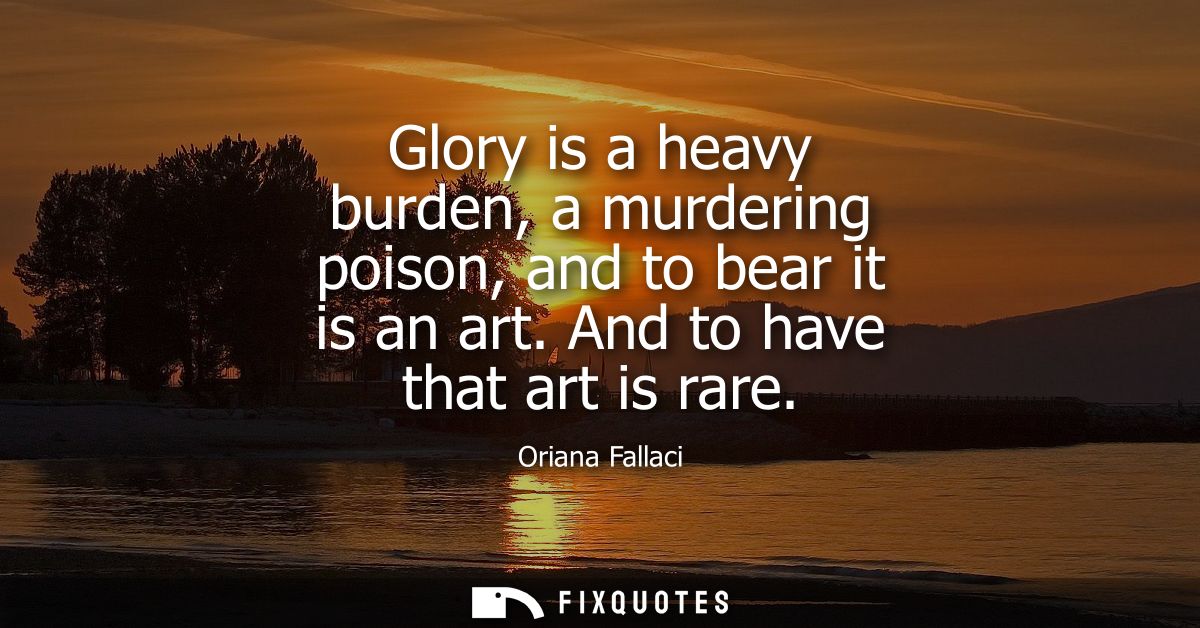
"Glory is a heavy burden, a murdering poison, and to bear it is an art. And to have that art is rare"
About this Quote
The subtext is classic Fallaci: distrust of power, contempt for public mythmaking, and an insistence on the private costs behind public triumph. As a journalist who built a career interviewing leaders, revolutionaries, and celebrities, she watched “glory” operate less like a medal and more like an enclosed environment. It distorts relationships, invites parasites, and pressures the celebrated person to live inside a simplified version of themselves. The poison “murders” not necessarily the body, but the self that existed before the crowd started narrating your life.
What makes the line work is its refusal to offer redemption. She doesn’t say glory can be balanced, or used well, or turned into service. She says bearing it is an art, implying discipline, self-knowledge, and a kind of emotional austerity: the ability to endure applause without needing it, to keep perspective while being constantly misread, to resist performing your own legend.
“And to have that art is rare” lands like a verdict. Most people, Fallaci implies, don’t fail at glory because they’re wicked; they fail because glory is engineered to unmake them.
Quote Details
| Topic | Wisdom |
|---|---|
| Source | Help us find the source |
| Cite |
Citation Formats
APA Style (7th ed.)
Fallaci, Oriana. (2026, January 16). Glory is a heavy burden, a murdering poison, and to bear it is an art. And to have that art is rare. FixQuotes. https://fixquotes.com/quotes/glory-is-a-heavy-burden-a-murdering-poison-and-to-89421/
Chicago Style
Fallaci, Oriana. "Glory is a heavy burden, a murdering poison, and to bear it is an art. And to have that art is rare." FixQuotes. January 16, 2026. https://fixquotes.com/quotes/glory-is-a-heavy-burden-a-murdering-poison-and-to-89421/.
MLA Style (9th ed.)
"Glory is a heavy burden, a murdering poison, and to bear it is an art. And to have that art is rare." FixQuotes, 16 Jan. 2026, https://fixquotes.com/quotes/glory-is-a-heavy-burden-a-murdering-poison-and-to-89421/. Accessed 28 Mar. 2026.