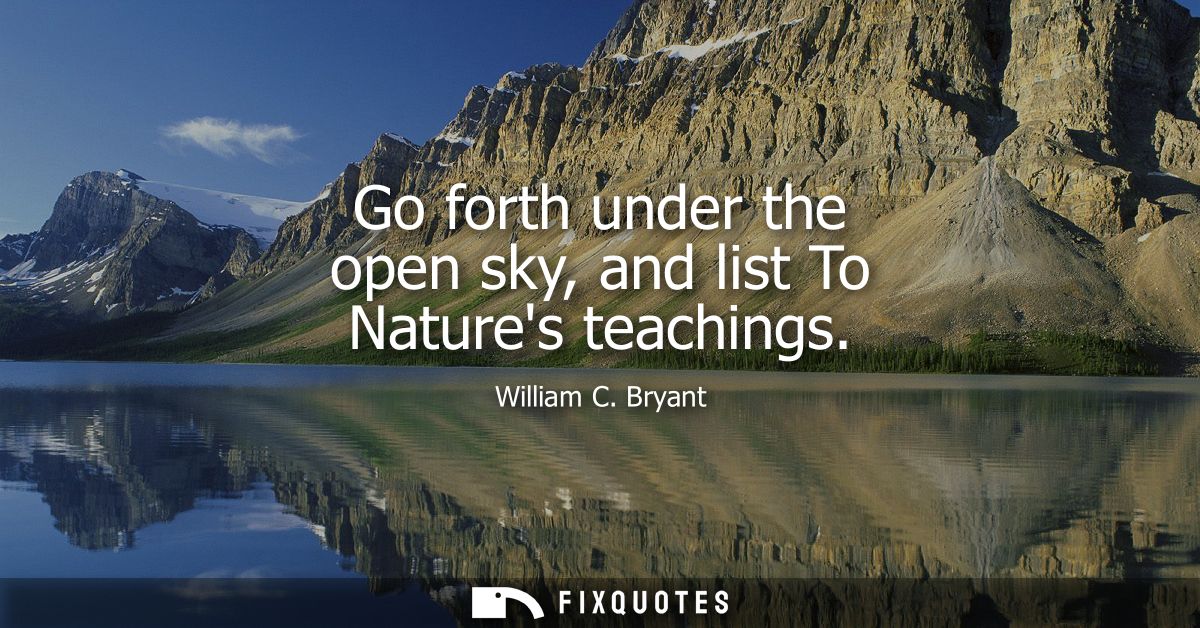
"Go forth under the open sky, and list to Nature's teachings"
About this Quote
Bryant’s line is a polite command that doubles as a manifesto: stop looking inward for wisdom and go submit yourself to the world as it is. “Go forth” has the ring of a sermon, but the cathedral here is “the open sky,” not a church. The posture matters. You don’t conquer nature, you “list” to it - an older verb that implies attentive, disciplined listening, the opposite of the 19th-century hustle to tame land, catalog it, sell it.
That quiet imperative sits in the cultural crosscurrents of early American Romanticism. Bryant is writing in a moment when the United States is expanding, clearing forests, laying rail, and building a national identity hungry for grand scenery and moral self-justification. Nature becomes both refuge and instructor: a place where the individual can be made small in a way that feels cleansing rather than humiliating. “Teachings” signals that the landscape is not mere backdrop; it carries ethics. The subtext is almost anti-urban, anti-noise, anti-politics: the truest education is pre-verbal and unsponsored.
It also flatters the reader’s independence. You don’t need institutions to mediate meaning; you can walk outside and be corrected by wind, weather, and scale. There’s an American confidence in that, but also a warning: if your society is getting too loud, too acquisitive, the open sky will remind you what lasts and what doesn’t.
That quiet imperative sits in the cultural crosscurrents of early American Romanticism. Bryant is writing in a moment when the United States is expanding, clearing forests, laying rail, and building a national identity hungry for grand scenery and moral self-justification. Nature becomes both refuge and instructor: a place where the individual can be made small in a way that feels cleansing rather than humiliating. “Teachings” signals that the landscape is not mere backdrop; it carries ethics. The subtext is almost anti-urban, anti-noise, anti-politics: the truest education is pre-verbal and unsponsored.
It also flatters the reader’s independence. You don’t need institutions to mediate meaning; you can walk outside and be corrected by wind, weather, and scale. There’s an American confidence in that, but also a warning: if your society is getting too loud, too acquisitive, the open sky will remind you what lasts and what doesn’t.
Quote Details
| Topic | Nature |
|---|---|
| Source | Thanatopsis, William Cullen Bryant (poem, first published 1817). Contains lines: "Go forth under the open sky, and list / To Nature's teachings." |
| Cite |
Citation Formats
APA Style (7th ed.)
Bryant, William C. (2026, February 16). Go forth under the open sky, and list to Nature's teachings. FixQuotes. https://fixquotes.com/quotes/go-forth-under-the-open-sky-and-list-to-natures-131229/
Chicago Style
Bryant, William C. "Go forth under the open sky, and list to Nature's teachings." FixQuotes. February 16, 2026. https://fixquotes.com/quotes/go-forth-under-the-open-sky-and-list-to-natures-131229/.
MLA Style (9th ed.)
"Go forth under the open sky, and list to Nature's teachings." FixQuotes, 16 Feb. 2026, https://fixquotes.com/quotes/go-forth-under-the-open-sky-and-list-to-natures-131229/. Accessed 28 Mar. 2026.
More Quotes by William
Add to List