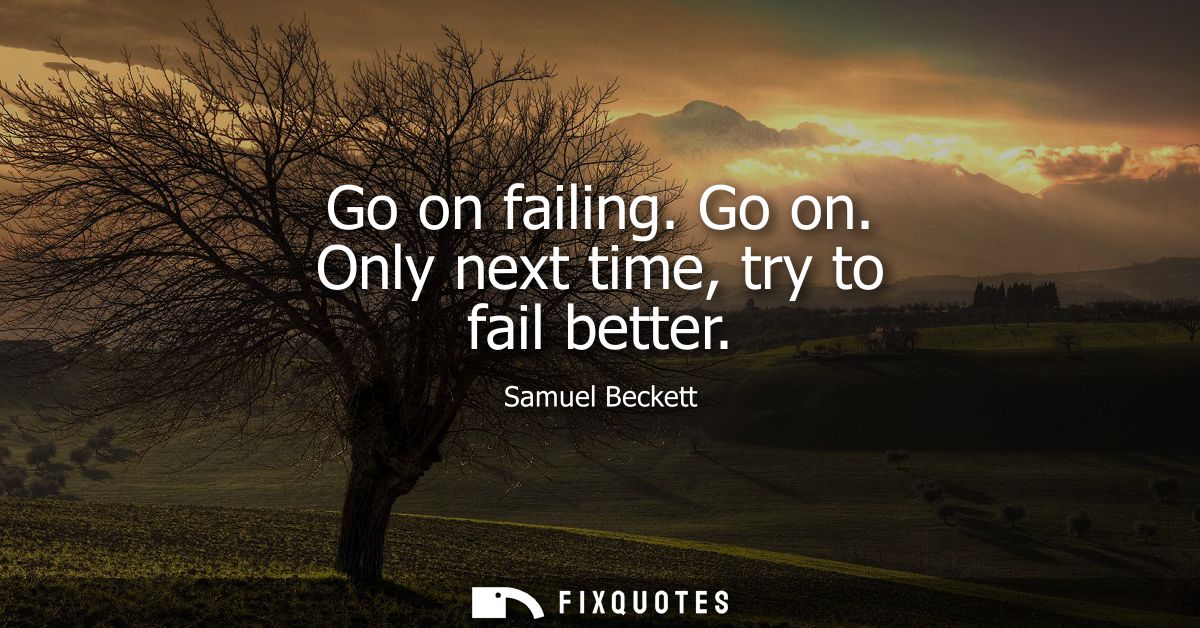
"Go on failing. Go on. Only next time, try to fail better"
About this Quote
Failure, in Beckett’s hands, isn’t a motivational poster; it’s a grim operating system. “Go on failing. Go on. Only next time, try to fail better” carries the clipped, engine-like rhythm of his late work: short sentences that feel less like advice than an order barked into the void. The wit is dry and pitiless. “Fail better” is an oxymoron with teeth, because it refuses the comforting premise that effort necessarily leads to success. Progress, here, is not triumph but refinement in defeat.
The intent is partly aesthetic, partly existential. Beckett is defending a kind of artistry that keeps moving even when meaning collapses: the writer who drafts another line knowing it will be inadequate, the character who takes another step even when the plot is basically a loop. The subtext is that failure isn’t an event; it’s the default condition of being conscious, trying to speak, trying to connect. The only dignity available is persistence without illusion.
Context matters: the line comes from Worstward Ho (1983), a late, stripped-down prose text where language is pared to bone and the world is reduced to minimal figures and motions. Postwar modernism sits behind it, too: after the century’s grand narratives combust, Beckett distrusts redemption arcs. The genius is how the sentence smuggles a sliver of agency into despair. You may not get “better” in the way culture sells it, but you can get more precise, more honest, less noisy about your limitations. Keep going, he says, but don’t lie to yourself about where you are going.
The intent is partly aesthetic, partly existential. Beckett is defending a kind of artistry that keeps moving even when meaning collapses: the writer who drafts another line knowing it will be inadequate, the character who takes another step even when the plot is basically a loop. The subtext is that failure isn’t an event; it’s the default condition of being conscious, trying to speak, trying to connect. The only dignity available is persistence without illusion.
Context matters: the line comes from Worstward Ho (1983), a late, stripped-down prose text where language is pared to bone and the world is reduced to minimal figures and motions. Postwar modernism sits behind it, too: after the century’s grand narratives combust, Beckett distrusts redemption arcs. The genius is how the sentence smuggles a sliver of agency into despair. You may not get “better” in the way culture sells it, but you can get more precise, more honest, less noisy about your limitations. Keep going, he says, but don’t lie to yourself about where you are going.
Quote Details
| Topic | Learning from Mistakes |
|---|---|
| Source | Help us find the source |
| Cite |
Citation Formats
APA Style (7th ed.)
Beckett, Samuel. (2026, January 18). Go on failing. Go on. Only next time, try to fail better. FixQuotes. https://fixquotes.com/quotes/go-on-failing-go-on-only-next-time-try-to-fail-1699/
Chicago Style
Beckett, Samuel. "Go on failing. Go on. Only next time, try to fail better." FixQuotes. January 18, 2026. https://fixquotes.com/quotes/go-on-failing-go-on-only-next-time-try-to-fail-1699/.
MLA Style (9th ed.)
"Go on failing. Go on. Only next time, try to fail better." FixQuotes, 18 Jan. 2026, https://fixquotes.com/quotes/go-on-failing-go-on-only-next-time-try-to-fail-1699/. Accessed 6 Apr. 2026.
More Quotes by Samuel
Add to List