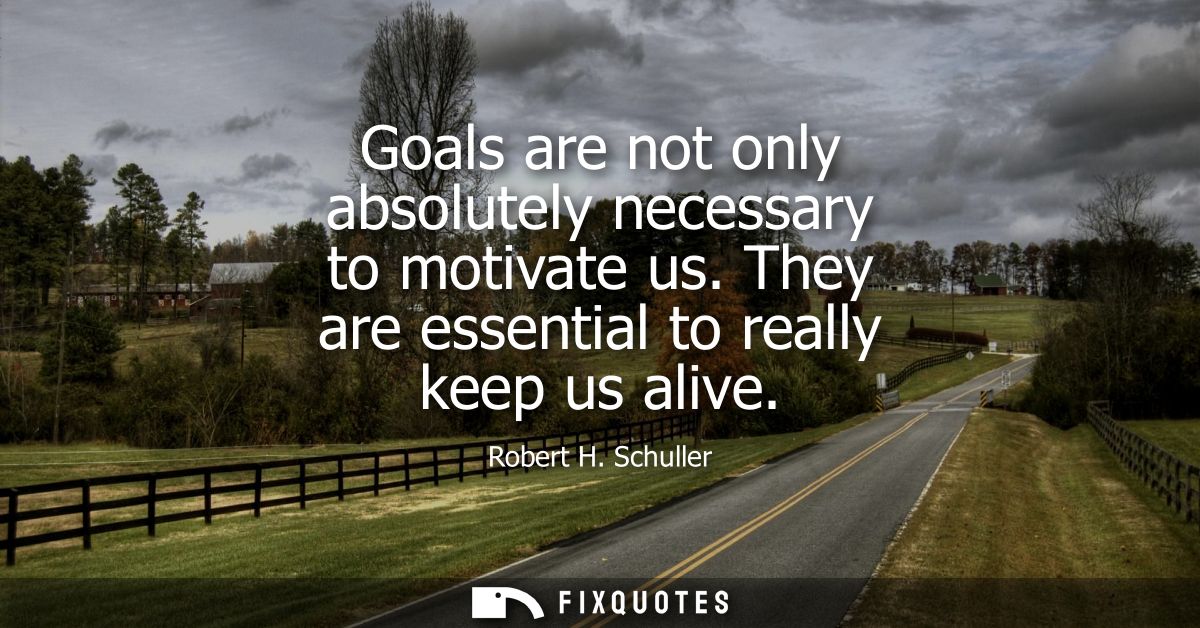
"Goals are not only absolutely necessary to motivate us. They are essential to really keep us alive"
About this Quote
The subtext is classic mid-to-late 20th-century American motivational Christianity: faith expressed through forward motion, doubt treated less as theological crisis than as stalled momentum. Schuller’s ministry, built around the optimism of the Crystal Cathedral era, often translated religious assurance into practical uplift. In that context, “goals” become a stand-in for vocation, purpose, even salvation, stripped of doctrinal friction and packaged as an accessible, almost civic virtue. You don’t have to argue about sin or grace; you just have to keep moving toward something.
The line also smuggles in a quiet critique of modern drift. If you feel numb, Schuller implies, it might not be because the world is cruel or confusing; it might be because you’ve lost a concrete horizon. That’s comforting and bracing at once. It offers agency to the weary, while subtly placing responsibility back on the individual: staying “alive” is not only a matter of circumstances, but of chosen direction.
Quote Details
| Topic | Goal Setting |
|---|---|
| Source | Help us find the source |
| Cite |
Citation Formats
APA Style (7th ed.)
Schuller, Robert H. (2026, January 18). Goals are not only absolutely necessary to motivate us. They are essential to really keep us alive. FixQuotes. https://fixquotes.com/quotes/goals-are-not-only-absolutely-necessary-to-16391/
Chicago Style
Schuller, Robert H. "Goals are not only absolutely necessary to motivate us. They are essential to really keep us alive." FixQuotes. January 18, 2026. https://fixquotes.com/quotes/goals-are-not-only-absolutely-necessary-to-16391/.
MLA Style (9th ed.)
"Goals are not only absolutely necessary to motivate us. They are essential to really keep us alive." FixQuotes, 18 Jan. 2026, https://fixquotes.com/quotes/goals-are-not-only-absolutely-necessary-to-16391/. Accessed 1 Apr. 2026.