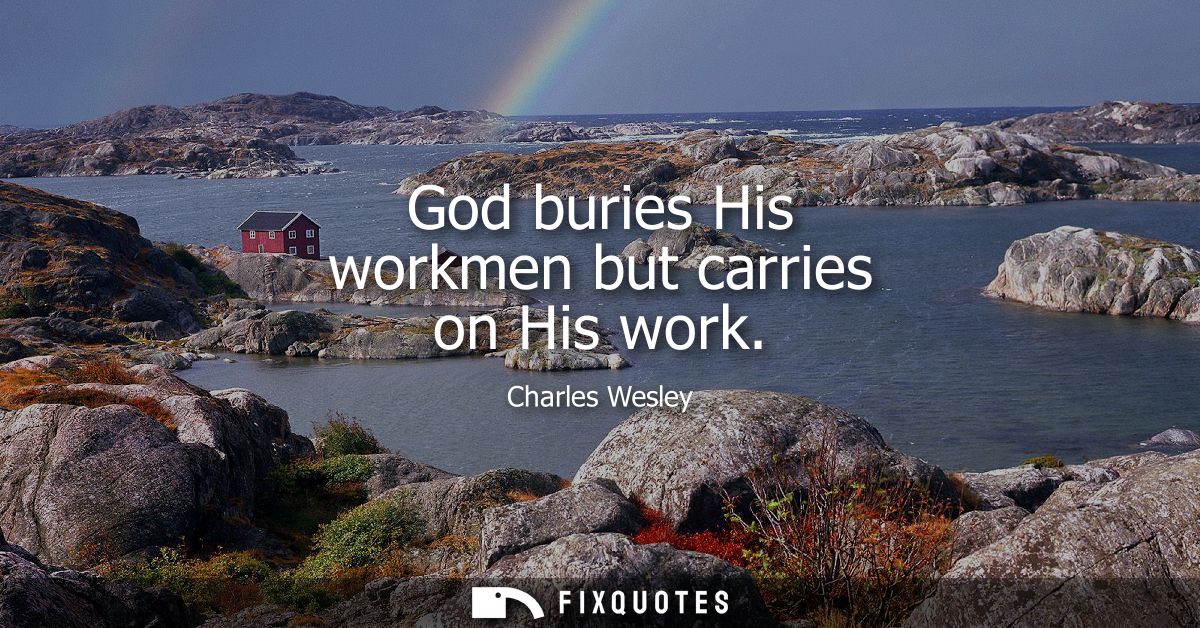
"God buries His workmen but carries on His work"
About this Quote
Mortality is the blunt instrument; continuity is the consolation. Charles Wesley, writing as an 18th-century clergyman and hymn-writer in the furnace of early Methodism, frames death not as chaos but as delegation. The line has the chill efficiency of a proverb: God "buries" the laborers, then keeps the project moving. It’s spiritually bracing, almost managerial, and that’s part of its power. Wesley is speaking to a movement built on itinerant preaching, burnout, illness, and short lives; if the mission depends on any one charismatic voice, it’s doomed. This sentence strips the ego out of vocation.
The subtext is two-sided. For the faithful worker, it offers dignity without illusion: you matter, but you are replaceable. That’s not an insult in Wesley’s theology; it’s a cure for vanity and despair at once. Your labor plugs into something larger than your lifespan. For the community left behind, it’s grief given a job description. Mourn, but don’t freeze. The work continues because God is the subject of the verb "carries on", not the institution, not the clergy, not the survivors.
The rhetoric is doing quiet violence to the cult of the indispensable leader. Wesley compresses a whole ecclesiology into one contrast: "workmen" are buried, "work" is carried. The harshness of "buries" keeps it from becoming sentimental, while the steadiness of "carries on" turns faith into a practice of succession. In an age of revival and reform, it’s a line designed to keep a cause from dying of personality.
The subtext is two-sided. For the faithful worker, it offers dignity without illusion: you matter, but you are replaceable. That’s not an insult in Wesley’s theology; it’s a cure for vanity and despair at once. Your labor plugs into something larger than your lifespan. For the community left behind, it’s grief given a job description. Mourn, but don’t freeze. The work continues because God is the subject of the verb "carries on", not the institution, not the clergy, not the survivors.
The rhetoric is doing quiet violence to the cult of the indispensable leader. Wesley compresses a whole ecclesiology into one contrast: "workmen" are buried, "work" is carried. The harshness of "buries" keeps it from becoming sentimental, while the steadiness of "carries on" turns faith into a practice of succession. In an age of revival and reform, it’s a line designed to keep a cause from dying of personality.
Quote Details
| Topic | God |
|---|---|
| Source | Later attribution: Wesley, the Man, His Teaching, and His Work (John Wesley, 1891) modern compilationID: tHaoTDvSyLYC
Evidence:
... Wesley's Death, Revised by the Authors John Wesley. thunders of applause ... Charles Wesley , with the memorable words inscribed upon it : " I look upon the whole world as my parish ; " " God buries His workmen , but carries on His work ... |
| Cite |
Citation Formats
APA Style (7th ed.)
Wesley, Charles. (2026, February 8). God buries His workmen but carries on His work. FixQuotes. https://fixquotes.com/quotes/god-buries-his-workmen-but-carries-on-his-work-136109/
Chicago Style
Wesley, Charles. "God buries His workmen but carries on His work." FixQuotes. February 8, 2026. https://fixquotes.com/quotes/god-buries-his-workmen-but-carries-on-his-work-136109/.
MLA Style (9th ed.)
"God buries His workmen but carries on His work." FixQuotes, 8 Feb. 2026, https://fixquotes.com/quotes/god-buries-his-workmen-but-carries-on-his-work-136109/. Accessed 5 Mar. 2026.
More Quotes by Charles
Add to List