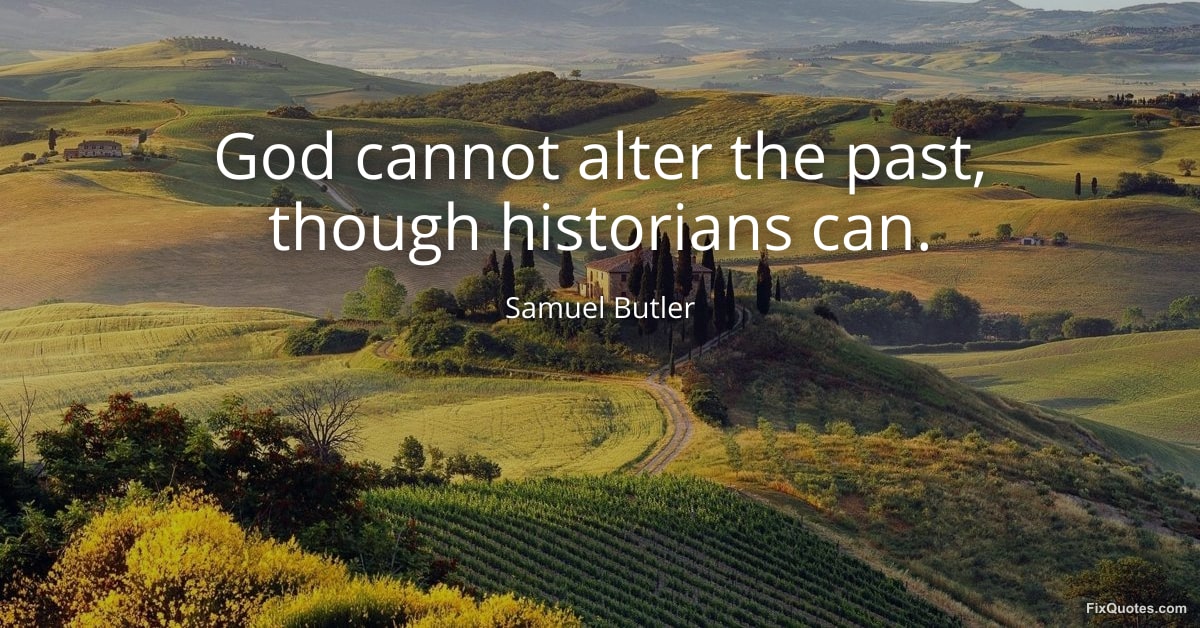
"God cannot alter the past, though historians can"
About this Quote
Butler’s line lands like a punchline with a theologian’s timing: even an all-powerful God is boxed in by time, but the historian, armed with narrative and selection, can re-engineer yesterday on the page. The joke is barbed because it targets two kinds of authority at once. It quietly demotes divine omnipotence to a technicality (surely God can do anything... except rewrite what already happened), then elevates a supposedly humble profession into a kind of retroactive sovereign.
The intent isn’t just to sneer at historians as liars. Butler is pointing at the soft machinery of “the past” as we actually encounter it: archives with gaps, memories with agendas, documents produced by winners, and later interpretations that harden into “what really happened.” Historians don’t change events; they change the usable version of events. That difference is precisely what makes the aphorism sting. The past is fixed, but public reality is editable.
As a Victorian poet and skeptic, Butler is writing in a period obsessed with progress, science, and institutional confidence, when “History” was becoming a professional discipline and empire loved to justify itself with grand narratives. The subtext is anti-pious in two directions: a wink at theology’s limits and a warning about secular priesthoods. If God can’t alter the past, Butler implies, then anyone claiming to deliver it unfiltered is performing a miracle. The more calmly a history is told, the more power it’s quietly exercising.
The intent isn’t just to sneer at historians as liars. Butler is pointing at the soft machinery of “the past” as we actually encounter it: archives with gaps, memories with agendas, documents produced by winners, and later interpretations that harden into “what really happened.” Historians don’t change events; they change the usable version of events. That difference is precisely what makes the aphorism sting. The past is fixed, but public reality is editable.
As a Victorian poet and skeptic, Butler is writing in a period obsessed with progress, science, and institutional confidence, when “History” was becoming a professional discipline and empire loved to justify itself with grand narratives. The subtext is anti-pious in two directions: a wink at theology’s limits and a warning about secular priesthoods. If God can’t alter the past, Butler implies, then anyone claiming to deliver it unfiltered is performing a miracle. The more calmly a history is told, the more power it’s quietly exercising.
Quote Details
| Topic | Witty One-Liners |
|---|
More Quotes by Samuel
Add to List