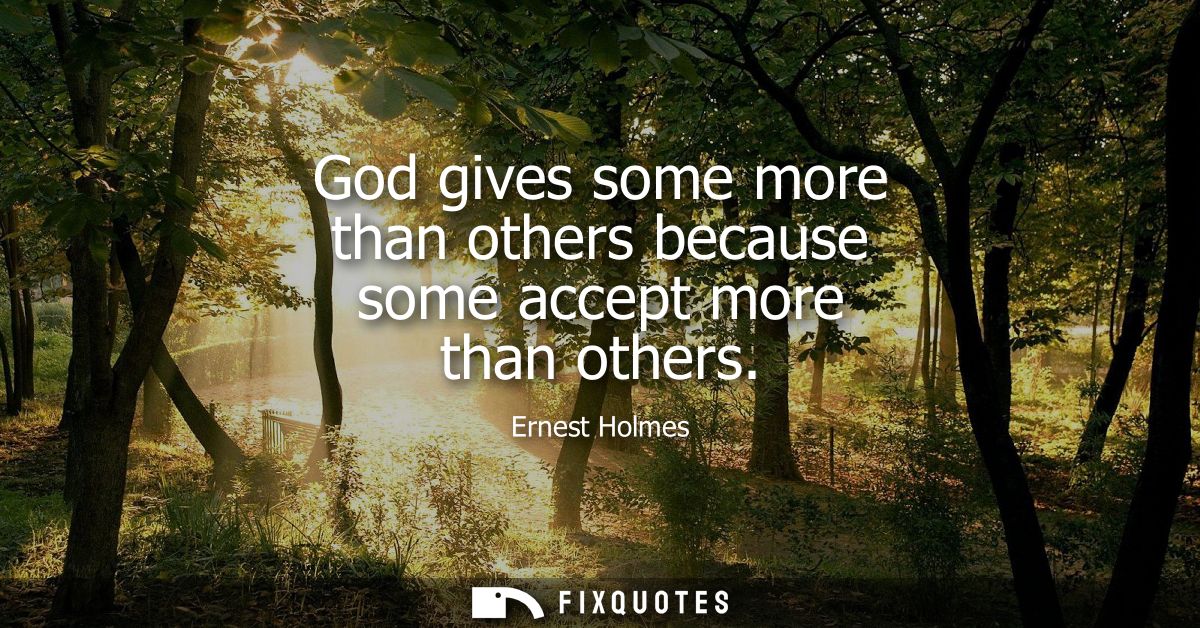
"God gives some more than others because some accept more than others"
About this Quote
Holmes sneaks a radical moral claim into the gentle language of spiritual reassurance: inequality isn’t just real, it’s administratively tidy. God “gives,” but the distribution looks less like whim and more like a logistics problem of receptivity. The sentence flatters the listener with a loophole: if you’re lacking, it’s not necessarily because you’re forsaken; it’s because you haven’t learned to accept. That pivot from divine sovereignty to human “acceptance” is the engine of Holmes’s New Thought universe, where consciousness operates like a valve on abundance.
The intent is motivational theology dressed as metaphysics. By making “accept” the decisive verb, Holmes relocates power from an inscrutable heaven to the inner life, inviting spiritual practice to function like self-management: cultivate belief, widen your capacity, raise the ceiling on what you can receive. It’s pastoral, but it’s also bracingly transactional. Grace becomes less a gift than a flow that can be throttled by attitude, fear, or doubt.
The subtext carries a modern American edge: scarcity is psychological; prosperity is a spiritual skill. That can be liberating for people boxed in by fatalism, yet it also risks sanctifying the status quo. If “more” goes to those who “accept” more, then deprivation starts to look like a failure of openness rather than a product of history, policy, or luck.
Context matters: Holmes, writing amid early-20th-century self-help spirituality, fused church language with the era’s faith in mind power. The line works because it comforts without surrendering to randomness, promising that the universe is responsive, but only if you are.
The intent is motivational theology dressed as metaphysics. By making “accept” the decisive verb, Holmes relocates power from an inscrutable heaven to the inner life, inviting spiritual practice to function like self-management: cultivate belief, widen your capacity, raise the ceiling on what you can receive. It’s pastoral, but it’s also bracingly transactional. Grace becomes less a gift than a flow that can be throttled by attitude, fear, or doubt.
The subtext carries a modern American edge: scarcity is psychological; prosperity is a spiritual skill. That can be liberating for people boxed in by fatalism, yet it also risks sanctifying the status quo. If “more” goes to those who “accept” more, then deprivation starts to look like a failure of openness rather than a product of history, policy, or luck.
Context matters: Holmes, writing amid early-20th-century self-help spirituality, fused church language with the era’s faith in mind power. The line works because it comforts without surrendering to randomness, promising that the universe is responsive, but only if you are.
Quote Details
| Topic | God |
|---|
More Quotes by Ernest
Add to List