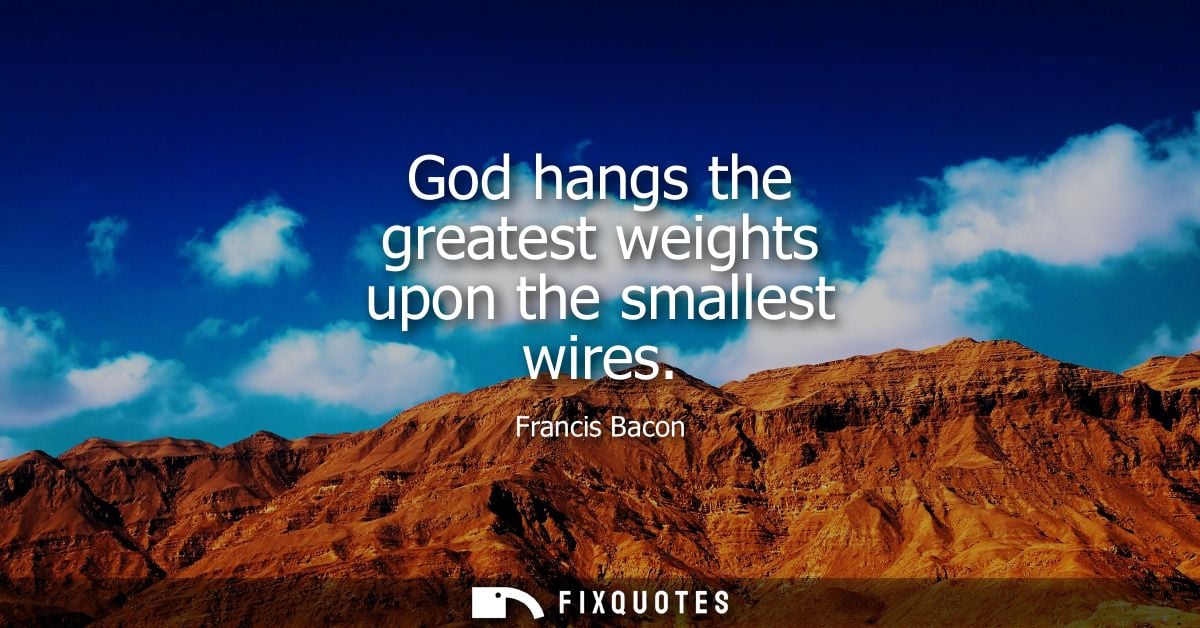
"God hangs the greatest weights upon the smallest wires"
About this Quote
Providence, Bacon suggests, is a cruel engineer: it loves to load the world’s heaviest burdens onto the thinnest supports. The line works because it flips our instinct for proportion. We expect big forces to require big structures. Bacon gives us a picture of reality as a kind of cosmic stress test, where the most consequential outcomes hinge on what looks flimsy: a minor decision, a weak institution, a single person’s temperament, a fragile alliance.
As a philosopher-statesman writing in an age of religious conflict, court intrigue, and scientific upheaval, Bacon knew how often history turns on small mechanisms. Early modern England ran on “small wires” - patronage networks, whispered accusations, a monarch’s favor - that could suddenly carry “great weights” like careers, policies, even lives. Read against Bacon’s broader project (to replace scholastic certainty with experimental inquiry), the aphorism also smuggles in a methodological warning: the world is not organized to satisfy our sense of elegance. Causality can be disproportionate, and the subtle variables matter.
The subtext isn’t simply humility before God; it’s also a political and epistemic realism. If power and fate routinely travel through delicate channels, then prudence becomes a craft of reinforcement: build redundancy, test assumptions, distrust the apparent sturdiness of institutions. Bacon’s image is devotional on the surface, but its bite is managerial and modern: systems fail where they look most incidental, and that’s exactly where the future likes to attach itself.
As a philosopher-statesman writing in an age of religious conflict, court intrigue, and scientific upheaval, Bacon knew how often history turns on small mechanisms. Early modern England ran on “small wires” - patronage networks, whispered accusations, a monarch’s favor - that could suddenly carry “great weights” like careers, policies, even lives. Read against Bacon’s broader project (to replace scholastic certainty with experimental inquiry), the aphorism also smuggles in a methodological warning: the world is not organized to satisfy our sense of elegance. Causality can be disproportionate, and the subtle variables matter.
The subtext isn’t simply humility before God; it’s also a political and epistemic realism. If power and fate routinely travel through delicate channels, then prudence becomes a craft of reinforcement: build redundancy, test assumptions, distrust the apparent sturdiness of institutions. Bacon’s image is devotional on the surface, but its bite is managerial and modern: systems fail where they look most incidental, and that’s exactly where the future likes to attach itself.
Quote Details
| Topic | God |
|---|
More Quotes by Francis
Add to List