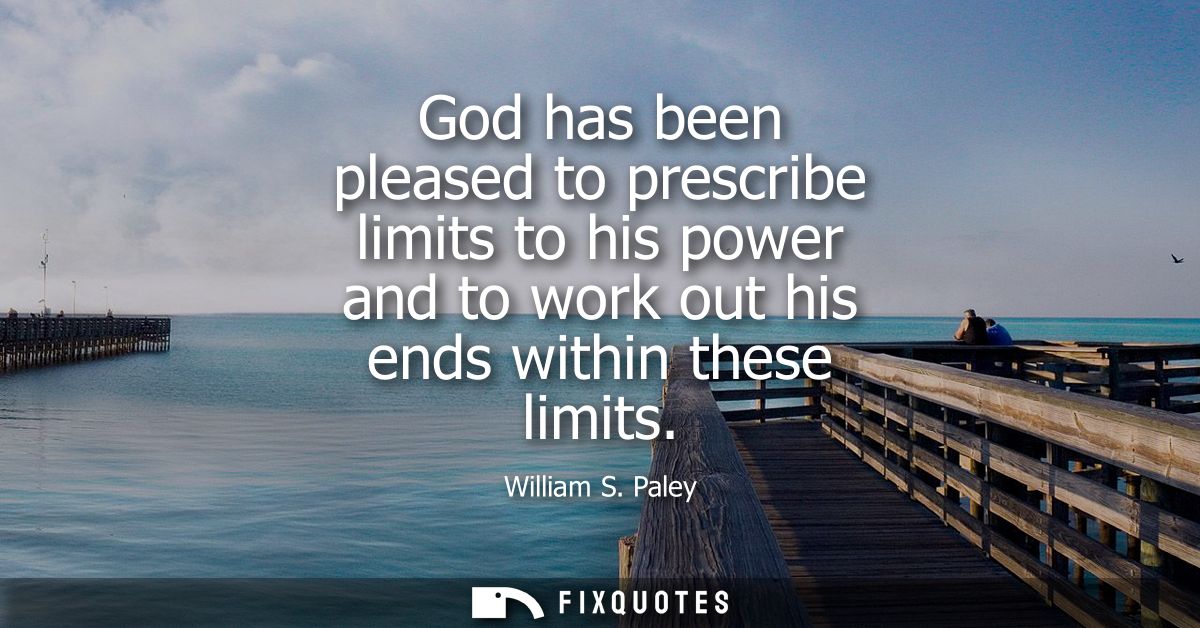
"God has been pleased to prescribe limits to his power and to work out his ends within these limits"
About this Quote
The intent feels apologetic in the classic sense: a defense of belief in a world that plainly runs on friction. If God can do anything, why do suffering, randomness, and human stupidity keep winning daily headlines? Paley’s answer is a kind of theological governance. The universe is a rule-bound system; God respects the rules he authored. “Work out his ends” reads like corporate language for long-horizon execution: outcomes matter, but you don’t smash the machinery to get them. Ends are achieved through process, time, and intermediaries - people, institutions, consequences.
The subtext also flatters human agency. If God self-limits, then responsibility doesn’t get outsourced upward. Moral work remains on us; prayer doesn’t replace policy. That’s a particularly modern bargain for a business-minded worldview: order exists, purpose exists, but the market of history still has volatility.
Contextually, it fits a 20th-century sensibility shaped by war, mass systems, and bureaucratic power - eras when “unlimited power” stopped sounding like a virtue. Paley’s God looks less like a tyrant and more like a self-restrained sovereign, which is exactly the kind of divinity a pluralistic, institution-heavy society can tolerate.
Quote Details
| Topic | God |
|---|---|
| Source | Help us find the source |
| Cite |
Citation Formats
APA Style (7th ed.)
Paley, William S. (2026, January 16). God has been pleased to prescribe limits to his power and to work out his ends within these limits. FixQuotes. https://fixquotes.com/quotes/god-has-been-pleased-to-prescribe-limits-to-his-134921/
Chicago Style
Paley, William S. "God has been pleased to prescribe limits to his power and to work out his ends within these limits." FixQuotes. January 16, 2026. https://fixquotes.com/quotes/god-has-been-pleased-to-prescribe-limits-to-his-134921/.
MLA Style (9th ed.)
"God has been pleased to prescribe limits to his power and to work out his ends within these limits." FixQuotes, 16 Jan. 2026, https://fixquotes.com/quotes/god-has-been-pleased-to-prescribe-limits-to-his-134921/. Accessed 14 Mar. 2026.