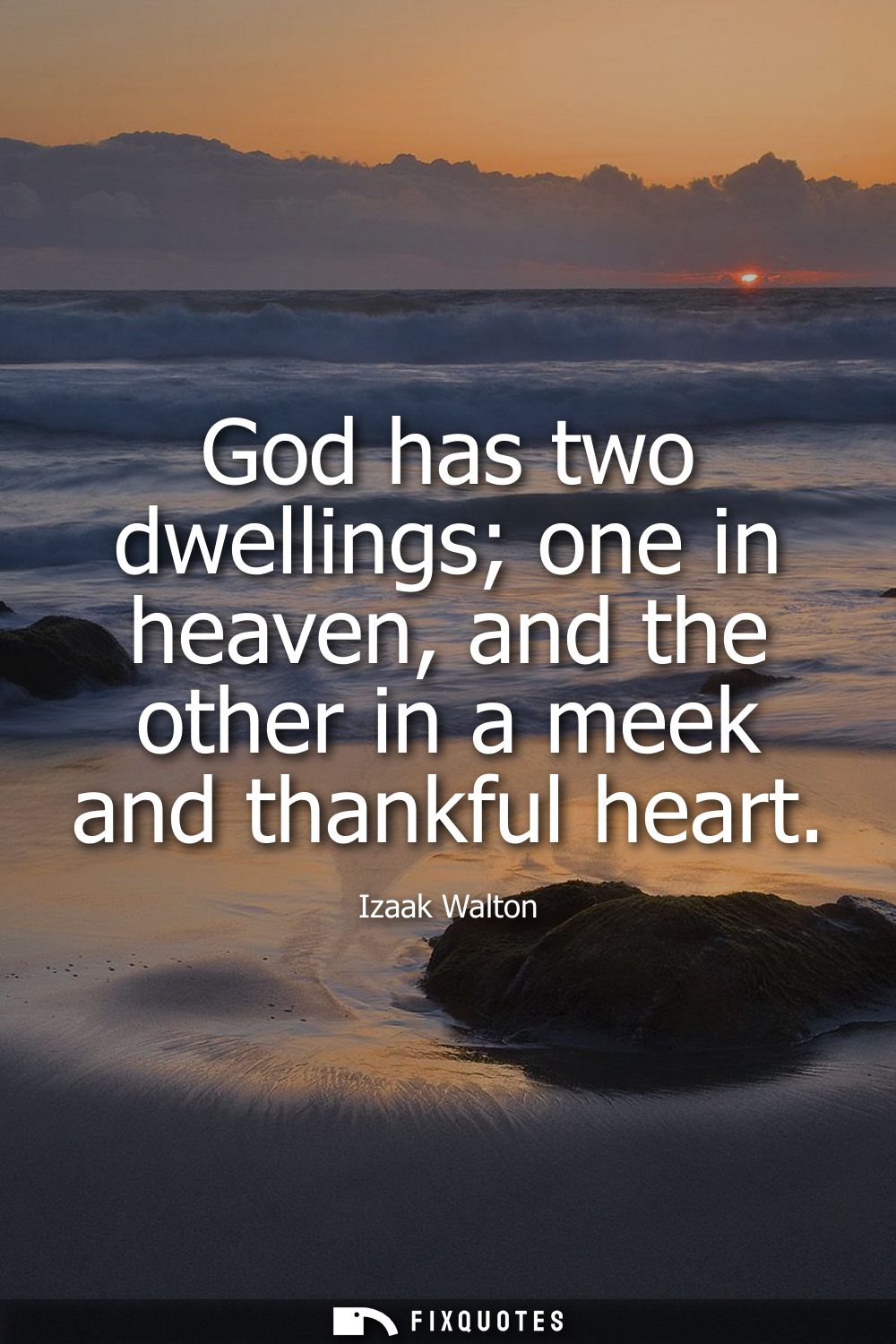
"God has two dwellings; one in heaven, and the other in a meek and thankful heart"
About this Quote
The subtext is a critique of performative piety. “Meek” and “thankful” aren’t flashy virtues; they’re anti-theatrical. Walton isn’t asking for mystical feats or militant certainty. He’s praising a posture that can survive disappointment, loss, and the daily irritations that make grand religious rhetoric feel hollow. The sentence also smuggles in a moral hierarchy. Heaven is named first, but the surprise is the second address, which implies that access to God isn’t mediated by status, education, or even theological sophistication. It’s mediated by disposition.
Why it works is its calm audacity. By putting heaven and the human heart in the same grammatical frame, Walton makes intimacy with God sound not radical but natural, almost inevitable. The line offers consolation without sentimentality: if the world is unstable, at least the “dwelling” you can maintain is your own interior one.
Quote Details
| Topic | God |
|---|---|
| Source | Izaak Walton, The Compleat Angler (first pub. 1653). Commonly cited line: "God has two dwellings; one in heaven, and the other in a meek and thankful heart." |
| Cite |
Citation Formats
APA Style (7th ed.)
Walton, Izaak. (2026, January 18). God has two dwellings; one in heaven, and the other in a meek and thankful heart. FixQuotes. https://fixquotes.com/quotes/god-has-two-dwellings-one-in-heaven-and-the-other-15083/
Chicago Style
Walton, Izaak. "God has two dwellings; one in heaven, and the other in a meek and thankful heart." FixQuotes. January 18, 2026. https://fixquotes.com/quotes/god-has-two-dwellings-one-in-heaven-and-the-other-15083/.
MLA Style (9th ed.)
"God has two dwellings; one in heaven, and the other in a meek and thankful heart." FixQuotes, 18 Jan. 2026, https://fixquotes.com/quotes/god-has-two-dwellings-one-in-heaven-and-the-other-15083/. Accessed 7 Mar. 2026.