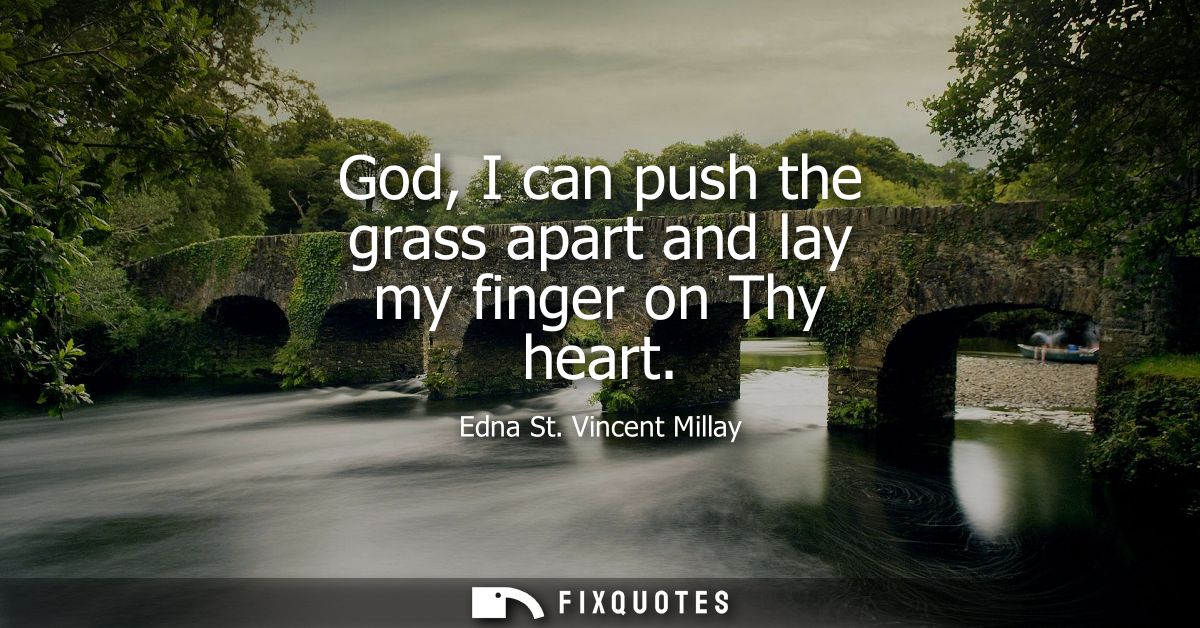
"God, I can push the grass apart and lay my finger on Thy heart"
About this Quote
Millay’s line doesn’t ask for God; it handles God. The diction is bodily, almost brazen in its intimacy: push the grass apart, lay my finger. This is not the usual vertical posture of prayer, eyes up, hands clasped, waiting. It’s horizontal, close to the ground, like someone kneeling in a field and discovering that divinity isn’t above the world but inside its most ordinary cover. The gesture is small and exact. A finger is enough.
The erotic charge is hard to miss, and it’s doing real work. Millay borrows the language of touch to collapse the distance that religion often insists on. “Thy heart” is a devotional phrase, but here it becomes anatomical, almost vulnerable. God is not thunder or commandment; God has a pulse you can locate. That’s comfort and provocation in the same breath: if you can touch God, you can also implicate God in the mess of the living world.
Context matters because Millay’s career sits at the crossroads of modernist frankness and older lyric tradition. She writes in inherited forms but smuggles in a new kind of authority: the speaker’s body and perception become the instruments of revelation. The grass reads as both nature’s veil and the grave’s cover, suggesting that holiness is contiguous with mortality. The subtext is audaciously democratic: you don’t need priests, proofs, or transcendence. You need attention, nerve, and a willingness to get your hands dirty.
The erotic charge is hard to miss, and it’s doing real work. Millay borrows the language of touch to collapse the distance that religion often insists on. “Thy heart” is a devotional phrase, but here it becomes anatomical, almost vulnerable. God is not thunder or commandment; God has a pulse you can locate. That’s comfort and provocation in the same breath: if you can touch God, you can also implicate God in the mess of the living world.
Context matters because Millay’s career sits at the crossroads of modernist frankness and older lyric tradition. She writes in inherited forms but smuggles in a new kind of authority: the speaker’s body and perception become the instruments of revelation. The grass reads as both nature’s veil and the grave’s cover, suggesting that holiness is contiguous with mortality. The subtext is audaciously democratic: you don’t need priests, proofs, or transcendence. You need attention, nerve, and a willingness to get your hands dirty.
Quote Details
| Topic | God |
|---|---|
| Source | Help us find the source |
| Cite |
Citation Formats
APA Style (7th ed.)
Millay, Edna St. Vincent. (2026, January 17). God, I can push the grass apart and lay my finger on Thy heart. FixQuotes. https://fixquotes.com/quotes/god-i-can-push-the-grass-apart-and-lay-my-finger-52707/
Chicago Style
Millay, Edna St. Vincent. "God, I can push the grass apart and lay my finger on Thy heart." FixQuotes. January 17, 2026. https://fixquotes.com/quotes/god-i-can-push-the-grass-apart-and-lay-my-finger-52707/.
MLA Style (9th ed.)
"God, I can push the grass apart and lay my finger on Thy heart." FixQuotes, 17 Jan. 2026, https://fixquotes.com/quotes/god-i-can-push-the-grass-apart-and-lay-my-finger-52707/. Accessed 12 Feb. 2026.
More Quotes by Edna
Add to List