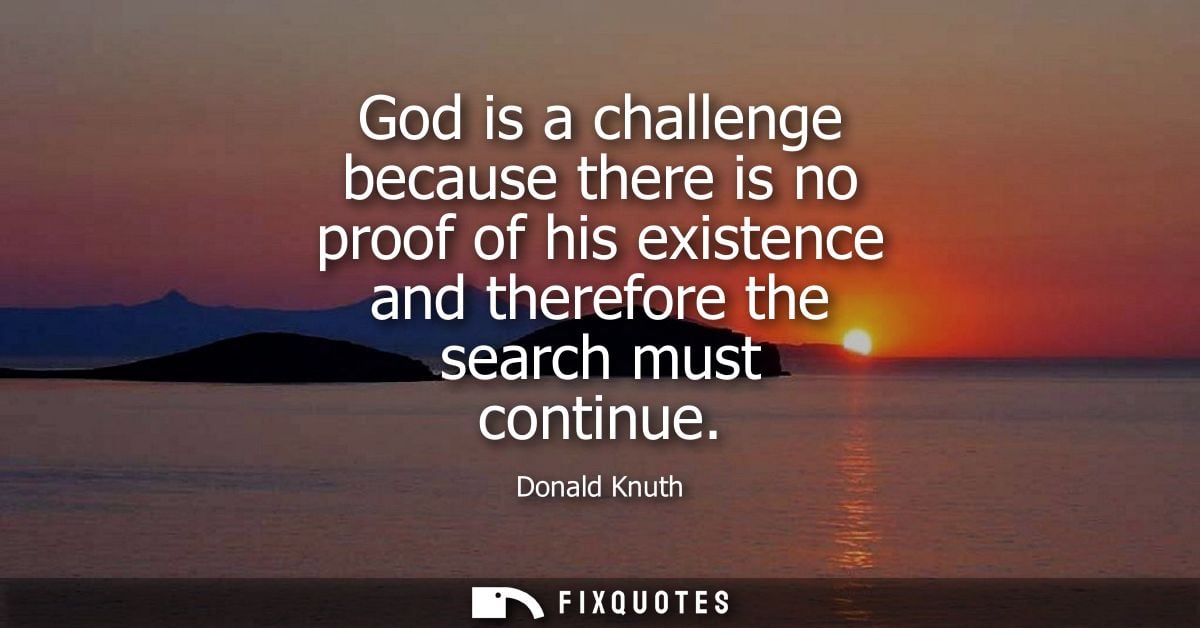
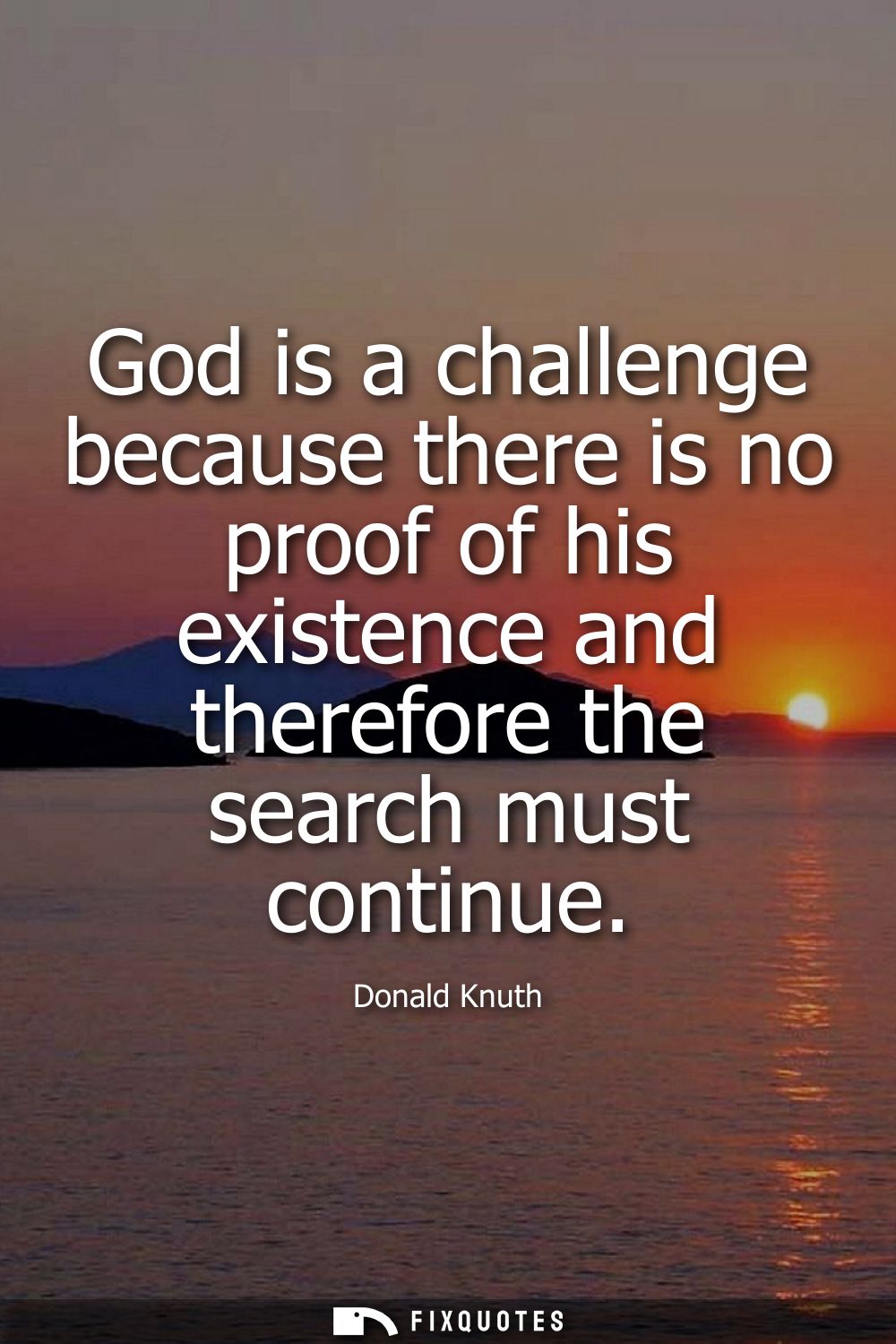
"God is a challenge because there is no proof of his existence and therefore the search must continue"
About this Quote
The subtext is a quiet rebuke to both camps that love finality. To the militant skeptic, it says: you don't get to declare victory just because the proof isn't there. To the confident believer, it says: if you want this to be more than inheritance or habit, you have to live with the discomfort of not having a theorem. The word "therefore" matters. It's not "despite" no proof, but because of it, the search continues. Doubt becomes the engine, not the enemy.
Contextually, this fits a 20th-century scientific culture that prizes rigor yet continually runs into limits: incompleteness, undecidability, the hard edges of what can be shown. Knuth, steeped in formal proof and its boundaries, treats metaphysics as a kind of asymptote. You may never arrive, but you can still move closer, refine your questions, and learn something about your own methods along the way.
Quote Details
| Topic | God |
|---|---|
| Source | Help us find the source |
| Cite |
Citation Formats
APA Style (7th ed.)
Knuth, Donald. (2026, January 15). God is a challenge because there is no proof of his existence and therefore the search must continue. FixQuotes. https://fixquotes.com/quotes/god-is-a-challenge-because-there-is-no-proof-of-158134/
Chicago Style
Knuth, Donald. "God is a challenge because there is no proof of his existence and therefore the search must continue." FixQuotes. January 15, 2026. https://fixquotes.com/quotes/god-is-a-challenge-because-there-is-no-proof-of-158134/.
MLA Style (9th ed.)
"God is a challenge because there is no proof of his existence and therefore the search must continue." FixQuotes, 15 Jan. 2026, https://fixquotes.com/quotes/god-is-a-challenge-because-there-is-no-proof-of-158134/. Accessed 14 Mar. 2026.