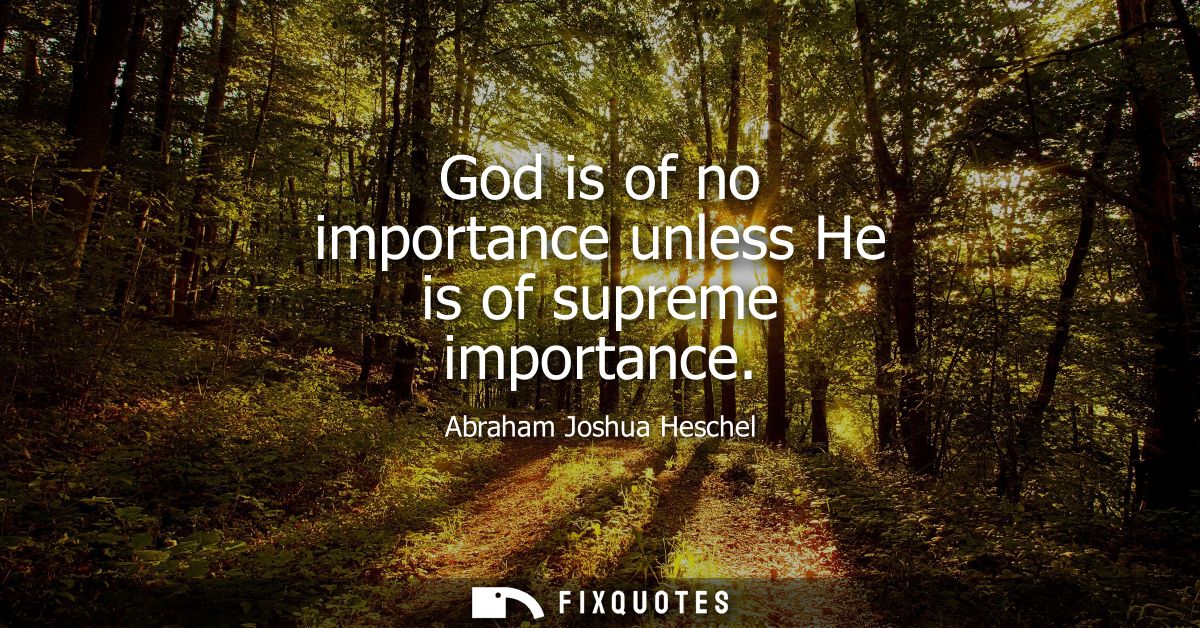
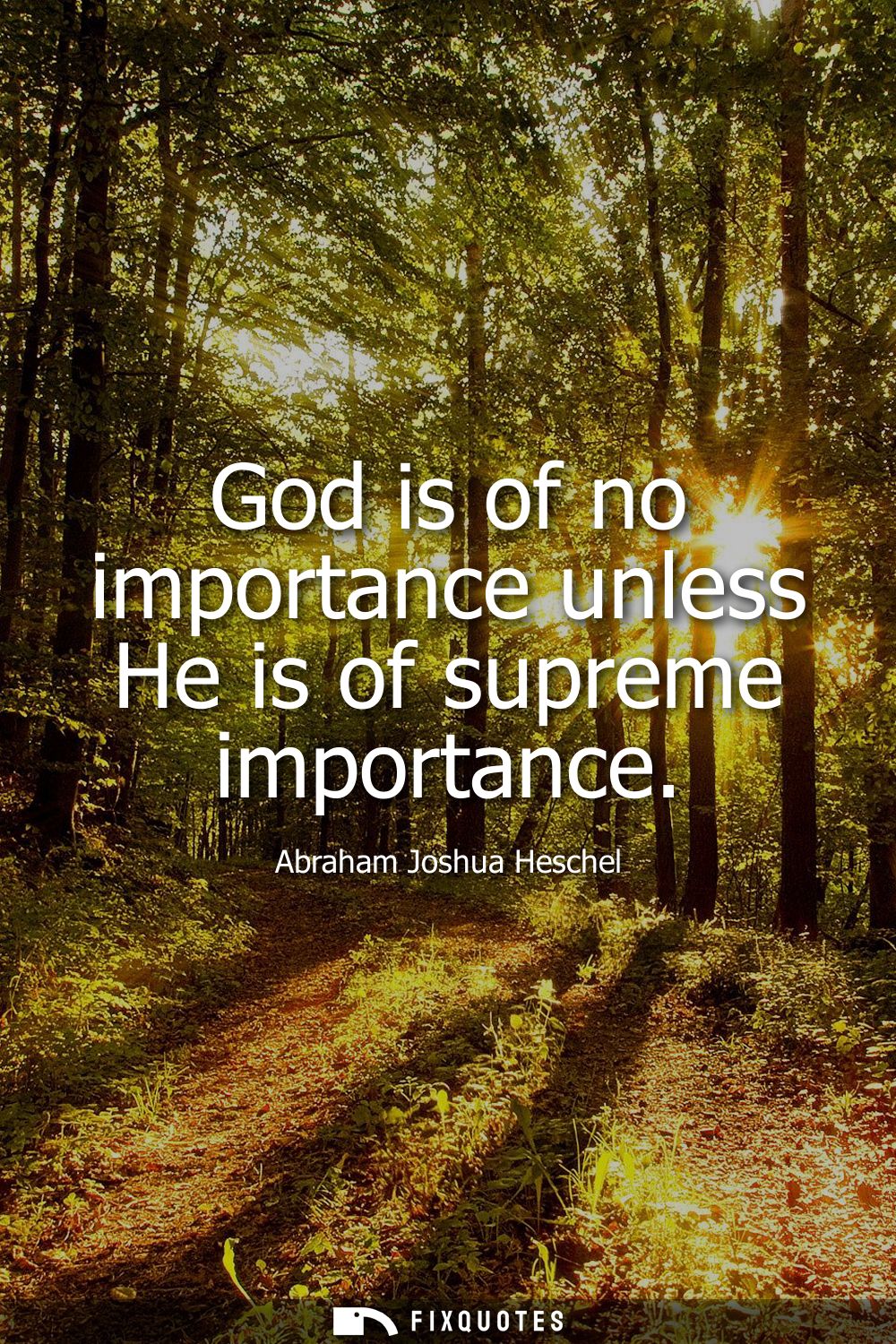
"God is of no importance unless He is of supreme importance"
About this Quote
A polite, pocket-sized God is worse than no God at all. Heschel’s line lands like a rebuke to the modern habit of treating religion as a lifestyle accessory: a bit of comfort, a holiday aesthetic, a moral garnish you can sprinkle over whatever you already wanted to do. By insisting that God is “of no importance unless He is of supreme importance,” Heschel isn’t merely demanding piety; he’s exposing the bargain many people try to cut with the divine. If God is real, then God cannot be a minor character in the story of your life. Anything less turns “God” into a projection: a soothing name for our preferences, anxieties, and tribal loyalties.
The subtext is aimed at both skeptics and believers. To skeptics, he grants an unexpected concession: a religion that makes no costly claim on you is intellectually unserious. To believers, he delivers the harsher message: you may be practicing a kind of spiritual theater, keeping God safely small so your conscience stays manageable. “Supreme importance” implies total demand - on attention, ethics, time, and the way power is handled. It’s not an invitation to intensity for its own sake; it’s a warning against domestication.
Context matters. Heschel, a Jewish theologian shaped by European catastrophe and later a visible moral voice in America (civil rights, Vietnam), wrote in a century that watched institutions collapse and ideologies become quasi-religions. The sentence challenges the modern temptation to outsource ultimacy to the nation, the market, or the self - and then keep God on standby as a private comfort. Heschel’s God, if invoked, must be the standard that judges everything else.
The subtext is aimed at both skeptics and believers. To skeptics, he grants an unexpected concession: a religion that makes no costly claim on you is intellectually unserious. To believers, he delivers the harsher message: you may be practicing a kind of spiritual theater, keeping God safely small so your conscience stays manageable. “Supreme importance” implies total demand - on attention, ethics, time, and the way power is handled. It’s not an invitation to intensity for its own sake; it’s a warning against domestication.
Context matters. Heschel, a Jewish theologian shaped by European catastrophe and later a visible moral voice in America (civil rights, Vietnam), wrote in a century that watched institutions collapse and ideologies become quasi-religions. The sentence challenges the modern temptation to outsource ultimacy to the nation, the market, or the self - and then keep God on standby as a private comfort. Heschel’s God, if invoked, must be the standard that judges everything else.
Quote Details
| Topic | God |
|---|---|
| Source | Help us find the source |
| Cite |
Citation Formats
APA Style (7th ed.)
Heschel, Abraham Joshua. (2026, January 16). God is of no importance unless He is of supreme importance. FixQuotes. https://fixquotes.com/quotes/god-is-of-no-importance-unless-he-is-of-supreme-137987/
Chicago Style
Heschel, Abraham Joshua. "God is of no importance unless He is of supreme importance." FixQuotes. January 16, 2026. https://fixquotes.com/quotes/god-is-of-no-importance-unless-he-is-of-supreme-137987/.
MLA Style (9th ed.)
"God is of no importance unless He is of supreme importance." FixQuotes, 16 Jan. 2026, https://fixquotes.com/quotes/god-is-of-no-importance-unless-he-is-of-supreme-137987/. Accessed 7 Feb. 2026.
More Quotes by Abraham
Add to List