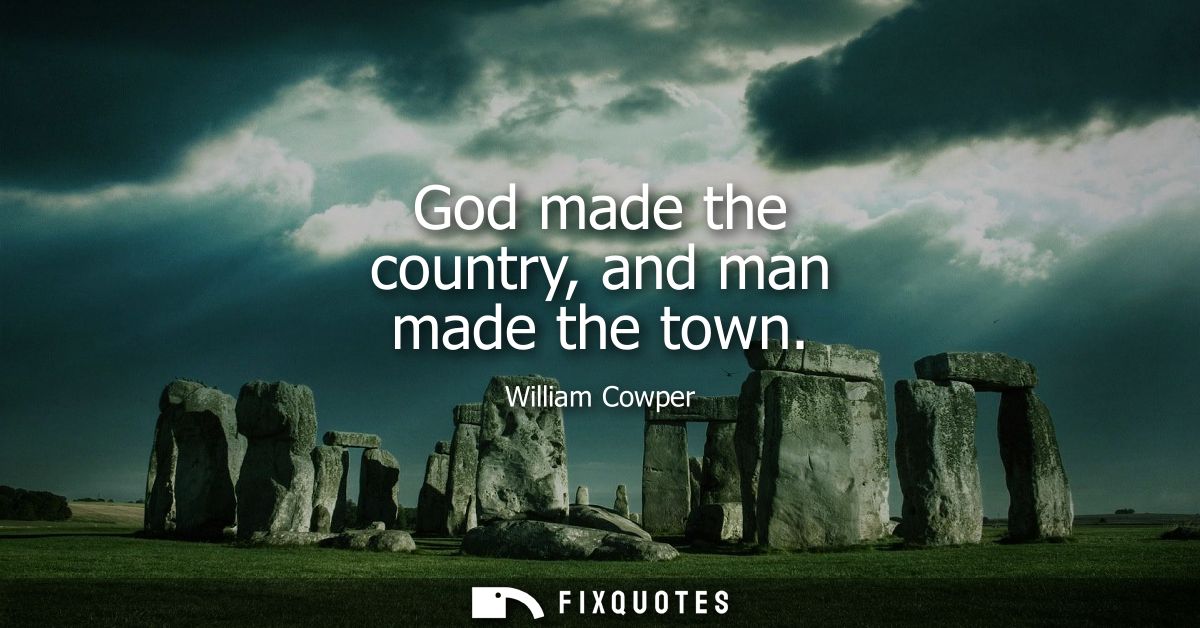
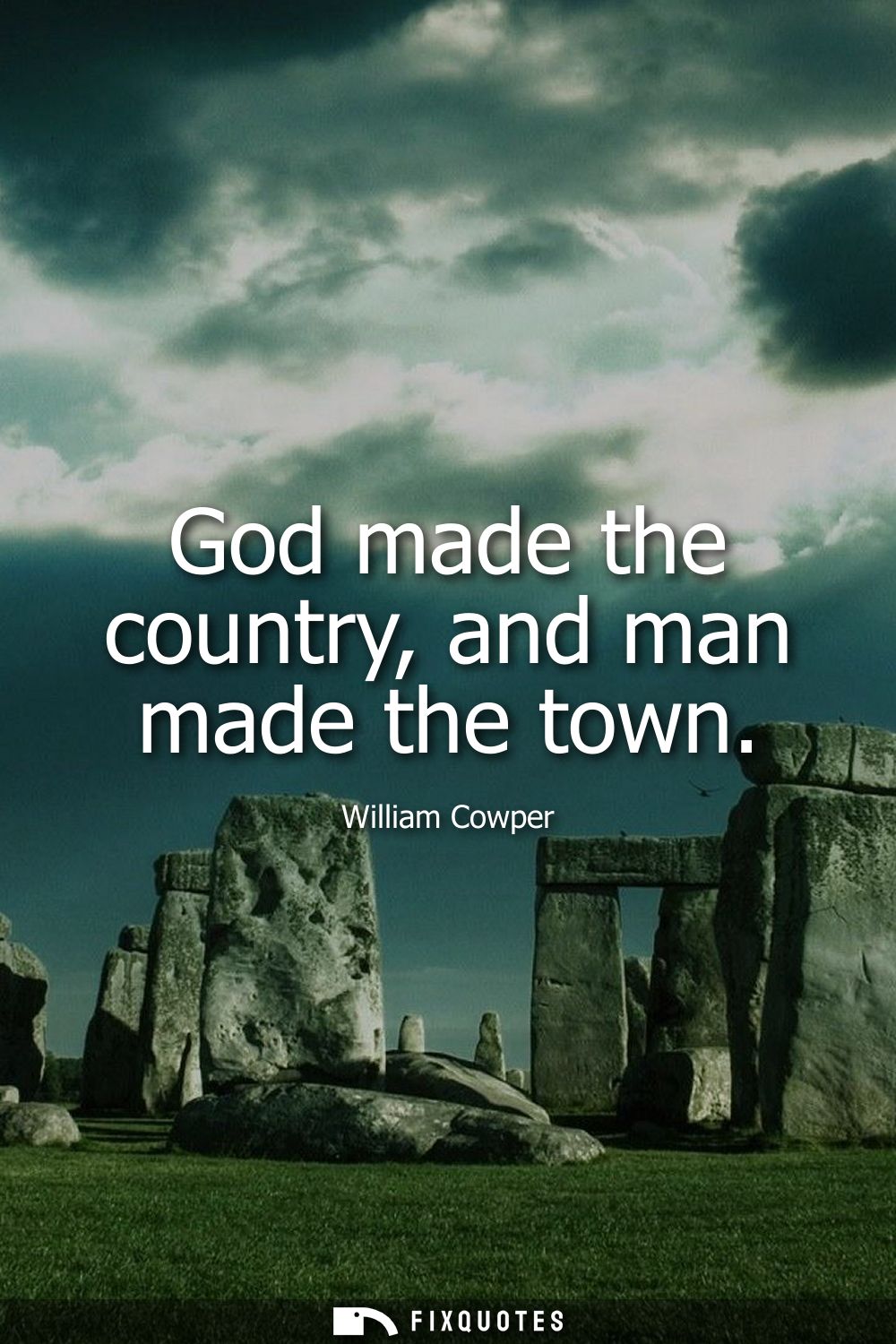
"God made the country, and man made the town"
About this Quote
Cowper’s line flatters the countryside with a deceptively simple hierarchy: God gets the country; humans get the town. It’s praise that doubles as indictment. The country arrives as creation - organic, morally legible, “made” with purpose. The town, by contrast, is fabrication: an artifact of commerce, crowding, and human restlessness. The grammar itself does the work. “God made” carries inevitability and authority; “man made” sounds busy, clever, faintly suspect. Cowper isn’t just contrasting landscapes; he’s contrasting moral atmospheres.
The subtext is an 18th-century anxiety about modernity before we had the word for it. Britain was swelling with trade, urban growth, and the early churn of industrial life. “Town” here isn’t a charming village center; it’s the social machine - status games, vice marketed as entertainment, attention turned into currency. Cowper, a religious poet who knew depression and fragility intimately, frames nature as sanctuary and the city as overstimulation: a place where the soul gets crowded out by noise and performance.
What makes the aphorism stick is how it weaponizes pastoral nostalgia without sounding like nostalgia. It’s not “the country is nicer.” It’s a claim about origin and legitimacy: one space is aligned with the divine order, the other with human ego. That sharp division flatters readers who want innocence, then quietly warns them: what we build to feel powerful can also be what deforms us.
The subtext is an 18th-century anxiety about modernity before we had the word for it. Britain was swelling with trade, urban growth, and the early churn of industrial life. “Town” here isn’t a charming village center; it’s the social machine - status games, vice marketed as entertainment, attention turned into currency. Cowper, a religious poet who knew depression and fragility intimately, frames nature as sanctuary and the city as overstimulation: a place where the soul gets crowded out by noise and performance.
What makes the aphorism stick is how it weaponizes pastoral nostalgia without sounding like nostalgia. It’s not “the country is nicer.” It’s a claim about origin and legitimacy: one space is aligned with the divine order, the other with human ego. That sharp division flatters readers who want innocence, then quietly warns them: what we build to feel powerful can also be what deforms us.
Quote Details
| Topic | Nature |
|---|---|
| Source | Attributed to William Cowper — short quotation appears in reference sources (see Wikiquote entry). |
| Cite |
Citation Formats
APA Style (7th ed.)
Cowper, William. (2026, January 18). God made the country, and man made the town. FixQuotes. https://fixquotes.com/quotes/god-made-the-country-and-man-made-the-town-2534/
Chicago Style
Cowper, William. "God made the country, and man made the town." FixQuotes. January 18, 2026. https://fixquotes.com/quotes/god-made-the-country-and-man-made-the-town-2534/.
MLA Style (9th ed.)
"God made the country, and man made the town." FixQuotes, 18 Jan. 2026, https://fixquotes.com/quotes/god-made-the-country-and-man-made-the-town-2534/. Accessed 19 Mar. 2026.
More Quotes by William
Add to List