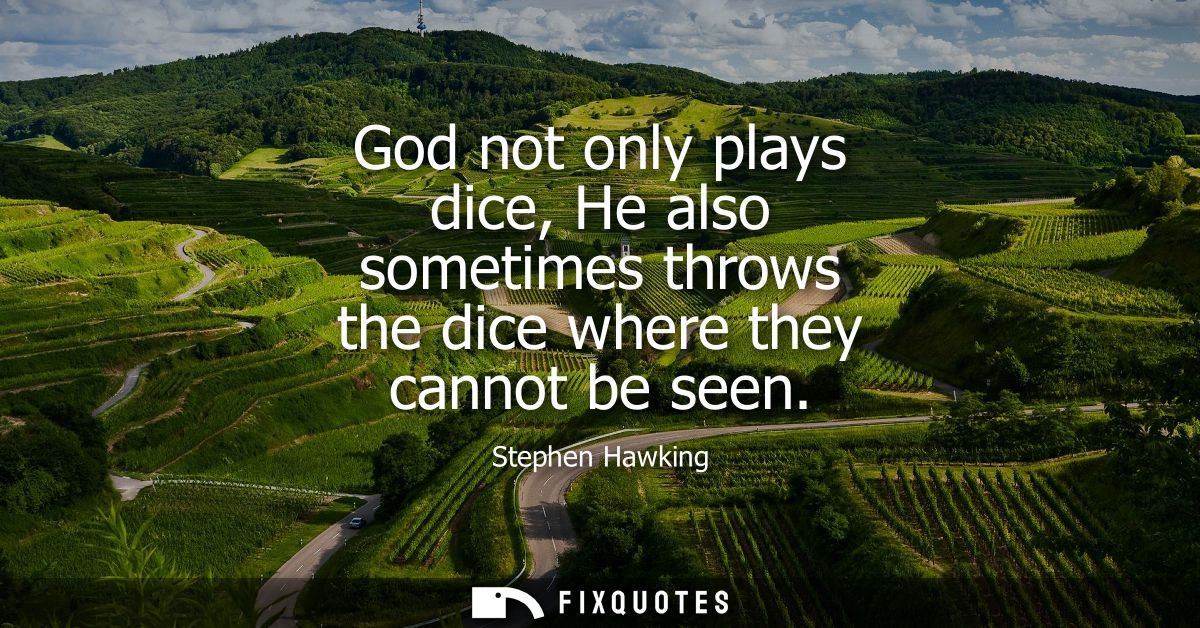
"God not only plays dice, He also sometimes throws the dice where they cannot be seen"
About this Quote
Intent-wise, Hawking is doing two things at once. He's defending modern physics' willingness to live with indeterminacy (quantum mechanics) while also warning against the cozy belief that uncertainty is merely a temporary gap in knowledge. If the dice land where we can't see them, then no amount of better instrumentation or cleverer math guarantees a full accounting. That's not anti-science; it's a bracing statement about the limits science might run into.
The subtext is a jab at determinism dressed up as humility. Einstein could tolerate hidden variables - the idea that the universe only looks random because we haven't found the mechanism. Hawking implies a harsher possibility: the mechanism might be fundamentally inaccessible, not just currently unknown. It's a line that flirts with theological language ("God") while actually stripping it of comfort. Here, "God" is just shorthand for nature's rulebook, and the rulebook doesn't promise transparency.
Context matters: Hawking spent a career arguing about what information the universe keeps or loses, most famously in the black hole information paradox. The image of unseen dice feels tailored to horizons, censorship, and events forever sealed off from observers - physics as a spectator sport where some plays happen behind the curtain.
Quote Details
| Topic | Free Will & Fate |
|---|---|
| Source | Help us find the source |
| Cite |
Citation Formats
APA Style (7th ed.)
Hawking, Stephen. (2026, January 15). God not only plays dice, He also sometimes throws the dice where they cannot be seen. FixQuotes. https://fixquotes.com/quotes/god-not-only-plays-dice-he-also-sometimes-throws-25354/
Chicago Style
Hawking, Stephen. "God not only plays dice, He also sometimes throws the dice where they cannot be seen." FixQuotes. January 15, 2026. https://fixquotes.com/quotes/god-not-only-plays-dice-he-also-sometimes-throws-25354/.
MLA Style (9th ed.)
"God not only plays dice, He also sometimes throws the dice where they cannot be seen." FixQuotes, 15 Jan. 2026, https://fixquotes.com/quotes/god-not-only-plays-dice-he-also-sometimes-throws-25354/. Accessed 12 Feb. 2026.