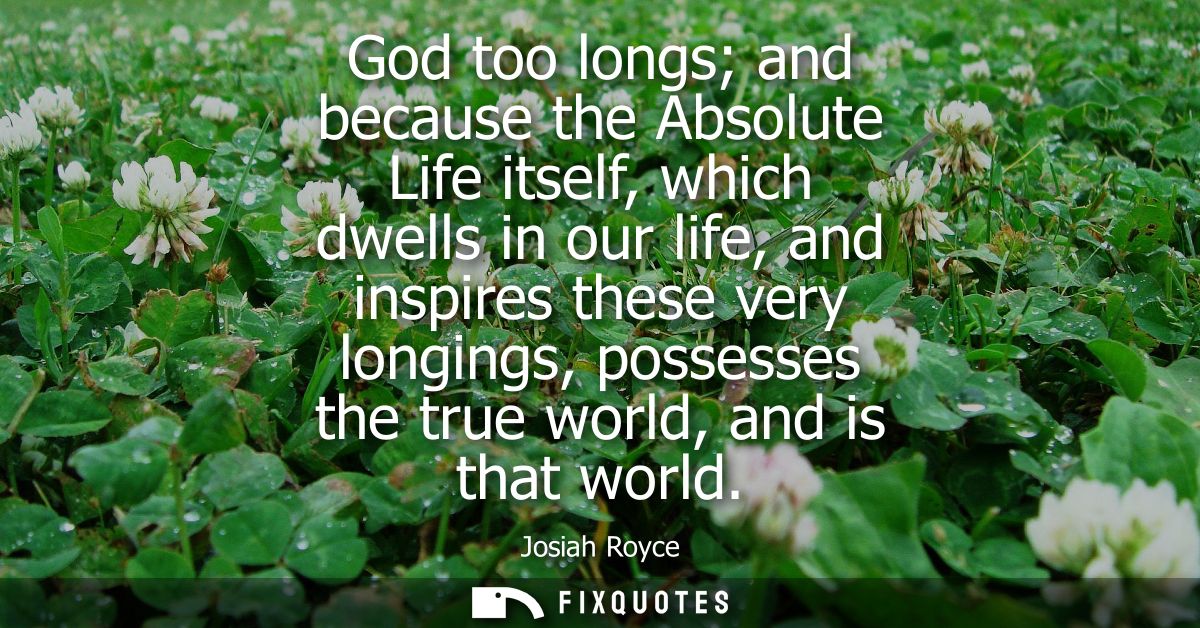
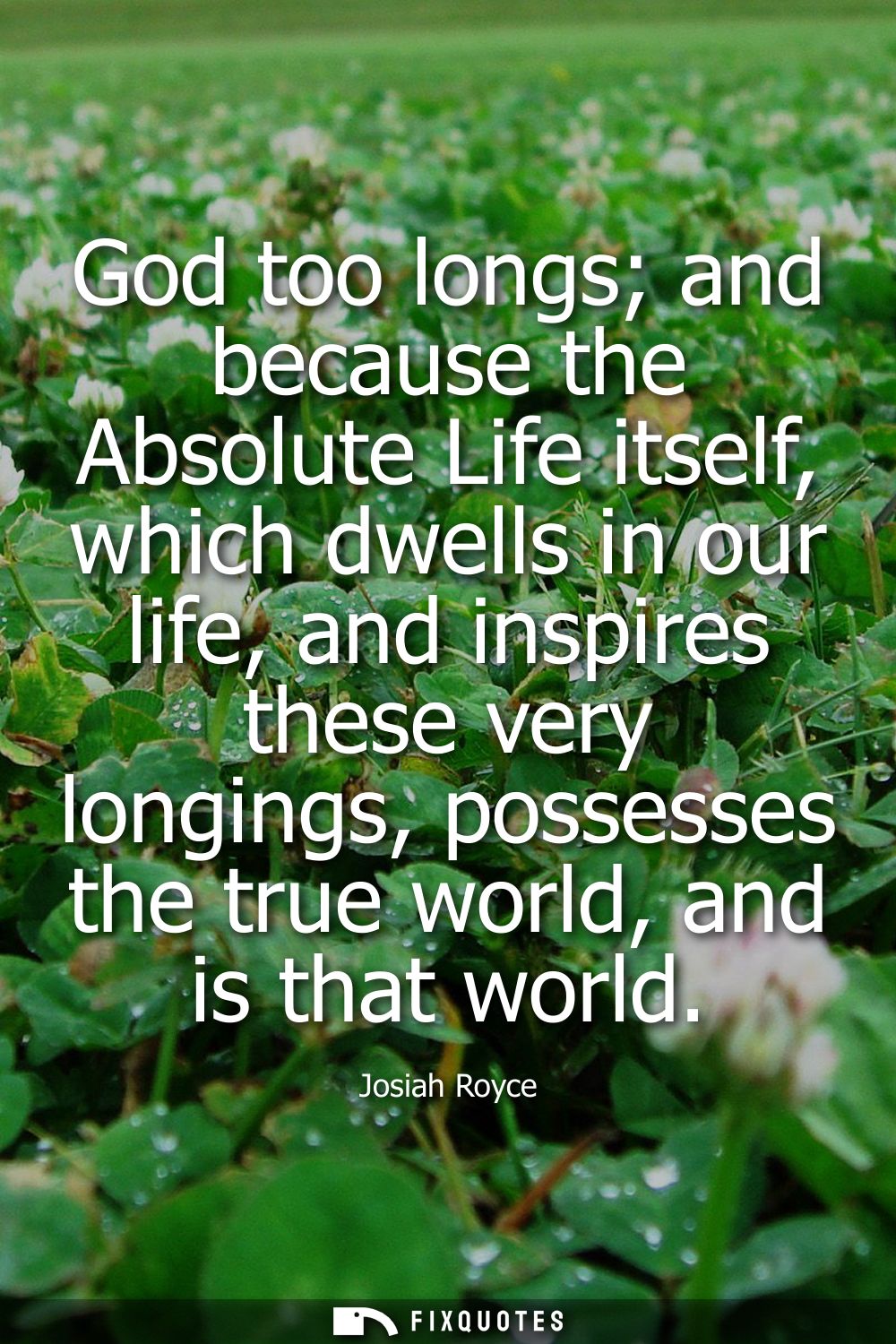
"God too longs; and because the Absolute Life itself, which dwells in our life, and inspires these very longings, possesses the true world, and is that world"
About this Quote
The sentence does its heaviest lifting with a chain of identifications: "Absolute Life" dwells in our life, inspires our longings, possesses the true world, and finally "is that world". Royce is trying to collapse the gap between inner experience and metaphysical order. Longing becomes an epistemic clue: our restlessness isn’t random appetite but the Absolute’s own motion within finite beings. It’s idealism with an emotional alibi.
The subtext is a rebuttal to two modern rivals: the bleak empiricist idea that desire is just evolutionary noise, and the religious picture of God as static perfection, beyond wanting. Royce’s God isn’t a marble monument; it’s a living, organizing consciousness that includes our unfinishedness. Historically, this sits inside late-19th-century American idealism, trying to keep spiritual meaning credible amid scientific prestige and cultural fragmentation. He’s offering a philosophy that dignifies yearning as participation in an ongoing, communal search for the “true world” rather than a private deficiency to be outgrown.
Quote Details
| Topic | God |
|---|---|
| Source | Help us find the source |
| Cite |
Citation Formats
APA Style (7th ed.)
Royce, Josiah. (2026, January 17). God too longs; and because the Absolute Life itself, which dwells in our life, and inspires these very longings, possesses the true world, and is that world. FixQuotes. https://fixquotes.com/quotes/god-too-longs-and-because-the-absolute-life-24736/
Chicago Style
Royce, Josiah. "God too longs; and because the Absolute Life itself, which dwells in our life, and inspires these very longings, possesses the true world, and is that world." FixQuotes. January 17, 2026. https://fixquotes.com/quotes/god-too-longs-and-because-the-absolute-life-24736/.
MLA Style (9th ed.)
"God too longs; and because the Absolute Life itself, which dwells in our life, and inspires these very longings, possesses the true world, and is that world." FixQuotes, 17 Jan. 2026, https://fixquotes.com/quotes/god-too-longs-and-because-the-absolute-life-24736/. Accessed 11 Mar. 2026.