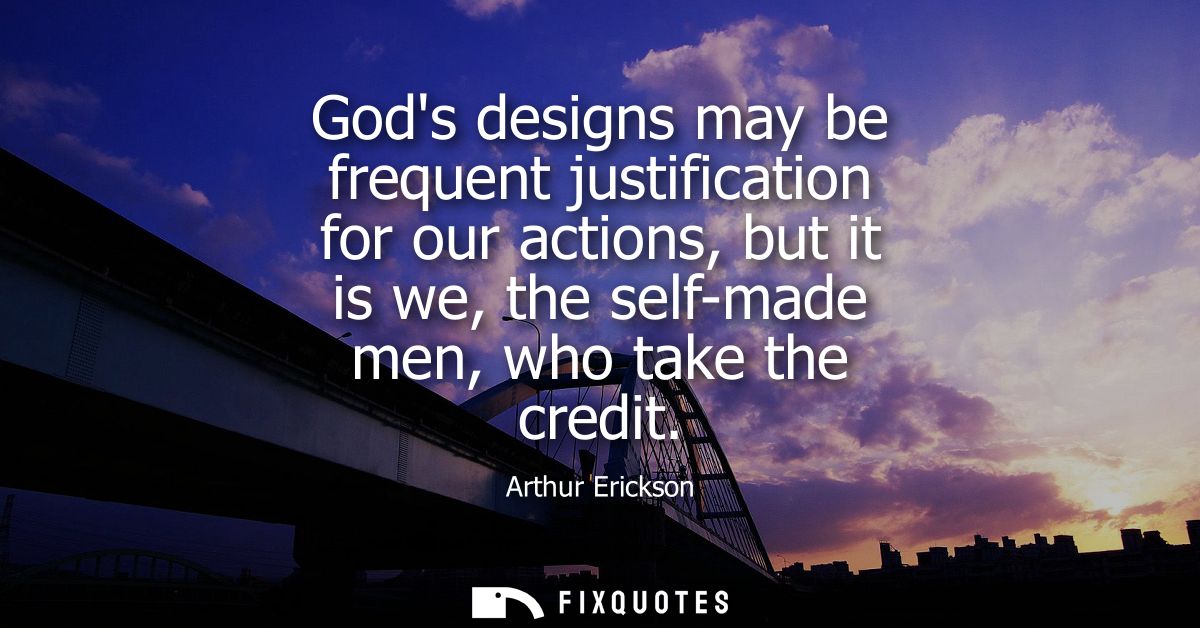
"God's designs may be frequent justification for our actions, but it is we, the self-made men, who take the credit"
About this Quote
The subtext is a critique of modern authorship and the cult of the individual creator. Architecture is famously collaborative and contingent: clients, budgets, engineers, zoning boards, labor, politics, geography. Yet the culture loves a singular genius, a brand-name architect whose signature can be marketed like a luxury good. Erickson’s “self-made men” reads as pointedly gendered, too, skewering the swaggering masculinity that historically policed who gets to claim mastery and who gets folded into the background as “support.”
There’s also an ethical sting in the reversal. Invoking God to justify actions is not neutral; it can sanctify risk, displacement, monumentality - decisions that reshape lives and cities. Erickson, working in an era when modernist ambition collided with public backlash and urban renewal’s scars, understands how easy it is to drape power in righteousness. The sentence lands because it indicts both piety-as-cover and meritocracy-as-myth, all in one clean, architectural cut.
Quote Details
| Topic | Free Will & Fate |
|---|---|
| Source | Help us find the source |
| Cite |
Citation Formats
APA Style (7th ed.)
Erickson, Arthur. (2026, January 16). God's designs may be frequent justification for our actions, but it is we, the self-made men, who take the credit. FixQuotes. https://fixquotes.com/quotes/gods-designs-may-be-frequent-justification-for-138185/
Chicago Style
Erickson, Arthur. "God's designs may be frequent justification for our actions, but it is we, the self-made men, who take the credit." FixQuotes. January 16, 2026. https://fixquotes.com/quotes/gods-designs-may-be-frequent-justification-for-138185/.
MLA Style (9th ed.)
"God's designs may be frequent justification for our actions, but it is we, the self-made men, who take the credit." FixQuotes, 16 Jan. 2026, https://fixquotes.com/quotes/gods-designs-may-be-frequent-justification-for-138185/. Accessed 31 Mar. 2026.