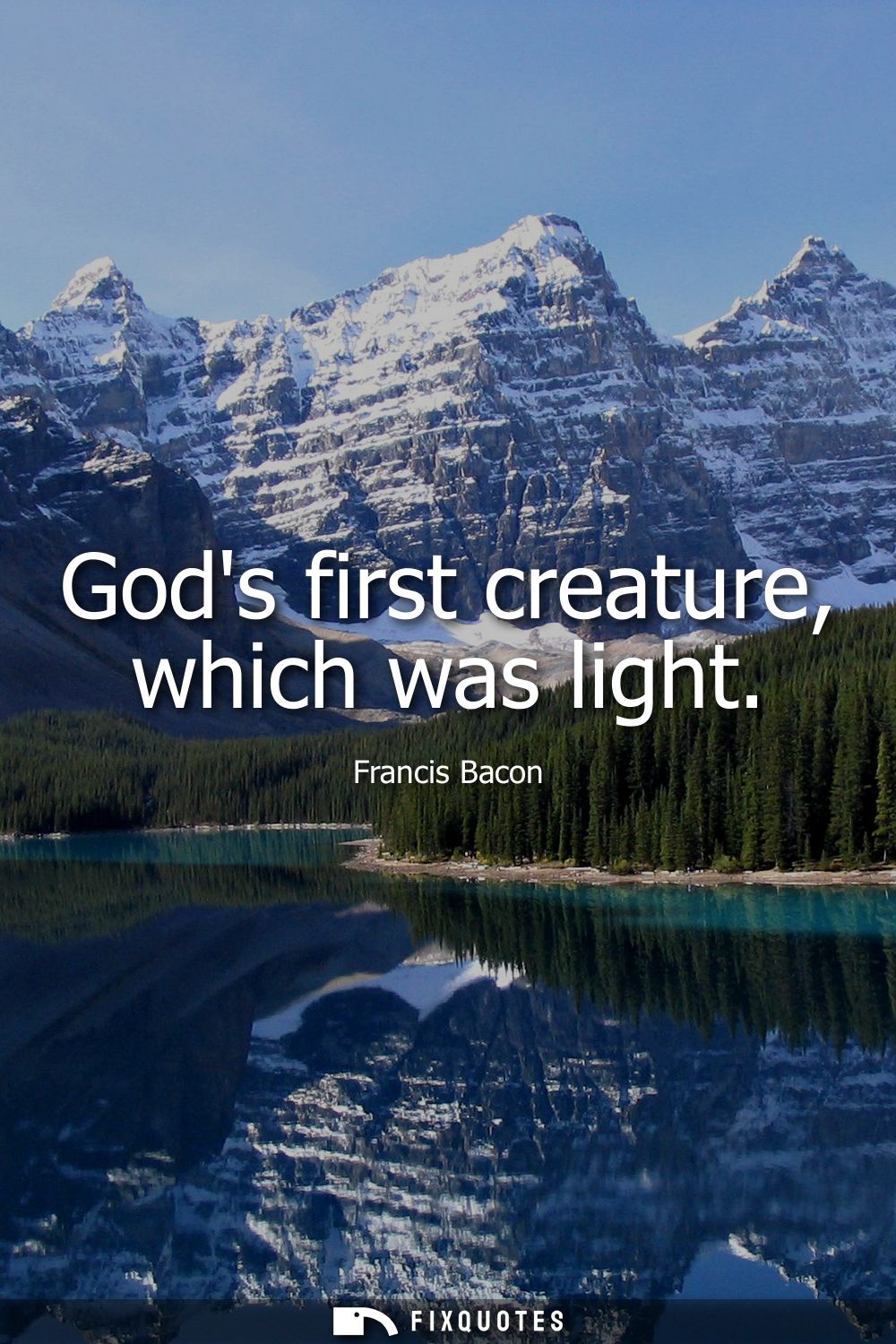
"God's first creature, which was light"
About this Quote
Bacon’s line borrows the Bible’s most stage-ready moment - “Let there be light” - and quietly rewires it into a manifesto for knowledge. Calling light “God’s first creature” does two things at once: it flatters theology (creation begins with divine order) while smuggling in an epistemological claim (creation begins with visibility, intelligibility, the conditions for measurement). Bacon isn’t merely being pious; he’s staking out a cultural hierarchy where illumination is prior to everything else, including doctrine, custom, and inherited authority.
The phrasing matters. “Creature” makes light not just a metaphor but a thing with agency and status, the inaugural product of a rational cosmos. That’s the subtext of Bacon’s broader project: science as a continuation of creation, not a rival to it. In an England still vibrating from Reformation shocks and anxious about skepticism, Bacon’s safest revolutionary move is to wrap empiricism in Genesis. He can argue for experiment, induction, and the disciplined collection of facts while appearing to defend the sacred narrative rather than replace it.
It also reads as political rhetoric, which Bacon understood intimately as a court operator. Light is the ideal royal image: it reveals, it orders, it legitimizes. By treating illumination as the first act, Bacon frames ignorance as not just error but a kind of pre-creation darkness - a state that invites governance, correction, and “advancement.” The line sells a new authority: not the old scholastic web of words, but the clarifying power of inquiry.
The phrasing matters. “Creature” makes light not just a metaphor but a thing with agency and status, the inaugural product of a rational cosmos. That’s the subtext of Bacon’s broader project: science as a continuation of creation, not a rival to it. In an England still vibrating from Reformation shocks and anxious about skepticism, Bacon’s safest revolutionary move is to wrap empiricism in Genesis. He can argue for experiment, induction, and the disciplined collection of facts while appearing to defend the sacred narrative rather than replace it.
It also reads as political rhetoric, which Bacon understood intimately as a court operator. Light is the ideal royal image: it reveals, it orders, it legitimizes. By treating illumination as the first act, Bacon frames ignorance as not just error but a kind of pre-creation darkness - a state that invites governance, correction, and “advancement.” The line sells a new authority: not the old scholastic web of words, but the clarifying power of inquiry.
Quote Details
| Topic | God |
|---|---|
| Source | Help us find the source |
| Cite |
Citation Formats
APA Style (7th ed.)
Bacon, Francis. (2026, January 18). God's first creature, which was light. FixQuotes. https://fixquotes.com/quotes/gods-first-creature-which-was-light-6623/
Chicago Style
Bacon, Francis. "God's first creature, which was light." FixQuotes. January 18, 2026. https://fixquotes.com/quotes/gods-first-creature-which-was-light-6623/.
MLA Style (9th ed.)
"God's first creature, which was light." FixQuotes, 18 Jan. 2026, https://fixquotes.com/quotes/gods-first-creature-which-was-light-6623/. Accessed 30 Mar. 2026.
More Quotes by Francis
Add to List