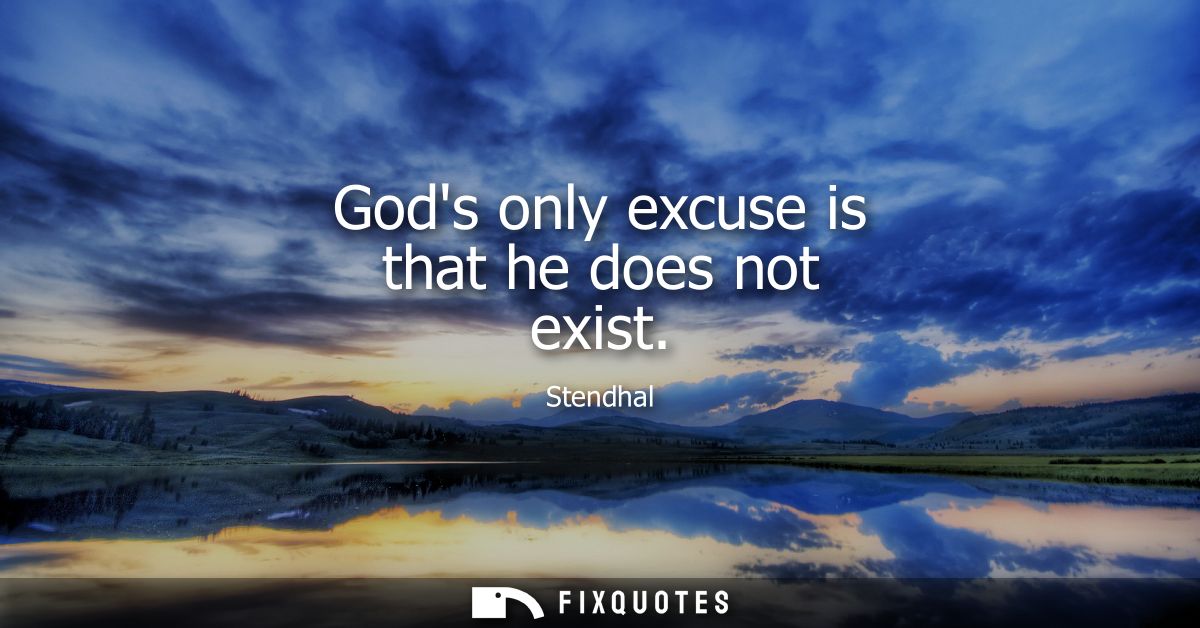
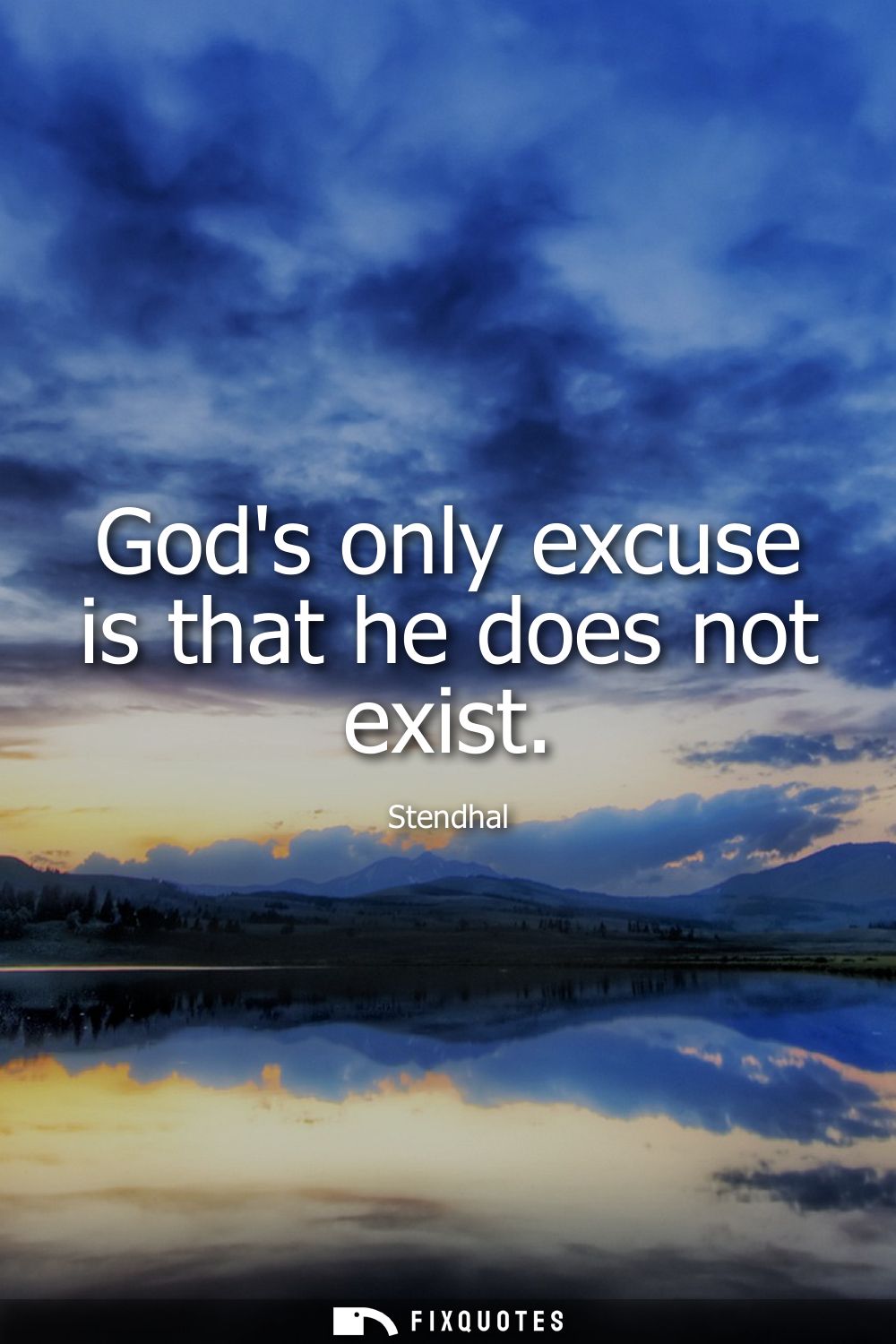
"God's only excuse is that he does not exist"
About this Quote
A line like this doesn’t just jab at God; it indicts the moral bookkeeping of the universe. Stendhal’s epigram lands because it reverses a familiar defense of suffering. If the world is cruel, believers often reach for “mysterious ways” or a divine plan. Stendhal offers a cleaner alibi: the only excuse that would actually exonerate God is nonexistence. Anything less leaves an all-powerful being complicit.
The wit is surgical. “Only excuse” smuggles in a courtroom drama: God as defendant, history as evidence, human misery as the prosecution’s exhibit A. The punchline isn’t “there is no God,” but “if there were, the case against him would be devastating.” That’s why the sentence works as both atheism and satire; it’s less metaphysics than moral pressure.
Context matters. Stendhal writes in post-Revolutionary France, in the long aftershock of Enlightenment skepticism and Napoleonic disillusionment. Institutions that once claimed sacred legitimacy had shown their teeth: the Terror, imperial wars, restored monarchies. In that landscape, piety can look like public relations for power. His line distills a modern suspicion that theology often functions as damage control for reality’s brutality.
Subtextually, it’s also a critique of easy consolation. The statement refuses the sentimental bargain where faith smooths over injustice. If you insist on an omnipotent, benevolent ruler of creation, Stendhal implies, you inherit the unbearable task of defending the indefensible.
The wit is surgical. “Only excuse” smuggles in a courtroom drama: God as defendant, history as evidence, human misery as the prosecution’s exhibit A. The punchline isn’t “there is no God,” but “if there were, the case against him would be devastating.” That’s why the sentence works as both atheism and satire; it’s less metaphysics than moral pressure.
Context matters. Stendhal writes in post-Revolutionary France, in the long aftershock of Enlightenment skepticism and Napoleonic disillusionment. Institutions that once claimed sacred legitimacy had shown their teeth: the Terror, imperial wars, restored monarchies. In that landscape, piety can look like public relations for power. His line distills a modern suspicion that theology often functions as damage control for reality’s brutality.
Subtextually, it’s also a critique of easy consolation. The statement refuses the sentimental bargain where faith smooths over injustice. If you insist on an omnipotent, benevolent ruler of creation, Stendhal implies, you inherit the unbearable task of defending the indefensible.
Quote Details
| Topic | God |
|---|---|
| Source | Later attribution: The Ninth (Harvey Sachs, 2010) modern compilationISBN: 9780571270958 · ID: 9nMq7Z8992MC
Evidence:
... Stendhal was an unlikely Romantic . As a young man he had studied mathematics , and throughout his life he shunned all forms of mysticism and religion . " God's only excuse is that he does not exist , " he said , in what Nietzsche ... |
| Cite |
Citation Formats
APA Style (7th ed.)
Stendhal. (2026, February 28). God's only excuse is that he does not exist. FixQuotes. https://fixquotes.com/quotes/gods-only-excuse-is-that-he-does-not-exist-21314/
Chicago Style
Stendhal. "God's only excuse is that he does not exist." FixQuotes. February 28, 2026. https://fixquotes.com/quotes/gods-only-excuse-is-that-he-does-not-exist-21314/.
MLA Style (9th ed.)
"God's only excuse is that he does not exist." FixQuotes, 28 Feb. 2026, https://fixquotes.com/quotes/gods-only-excuse-is-that-he-does-not-exist-21314/. Accessed 10 Mar. 2026.
More Quotes by Stendhal
Add to List