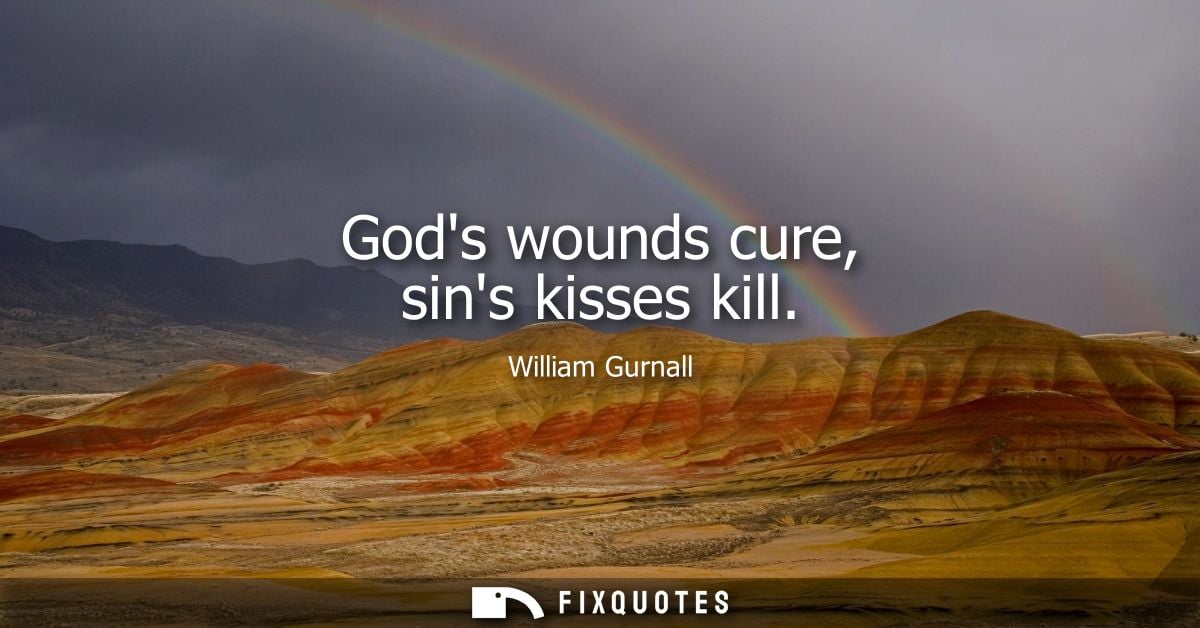
"God's wounds cure, sin's kisses kill"
About this Quote
“God’s wounds cure, sin’s kisses kill” has the cold snap of a proverb and the violence of a warning label. Gurnall, a 17th-century Puritan divine, writes in a world where the soul is not a metaphor but a contested territory. The line is engineered to reverse your instincts: wounds are supposed to harm; kisses are supposed to comfort. By flipping those expectations, he dramatizes a core Puritan conviction that the most reliable forms of danger arrive dressed as pleasure, while the most reliable forms of help often feel like pain.
The “wounds” are not random suffering; they’re corrective strikes: conviction, rebuke, discipline, the hard inward laceration of realizing you’ve been living wrong. Puritan spirituality prized that discomfort as evidence of grace at work. A God who never “wounds” is, in this logic, a God who leaves you untreated. The cure is not soothing; it’s surgical.
“Sin’s kisses,” meanwhile, are intimacy as ambush. Sin doesn’t usually show up snarling; it flatters, offers relief, promises belonging, whispers that the rules are for other people. Gurnall’s subtext is psychological as much as theological: temptation succeeds by mimicking care. The kiss is lethal because it disarms the conscience, making self-destruction feel like self-expression.
Context matters: post-Reformation England was steeped in sermons, self-examination, and anxiety about hypocrisy. Gurnall’s phrasing is a rhetorical tool meant to make readers suspicious of easy comforts and receptive to hard truths. It’s piety written with a strategist’s eye: shock the senses, then train the moral reflex.
The “wounds” are not random suffering; they’re corrective strikes: conviction, rebuke, discipline, the hard inward laceration of realizing you’ve been living wrong. Puritan spirituality prized that discomfort as evidence of grace at work. A God who never “wounds” is, in this logic, a God who leaves you untreated. The cure is not soothing; it’s surgical.
“Sin’s kisses,” meanwhile, are intimacy as ambush. Sin doesn’t usually show up snarling; it flatters, offers relief, promises belonging, whispers that the rules are for other people. Gurnall’s subtext is psychological as much as theological: temptation succeeds by mimicking care. The kiss is lethal because it disarms the conscience, making self-destruction feel like self-expression.
Context matters: post-Reformation England was steeped in sermons, self-examination, and anxiety about hypocrisy. Gurnall’s phrasing is a rhetorical tool meant to make readers suspicious of easy comforts and receptive to hard truths. It’s piety written with a strategist’s eye: shock the senses, then train the moral reflex.
Quote Details
| Topic | God |
|---|---|
| Source | Help us find the source |
More Quotes by William
Add to List