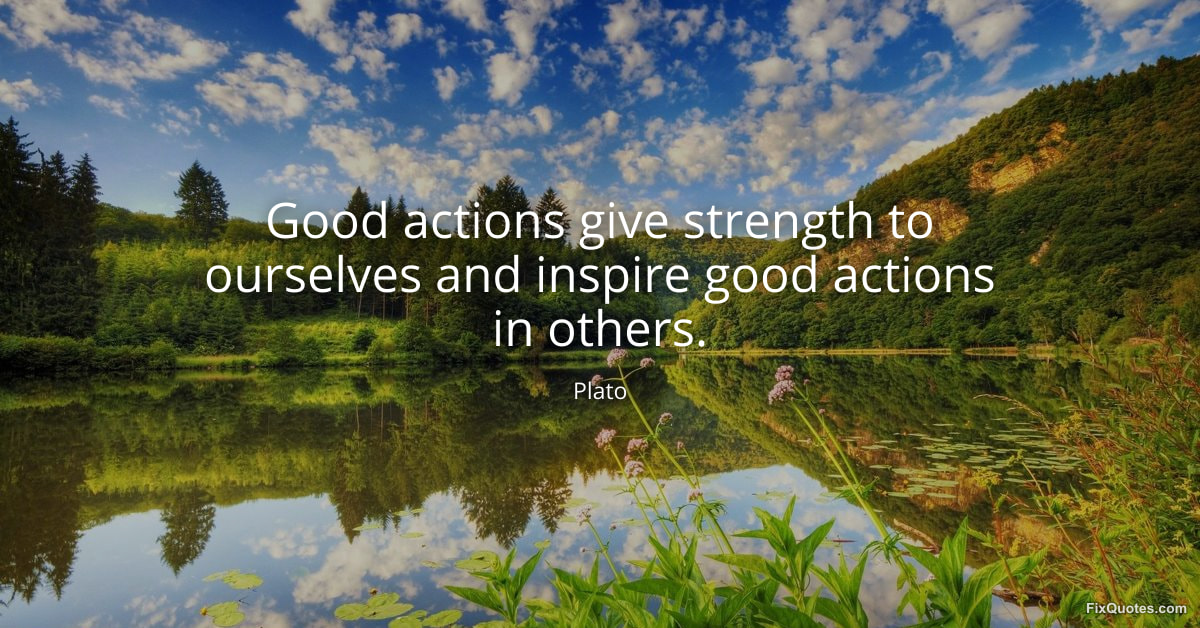
"Good actions give strength to ourselves and inspire good actions in others"
About this Quote
Moral behavior, for Plato, isn’t a public-relations strategy. It’s weight training for the soul. “Good actions give strength to ourselves” carries the unmistakable Platonic idea that virtue is not just a rule you follow but a condition you build: a harmony in which reason governs appetite and anger rather than getting dragged around by them. You don’t become just by believing in justice; you become just by practicing it until it reshapes your inner life. The “strength” here isn’t muscle or status but a kind of psychic resilience - the ability to stay aligned with what’s right when temptation, fear, or crowd pressure tries to hijack the steering wheel.
The second clause shifts from interior architecture to social contagion. Plato was fascinated (and worried) by imitation: in the Republic he treats art, rhetoric, and public spectacle as forces that train citizens’ desires, often badly. Read in that light, inspiring “good actions in others” isn’t a soft add-on; it’s a political claim. Every ethical choice is also civic pedagogy. People learn what’s acceptable by watching what gets done, rewarded, excused.
The subtext is a rebuke to moral minimalism. Goodness isn’t merely refraining from harm; it’s an active practice that compounds. Plato’s world was a democracy vulnerable to demagogues and a city still haunted by Socrates’ execution. In that context, private virtue becomes a form of public defense: a model that counters the seductive strength of bad examples with the quieter authority of a life lived coherently.
The second clause shifts from interior architecture to social contagion. Plato was fascinated (and worried) by imitation: in the Republic he treats art, rhetoric, and public spectacle as forces that train citizens’ desires, often badly. Read in that light, inspiring “good actions in others” isn’t a soft add-on; it’s a political claim. Every ethical choice is also civic pedagogy. People learn what’s acceptable by watching what gets done, rewarded, excused.
The subtext is a rebuke to moral minimalism. Goodness isn’t merely refraining from harm; it’s an active practice that compounds. Plato’s world was a democracy vulnerable to demagogues and a city still haunted by Socrates’ execution. In that context, private virtue becomes a form of public defense: a model that counters the seductive strength of bad examples with the quieter authority of a life lived coherently.
Quote Details
| Topic | Kindness |
|---|---|
| Source | Help us find the source |
| Cite |
Citation Formats
APA Style (7th ed.)
Plato. (2026, January 15). Good actions give strength to ourselves and inspire good actions in others. FixQuotes. https://fixquotes.com/quotes/good-actions-give-strength-to-ourselves-and-29277/
Chicago Style
Plato. "Good actions give strength to ourselves and inspire good actions in others." FixQuotes. January 15, 2026. https://fixquotes.com/quotes/good-actions-give-strength-to-ourselves-and-29277/.
MLA Style (9th ed.)
"Good actions give strength to ourselves and inspire good actions in others." FixQuotes, 15 Jan. 2026, https://fixquotes.com/quotes/good-actions-give-strength-to-ourselves-and-29277/. Accessed 31 Mar. 2026.
More Quotes by Plato
Add to List