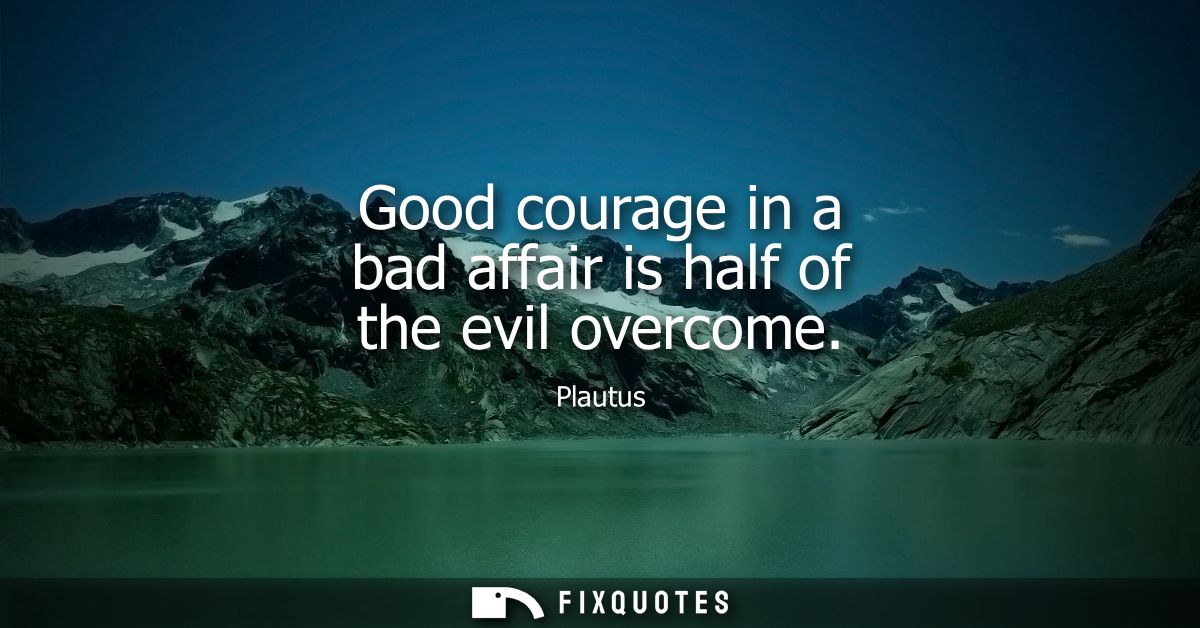
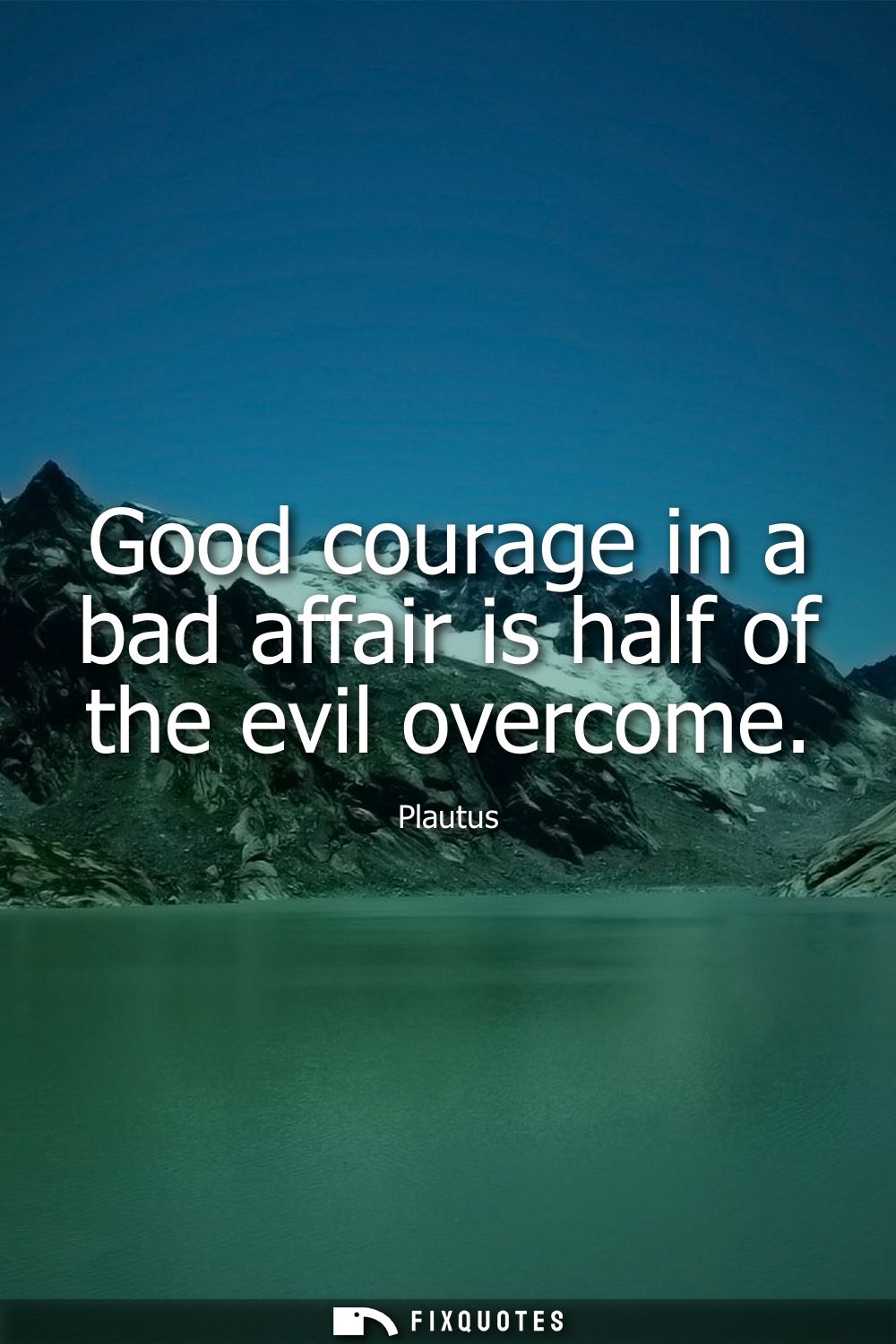
"Good courage in a bad affair is half of the evil overcome"
About this Quote
Bravery, Plautus suggests, is not a moral badge so much as a practical lever. In a world where the “affair” is already bad - a mess of debt, betrayal, bad luck, or bad judgment, all staples of Roman comedy - “good courage” becomes damage control. The line is calibrated to sound almost like bookkeeping: courage doesn’t erase the problem; it reduces the cost. Half the evil is “overcome” not because fate turns kind, but because fear stops compounding the loss.
The intent is quietly tactical. Plautus isn’t writing philosophy in marble; he’s writing for a stage where characters are forever improvising their way out of social traps. Courage here reads less like heroic grandstanding and more like the steady nerve that keeps a schemer from panicking, a servant from folding, a lover from botching the plan. It’s an endorsement of composure, not righteousness.
The subtext is equally Roman: bad affairs happen, often through human folly, and no god is obliged to tidy them. What you can control is your posture inside the crisis. “Good” courage matters because courage alone can be reckless; the adjective implies judgment, the ability to hold a line without making the situation worse.
Contextually, Plautus’ audience knew instability - war, slavery, status anxiety - and his comedies metabolized that into laughter. This aphorism works because it lands like a punchline with teeth: the world stays ugly, but a clear head can slice the ugliness down to size.
The intent is quietly tactical. Plautus isn’t writing philosophy in marble; he’s writing for a stage where characters are forever improvising their way out of social traps. Courage here reads less like heroic grandstanding and more like the steady nerve that keeps a schemer from panicking, a servant from folding, a lover from botching the plan. It’s an endorsement of composure, not righteousness.
The subtext is equally Roman: bad affairs happen, often through human folly, and no god is obliged to tidy them. What you can control is your posture inside the crisis. “Good” courage matters because courage alone can be reckless; the adjective implies judgment, the ability to hold a line without making the situation worse.
Contextually, Plautus’ audience knew instability - war, slavery, status anxiety - and his comedies metabolized that into laughter. This aphorism works because it lands like a punchline with teeth: the world stays ugly, but a clear head can slice the ugliness down to size.
Quote Details
| Topic | Overcoming Obstacles |
|---|---|
| Source | Help us find the source |
| Cite |
Citation Formats
APA Style (7th ed.)
Plautus. (2026, January 18). Good courage in a bad affair is half of the evil overcome. FixQuotes. https://fixquotes.com/quotes/good-courage-in-a-bad-affair-is-half-of-the-evil-6739/
Chicago Style
Plautus. "Good courage in a bad affair is half of the evil overcome." FixQuotes. January 18, 2026. https://fixquotes.com/quotes/good-courage-in-a-bad-affair-is-half-of-the-evil-6739/.
MLA Style (9th ed.)
"Good courage in a bad affair is half of the evil overcome." FixQuotes, 18 Jan. 2026, https://fixquotes.com/quotes/good-courage-in-a-bad-affair-is-half-of-the-evil-6739/. Accessed 8 Apr. 2026.
More Quotes by Plautus
Add to List