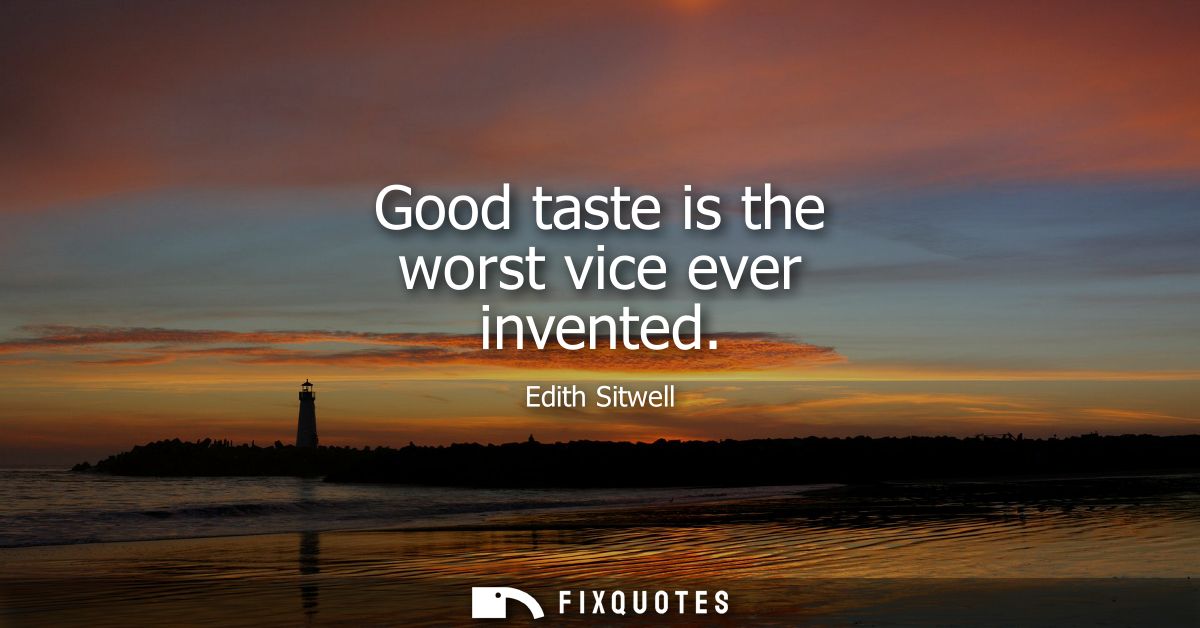
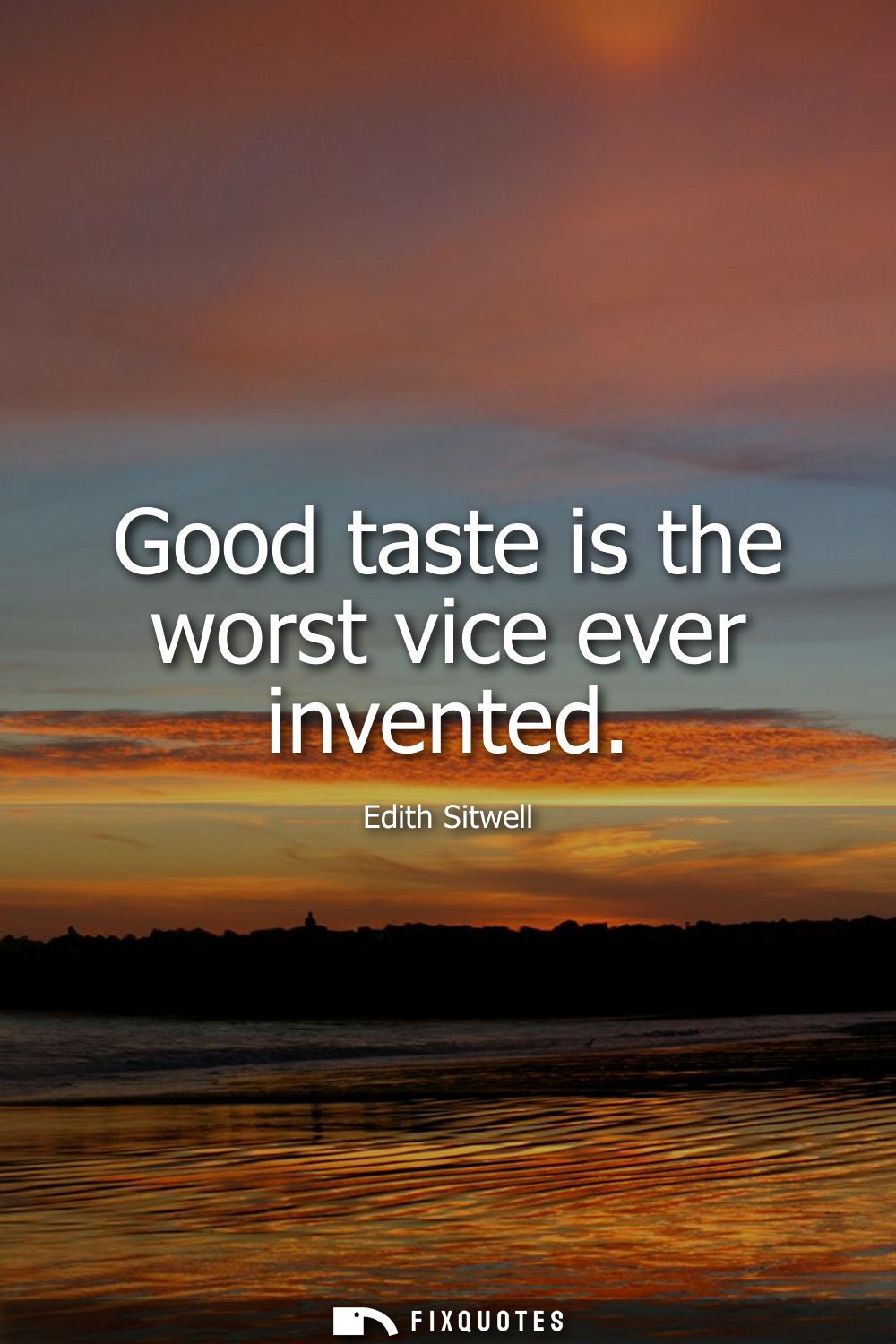
"Good taste is the worst vice ever invented"
About this Quote
"Good taste" sounds like a compliment until Sitwell twists it into a sin. Calling it "the worst vice" is a deliciously barbed reversal: taste, that supposedly civilizing faculty, becomes a covert addiction to approval. The line works because it treats refinement not as a neutral preference but as a social technology, a way to police imagination while pretending to merely curate it.
Sitwell is writing from inside a period that made "taste" a moral category. In early 20th-century Britain, the right books, the right wallpaper, the right accent functioned as class passwords; modernism, meanwhile, was busy smashing the old furniture. Sitwell, an eccentric aristocrat with an avant-garde streak, knew both the seductions and the suffocations of that system. Her jab lands with extra force because she isn't rejecting beauty; she's rejecting the bureaucratic version of beauty, the kind that arrives pre-approved, dampens risk, and mistakes restraint for virtue.
The subtext is that "good taste" isn't simply conservative; it's cowardly. It rewards the safe and punishes the strange, and it does so while wearing the halo of sensibility. By labeling it a vice, Sitwell suggests it operates like any other: it narrows the self, breeds hypocrisy, and encourages performance over perception. The sharpest irony is that good taste often presents itself as the antidote to vulgarity, yet in her formulation it becomes its own vulgarity: an obsession with being seen as correct.
Sitwell is writing from inside a period that made "taste" a moral category. In early 20th-century Britain, the right books, the right wallpaper, the right accent functioned as class passwords; modernism, meanwhile, was busy smashing the old furniture. Sitwell, an eccentric aristocrat with an avant-garde streak, knew both the seductions and the suffocations of that system. Her jab lands with extra force because she isn't rejecting beauty; she's rejecting the bureaucratic version of beauty, the kind that arrives pre-approved, dampens risk, and mistakes restraint for virtue.
The subtext is that "good taste" isn't simply conservative; it's cowardly. It rewards the safe and punishes the strange, and it does so while wearing the halo of sensibility. By labeling it a vice, Sitwell suggests it operates like any other: it narrows the self, breeds hypocrisy, and encourages performance over perception. The sharpest irony is that good taste often presents itself as the antidote to vulgarity, yet in her formulation it becomes its own vulgarity: an obsession with being seen as correct.
Quote Details
| Topic | Witty One-Liners |
|---|---|
| Source | Help us find the source |
| Cite |
Citation Formats
APA Style (7th ed.)
Sitwell, Edith. (2026, January 18). Good taste is the worst vice ever invented. FixQuotes. https://fixquotes.com/quotes/good-taste-is-the-worst-vice-ever-invented-8444/
Chicago Style
Sitwell, Edith. "Good taste is the worst vice ever invented." FixQuotes. January 18, 2026. https://fixquotes.com/quotes/good-taste-is-the-worst-vice-ever-invented-8444/.
MLA Style (9th ed.)
"Good taste is the worst vice ever invented." FixQuotes, 18 Jan. 2026, https://fixquotes.com/quotes/good-taste-is-the-worst-vice-ever-invented-8444/. Accessed 19 Feb. 2026.
More Quotes by Edith
Add to List