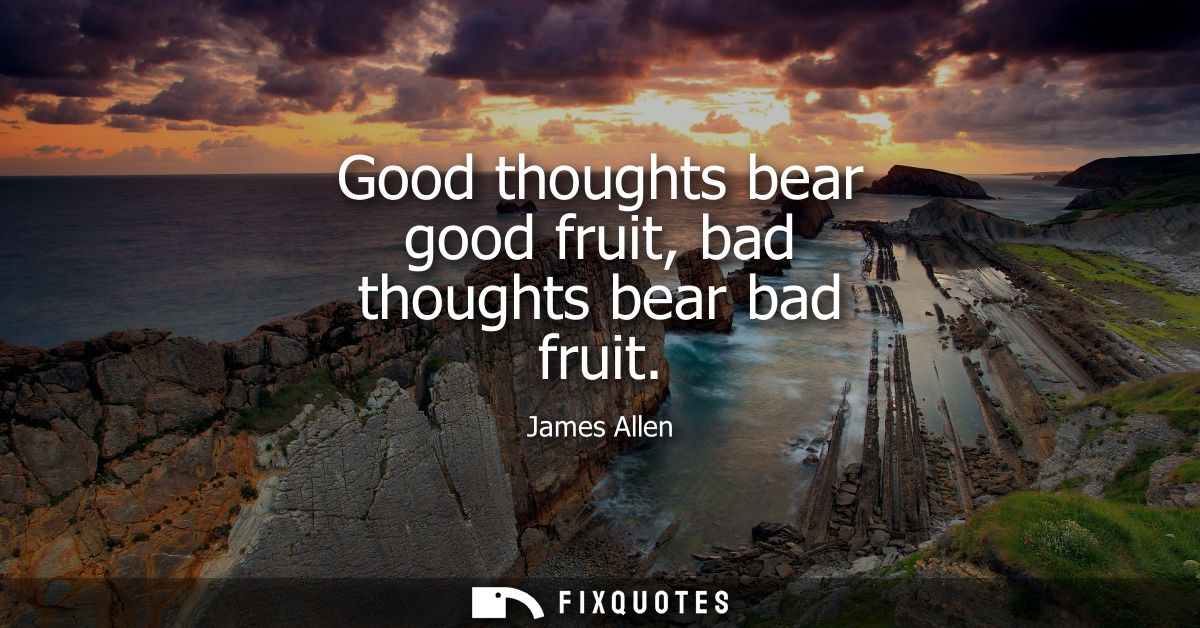
"Good thoughts bear good fruit, bad thoughts bear bad fruit"
About this Quote
Allen’s line is moral cause-and-effect dressed up as gardening advice: tidy, memorable, and quietly coercive. “Bear” does a lot of work here. Thoughts aren’t just private weather in the mind; they’re living things with consequences, reproducing into the world. It’s a Victorian-era upgrade of Proverbs for the self-help age: character becomes destiny, but now the “character” is your internal monologue.
The intent is practical and disciplinary. If you can be persuaded that outcomes are the fruit of your thinking, you’ll police your own mind. That’s the genius and the trap. It offers control in an uncertain world: no priests, no institutions, just you and your mental habits. But it also smuggles in a harsh subtext: if your life is bitter, your thoughts were rotten. The quote flattens structural realities - poverty, illness, discrimination - into personal mental hygiene. Comforting for readers who want a lever to pull; brutal for anyone already burdened.
Context matters. Allen wrote at a moment when industrial modernity was fraying older certainties and “mind cure” philosophies were taking off. His broader project (as in As a Man Thinketh) is to make self-mastery feel both ethical and achievable. The line works because it’s simple enough to remember, moral enough to feel true, and elastic enough to apply to almost anything. It’s a slogan for inward accountability, with an implicit promise: change the seed, change the harvest.
The intent is practical and disciplinary. If you can be persuaded that outcomes are the fruit of your thinking, you’ll police your own mind. That’s the genius and the trap. It offers control in an uncertain world: no priests, no institutions, just you and your mental habits. But it also smuggles in a harsh subtext: if your life is bitter, your thoughts were rotten. The quote flattens structural realities - poverty, illness, discrimination - into personal mental hygiene. Comforting for readers who want a lever to pull; brutal for anyone already burdened.
Context matters. Allen wrote at a moment when industrial modernity was fraying older certainties and “mind cure” philosophies were taking off. His broader project (as in As a Man Thinketh) is to make self-mastery feel both ethical and achievable. The line works because it’s simple enough to remember, moral enough to feel true, and elastic enough to apply to almost anything. It’s a slogan for inward accountability, with an implicit promise: change the seed, change the harvest.
Quote Details
| Topic | Wisdom |
|---|---|
| Source | Help us find the source |
| Cite |
Citation Formats
APA Style (7th ed.)
Allen, James. (2026, January 17). Good thoughts bear good fruit, bad thoughts bear bad fruit. FixQuotes. https://fixquotes.com/quotes/good-thoughts-bear-good-fruit-bad-thoughts-bear-25828/
Chicago Style
Allen, James. "Good thoughts bear good fruit, bad thoughts bear bad fruit." FixQuotes. January 17, 2026. https://fixquotes.com/quotes/good-thoughts-bear-good-fruit-bad-thoughts-bear-25828/.
MLA Style (9th ed.)
"Good thoughts bear good fruit, bad thoughts bear bad fruit." FixQuotes, 17 Jan. 2026, https://fixquotes.com/quotes/good-thoughts-bear-good-fruit-bad-thoughts-bear-25828/. Accessed 26 Mar. 2026.
More Quotes by James
Add to List