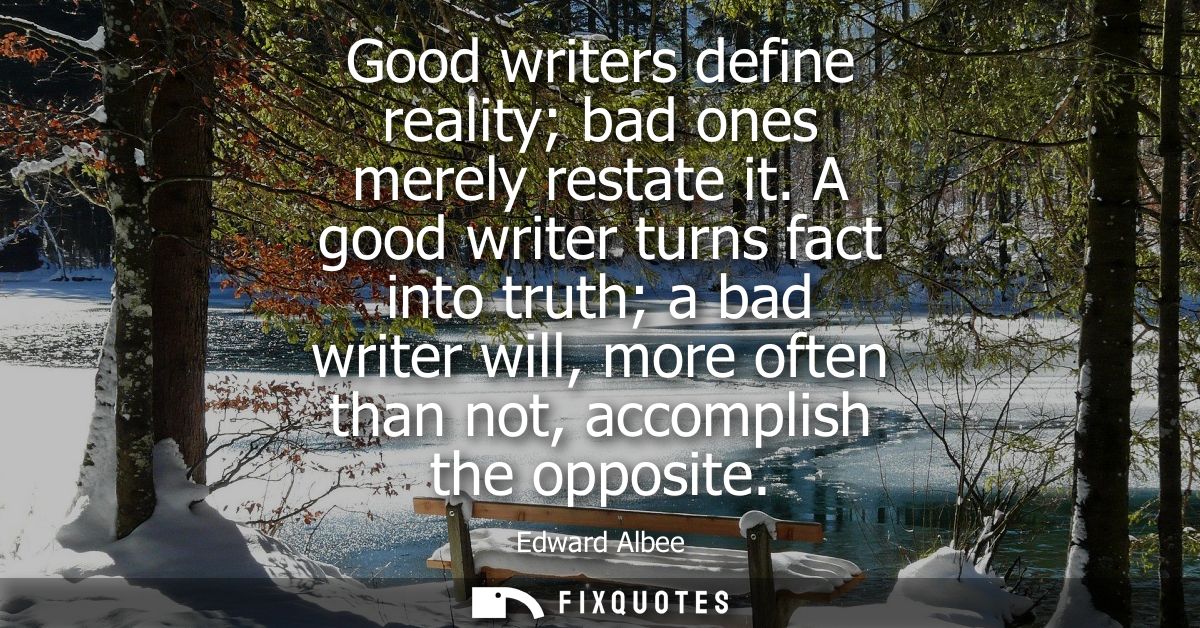
"Good writers define reality; bad ones merely restate it. A good writer turns fact into truth; a bad writer will, more often than not, accomplish the opposite"
About this Quote
Albee’s jab lands because it treats writing less as transcription than as stagecraft: the world is there, sure, but “reality” is what an audience agrees to inside a room. As a dramatist, he knows facts are cheap props; truth is the lighting, blocking, and timing that make those props feel inevitable. “Define reality” isn’t a plea for accuracy. It’s a claim about power: the writer sets the terms of perception, deciding what counts as normal, what gets named, what remains unspeakable.
The sly move is in the moral gradient he draws between fact and truth. Fact is data; truth is the human meaning extracted under pressure. Albee’s best plays thrive on that pressure: domestic chatter becomes a weapon, politeness becomes violence, and the “real” story is what characters refuse to admit. So when he says bad writers “merely restate” reality, he’s also indicting a kind of cowardice - the safe summary, the dutiful realism that reproduces the surface world without interrogating it.
The sting in the second sentence is sharper: bad writing can “accomplish the opposite,” turning fact into falsehood. That’s not just about clumsy prose; it’s about narrative malpractice. Arrange facts without insight and you don’t stay neutral - you smuggle in distortions, clichés, propaganda, or sentimentality. Albee wrote in a postwar American culture obsessed with appearances and consensus. His point is that the writer’s job is to puncture that consensus, not varnish it. Truth, in his worldview, is crafted - and the craft carries ethical consequences.
The sly move is in the moral gradient he draws between fact and truth. Fact is data; truth is the human meaning extracted under pressure. Albee’s best plays thrive on that pressure: domestic chatter becomes a weapon, politeness becomes violence, and the “real” story is what characters refuse to admit. So when he says bad writers “merely restate” reality, he’s also indicting a kind of cowardice - the safe summary, the dutiful realism that reproduces the surface world without interrogating it.
The sting in the second sentence is sharper: bad writing can “accomplish the opposite,” turning fact into falsehood. That’s not just about clumsy prose; it’s about narrative malpractice. Arrange facts without insight and you don’t stay neutral - you smuggle in distortions, clichés, propaganda, or sentimentality. Albee wrote in a postwar American culture obsessed with appearances and consensus. His point is that the writer’s job is to puncture that consensus, not varnish it. Truth, in his worldview, is crafted - and the craft carries ethical consequences.
Quote Details
| Topic | Writing |
|---|
More Quotes by Edward
Add to List